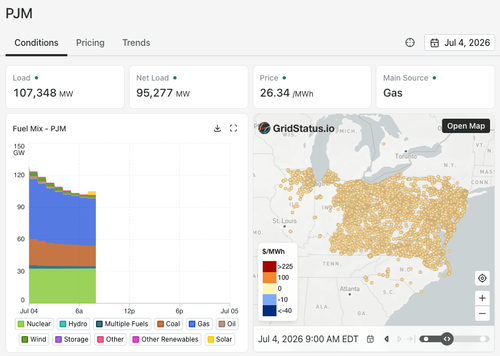
PJM Grid Hits Near-Record Loads Under Eastern Heat Dome, Sustained by Emergency Fossil Fuel Orders
Eastern heat pushed PJM toward record demand met primarily by gas, coal, and nuclear under emergency orders. Policy choices on capacity and renewables have narrowed operating margins. A brief cool period is expected before potential renewed stress in mid-July.
The heat dome centered on the Mid-Atlantic produced forecast highs of 104°F in Washington DC and Philadelphia through July 5, forcing cancellation of the DC Independence Day parade and elevating cooling demand during peak hours. PJM data show the grid avoided collapse only through federal emergency orders mandating full output from coal and gas plants, while solar and wind supplied single-digit percentages of generation.
PJM's recorded peak was suppressed by demand response; without it the instantaneous load would have exceeded prior records. Natural gas, nuclear, and coal together accounted for the large majority of supply. This pattern aligns with documented state-level policies that accelerated renewable integration without commensurate firm capacity additions, coinciding with data-center load growth.
Relief is projected after July 5 as temperatures fall below seasonal averages, but two-week outlooks indicate a second heat dome after mid-month. The immediate risk is involuntary load shedding if any major unit trips during the current episode, given the narrow reserve margins reported in PJM stakeholder updates.
Grid operators face the structural tradeoff between maintaining short-term reliability through existing thermal assets and longer-term decarbonization targets that reduce dispatchable capacity.
PJM: Peak load exceeds 165,000 MW on at least one day between July 3 and July 6 without additional emergency measures.
Sources (3)
- [1]PJM Operations Update July 2026(https://www.pjm.com/-/media/committees-groups/committees/oc/2026/20260703/item-03---operations-update.ashx)
- [2]NOAA Weather Prediction Center Heat Outlook(https://www.wpc.ncep.noaa.gov/heat/)
- [3]GridStatus Generation Mix Data(https://www.gridstatus.io/)