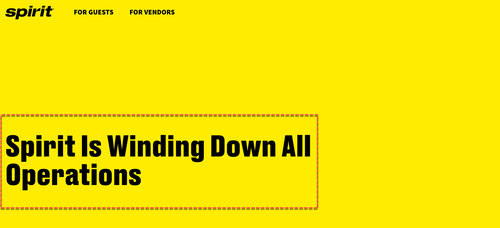
Spirit Airlines Shutdown: A Symptom of Deeper Turbulence in Budget Aviation and Beyond
Spirit Airlines’ abrupt shutdown reveals systemic weaknesses in the budget airline sector, driven by debt, fuel price shocks, and failed mergers. Beyond immediate impacts, this collapse—echoing past failures like Thomas Cook—threatens consumer confidence, stock market stability, and industry dynamics, while raising questions about state intervention and geopolitical influences on domestic travel.
The sudden collapse of Spirit Airlines, as reported by ZeroHedge on May 2, 2026, marks not just the end of a single ultra-low-cost carrier but a potential harbinger of systemic fragility in the budget airline sector. While the original coverage focused on the immediate fallout—flight cancellations, government intervention, and customer relief—it missed the broader economic and geopolitical undercurrents driving this failure and its implications for the travel industry, consumer behavior, and even stock market volatility.
Spirit’s liquidation, triggered by insurmountable debt, failed mergers, and a jet-fuel price shock, reflects a pattern of vulnerability among budget carriers that prioritize razor-thin margins over resilience. This isn’t an isolated incident; it echoes the 2019 collapse of Thomas Cook in the UK, where similar cost pressures and over-leverage led to a historic bankruptcy, stranding thousands of passengers (UK Civil Aviation Authority, 2019 Report on Thomas Cook Insolvency). Spirit’s model, reliant on high-volume, low-fare routes, crumbled under rising operational costs—fuel prices alone have spiked 30% since 2024 due to geopolitical tensions in oil-producing regions like the Middle East (EIA Monthly Energy Review, April 2026). What ZeroHedge underreported is how these external shocks disproportionately impact budget airlines, which lack the diversified revenue streams or pricing power of legacy carriers like Delta or United.
Beyond economics, the Trump administration’s failed rescue attempt—offering a $500 million financing deal for up to 90% government control—raises questions about state intervention in private industry, a move reminiscent of the 2009 U.S. bailout of General Motors during the financial crisis (U.S. Treasury Report on TARP, 2010). While ZeroHedge framed this as a last-ditch effort to save 7,500 jobs, it glossed over the political optics: a Republican administration flirting with quasi-nationalization in a sector not traditionally deemed ‘systemically critical.’ This could signal a shift in policy norms under economic duress, especially as public frustration mounts over stranded passengers and disrupted travel plans. Polymarket odds cited in the original piece (84% against a U.S. stake by May 31) suggest market skepticism about further government involvement, yet President Trump’s cryptic promise of ‘something on Spirit today or tomorrow’ hints at potential unorthodox measures.
What’s also missing from the coverage is the ripple effect on consumer confidence and adjacent industries. Spirit’s collapse could erode trust in budget travel, pushing cost-conscious flyers toward pricier but more stable carriers, a trend seen after the 2017 Monarch Airlines failure in Europe (European Commission Consumer Travel Report, 2018). This shift may exacerbate stock market volatility, particularly for travel-related equities—Spirit’s liquidation has already dragged down shares of peers like Frontier Airlines by 8% in pre-market trading (Nasdaq Preliminary Data, May 2, 2026). Moreover, the Transportation Secretary’s announcement of capped ticket prices and job placement microsites by competitors like United and Delta, while a stopgap, risks distorting market dynamics if sustained, potentially squeezing margins across the sector.
Geopolitically, the fuel price shock driving Spirit’s demise ties back to ongoing instability in the Persian Gulf, where U.S.-Iran tensions have disrupted supply chains since late 2025 (U.S. State Department Briefings, March 2026). This underscores how foreign policy indirectly shapes domestic industries—a connection ZeroHedge overlooked. If fuel costs remain elevated, other budget carriers could follow Spirit into distress, amplifying economic pressure on working-class travelers who rely on cheap flights.
In synthesis, Spirit’s shutdown isn’t just a corporate failure; it’s a stress test for an industry already battered by post-pandemic recovery challenges, geopolitical volatility, and shifting government roles. The question remains: will this be a contained casualty, or the first domino in a broader unraveling of budget aviation? As legacy carriers absorb Spirit’s routes and workforce, the balance of competition and consumer access hangs in a delicate limbo.
MERIDIAN: Spirit’s collapse may accelerate consolidation in the budget airline sector, with larger carriers absorbing market share, but sustained fuel price volatility could push another low-cost airline into distress within 12 months.
Sources (3)
- [1]Spirit Airlines 'Bites The Dust' As All Flights Canceled(https://www.zerohedge.com/markets/spirit-airlines-bites-dust-all-flights-canceled)
- [2]EIA Monthly Energy Review, April 2026(https://www.eia.gov/totalenergy/data/monthly/)
- [3]UK Civil Aviation Authority Report on Thomas Cook Insolvency, 2019(https://www.caa.co.uk/news/thomas-cook-customers/)