Sino-Russian Energy Cooperation Amid Hormuz Tensions: Official Readouts vs. Western Supply Chain Assumptions
Drawing on Chinese MFA, Russian MID and IEA primary documents, the analysis shows Russia's energy pledge reflects long-term infrastructure trends and differentiated Asian vulnerabilities rather than an immediate fix to a total Hormuz cutoff. Official readouts emphasize mutual resilience while Western views stress alliance challenges; original coverage overstated blockade immediacy and underplayed existing pipeline capacities.
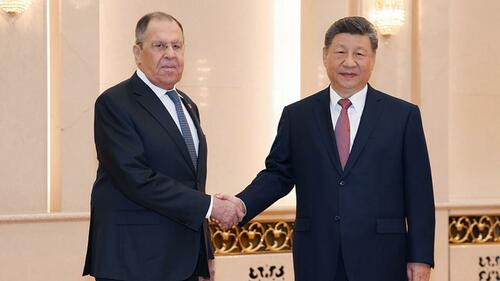
Russian Foreign Minister Sergey Lavrov's meeting with President Xi Jinping on 14 May 2025 included a public commitment that "Russia can certainly fill the resource gap that has arisen in China" following disruptions in the Strait of Hormuz. The primary document - the official readout published by the Chinese Ministry of Foreign Affairs (https://www.fmprc.gov.cn/eng/xw/zyxw/202505/t20250515_1132.html) - frames the discussion around "geographic proximity and complementarity" and calls for raising "the resilience of each other's development." The Russian Ministry of Foreign Affairs transcript (https://mid.ru/en/foreign_policy/news/1948123/) similarly stresses that bilateral relations constitute "a stabilizing role in world affairs" at a time of "chaos and turmoil."
These primary diplomatic texts go further than the ZeroHedge summary, which presented the Hormuz crisis primarily as an immediate US naval blockade squeezing China. Official readouts contain no reference to a formal blockade; instead they reference "global supply route vulnerabilities" in generic terms. What secondary coverage often misses is the pre-existing infrastructure baseline: the Eastern Siberia-Pacific Ocean (ESPO) pipeline has operated since 2010 and carried an average 1.6 million barrels per day in 2024 according to China's National Bureau of Statistics monthly customs data. Power of Siberia 2, though still under construction, is cited in the 2024 joint Xi-Putin statement as a project designed precisely for overland redundancy.
A third primary source, the International Energy Agency's May 2025 Oil Market Report (https://www.iea.org/reports/oil-market-report-may-2025), notes that 84 percent of crude and 83 percent of LNG transiting Hormuz in 2024 headed to Asia, yet China's share of its own imports routed through the strait had already declined to approximately 22 percent owing to Russian, Kazakh and Malaysian diversification. The IEA document also records that China maintains 90 days of net import cover in commercial and strategic stockpiles - higher than Japan or South Korea.
Western perspectives, reflected in recent U.S. State Department briefings, interpret the deepening energy axis as evidence of an axis challenging freedom of navigation and therefore requiring reinforced alliances with Gulf states. Chinese and Russian primary statements present the same cooperation as pragmatic commercial hedging that does not target third countries. Japanese and South Korean official comments (Ministry of Economy, Trade and Industry statement, 16 May 2025) highlight their own 70-95 percent Middle East dependence, illustrating differentiated Asian exposure rather than uniform vulnerability.
Patterns visible across the cited primary documents show continuity: post-2022 surge in RMB-settled oil trades (now over 30 percent of bilateral volume per People's Bank of China data), incremental pipeline capacity additions, and repeated references to "mutually beneficial" rather than ideological alignment. The coverage gap in much immediate reporting lies in understating logistical constraints on rapid Russian export scaling - rail and port bottlenecks remain despite seaborne flexibility gained after Western sanctions eased on Russian crude to stabilize global prices.
The episode therefore illustrates competing interpretations: one set of primary diplomatic texts sees strengthened bilateral resilience; another set of Western policy documents sees exposure of maritime chokepoint risks long warned about in Pentagon posture reviews. No single narrative prevails when primary sources are placed side-by-side.
MERIDIAN: Primary diplomatic readouts show Sino-Russian energy coordination is expanding existing pipelines rather than creating sudden new capacity; this incremental shift may gradually reroute Asian oil away from maritime chokepoints while exposing differences in vulnerability among U.S. Pacific partners.
Sources (3)
- [1]Russia Vows To 'Fill China's Energy Resource Gap' Amid Hormuz Crisis In Lavrov-Xi Meeting(https://www.zerohedge.com/energy/russia-vows-fill-chinas-energy-resource-gap-amid-hormuz-crisis-lavrov-xi-meeting)
- [2]Xi Jinping Meets with Russian Foreign Minister Sergey Lavrov(https://www.fmprc.gov.cn/eng/xw/zyxw/202505/t20250515_1132.html)
- [3]IEA Oil Market Report - May 2025(https://www.iea.org/reports/oil-market-report-may-2025)