SpaceX's AI Pivot Delivers Blowout Q3: Revenue Surges 161% to $14.6B, First Profit, Musk Eyes $500B-$1T ARR by 2027
Corroborated reporting confirms SpaceX's Q3 beat driven by AI revenue overtaking Starlink, record compute buildout, ambitious 2027 targets, and confirmed Tesla merger exploration committees. Deepens original by linking to investor capex concerns and content potential.
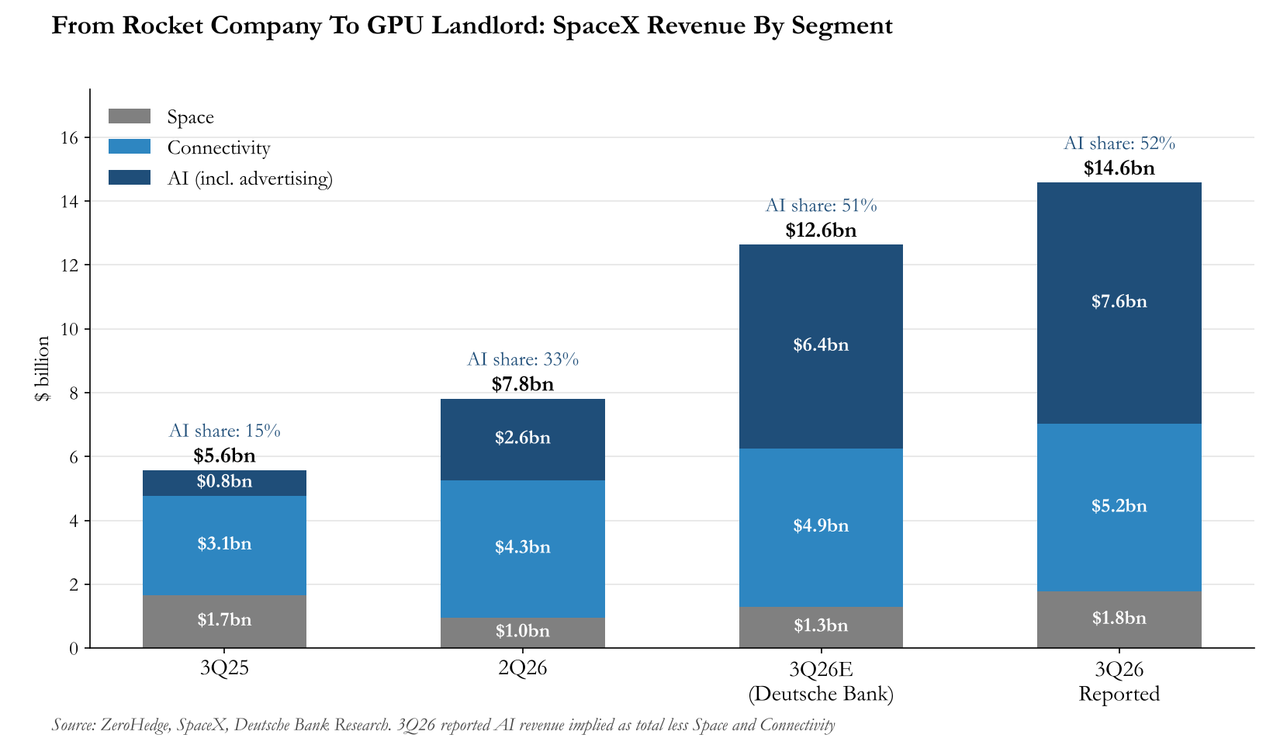
SpaceX (ticker: SPCX), now a public company following its June 2026 IPO, reported third-quarter results that underscored its rapid transformation from a space launch leader into a dominant AI infrastructure provider. Revenue reached $14.58 billion, up 161% year-over-year and well ahead of analyst estimates around $12.7-12.9 billion, driven primarily by its Super Intelligence (AI/neocloud) segment which generated $7.6 billion—surpassing Starlink's $5.2 billion for the first time.[1][2]
Net income swung to $4.4 billion from a prior-year loss, marking the company's first quarterly profit as a public entity, with adjusted EBITDA hitting $8.8 billion. AI-related capital expenditures accounted for the bulk of $19.6 billion in total capex, expanding nameplate compute to 1.7 GW by quarter-end.[3]
On the earnings call, CEO Elon Musk highlighted aggressive expansion plans: 2.5-3 GW expected online by year-end 2026, with potential for 10+ GW incremental in 2027 and a small chance of reaching 20 GW. He projected annual recurring revenue (ARR) of $500 billion to $1 trillion by end-2027, citing relentless demand from hyperscalers like Google and Anthropic for data center capacity. Musk also noted spending significant time in Memphis advancing Colossus II data centers.[4][3]
Separately, Musk confirmed that both SpaceX and Tesla have formed special committees of independent directors to explore a potential merger, describing it as having "a lot of merit" for synergies in superintelligence, chips, robotics, and connectivity—though he cautioned it is not certain and faces high shareholder approval hurdles, particularly at Tesla.[5][6]
This performance highlights SpaceX's pivot: AI compute leasing now outpaces traditional space and connectivity businesses, positioning the firm amid the broader AI infrastructure boom but requiring sustained massive investment. For investors, the results signal strong top-line momentum offset by capex intensity, with merger speculation adding volatility. The story lends itself to short-form video explainers due to its clear metrics, Musk's bold guidance, and accessible themes of AI scaling versus execution risk.
[Financial Analyst]: Explosive AI-driven growth and merger talks could drive significant near-term stock upside for SPCX, but sustained capex and scaling execution will determine if 2027 ARR targets materialize—ideal for plain-language investor explainers.
Sources (5)
- [1]SpaceX quarterly revenue jumps, beats estimates as AI business surges(https://www.reuters.com/business/media-telecom/spacex-quarterly-revenue-jumps-beats-estimates-ai-business-surges-2026-10-20/)
- [2]SpaceX's AI business is beating expectations(https://techcrunch.com/2026/10/20/spacexs-ai-business-is-beating-expectations/)
- [3]SpaceX’s data centre deals boost revenue by 161%(https://www.ft.com/content/f2a2a578-5a2e-42ff-b4c9-8bafff271b37)
- [4]CEO Elon Musk Just Gave SpaceX Investors Great News(https://www.fool.com/investing/2026/10/20/ceo-elon-musk-just-gave-spacex-investors-great-news/)
- [5]Musk Says SpaceX, Tesla Have Formed Committees to Explore Merger(https://www.bloomberg.com/news/articles/2026-10-20/musk-says-spacex-tesla-have-formed-committees-to-explore-merger)