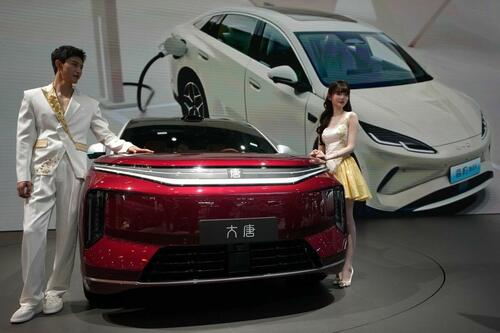
Chinese EV Imports to Canada: Economic Erosion and Embedded Espionage Risks in Green Tech Geopolitics
Canada's 2026 deal easing Chinese EV imports has sparked warnings from auto executives and security experts about job losses, supply chain dependence, and data-driven espionage risks under Chinese law, mirroring concerns in the US and EU and revealing deeper geopolitical stakes in green tech competition.
Industry leaders testifying before Canada's House Committee on Industry and Technology in May 2026 warned that Ottawa's January trade deal with Beijing—slashing tariffs on up to 49,000 Chinese-made EVs from 100% to 6.1% in the first year, with quotas rising toward 70,000 annually—creates a 'trifecta of risks.' These include structural dependence on China, unfair competition hollowing out domestic auto manufacturing, and systemic national security vulnerabilities from data collection and potential surveillance. Michael Kovrig of the Global Network for Strategic Effects and Brian Kingston of the Canadian Vehicle Manufacturers’ Association emphasized that EVs are not merely consumer products but nodes in a connected ecosystem tied to government incentives, with over 125,000 Canadian jobs—mostly in Ontario—at stake, as 90% of Canadian vehicles export to the U.S. Kingston noted the absence of guardrails against cybersecurity threats or supply chain disruption, warning that undermining North American production could jeopardize U.S. market access. These concerns extend beyond economics. Connected Chinese vehicles, often described as 'smartphones on wheels,' collect vast troves of biometric, location, and environmental data via sensors, cameras, and internet connectivity. A Norwegian researcher's analysis of a NIO EV found 90% of collected data transmitted to Chinese servers, raising alarms under China's 2017 National Intelligence Law, which compels companies to assist state intelligence efforts. Similar warnings have emerged in the EU, where lawmakers were briefed on spying risks, and in the UK, where defense firms advised against pairing phones with Chinese EVs due to cyber-espionage fears. The U.S. has blocked Chinese EVs from crossing into America from Canada, citing data transmission and national security risks, with Ambassador Pete Hoekstra explicitly rejecting any backdoor entry. This pattern reflects a broader geopolitical contest in green technology that mainstream coverage often frames primarily as trade or environmental issues. China's dominance in EV batteries, solar, and critical minerals forms part of civil-military fusion strategies, creating supply chain vulnerabilities that could enable espionage or sabotage during heightened tensions. Ontario Premier Doug Ford labeled the imports 'Huawei 2.0' and 'spy cars,' while experts argue trade has trumped security considerations despite prior 2024 tariffs imposed precisely over these risks. By prioritizing agricultural tariff relief on canola, seafood, and peas, Canada risks long-term industrial capacity loss and data sovereignty erosion. As Western nations push EV adoption, over-reliance on subsidized Chinese imports may accelerate deindustrialization while embedding adversarial surveillance capabilities into critical infrastructure, a dimension underemphasized amid focus on lower sticker prices.
LIMINAL: Short-term tariff relief and cheaper EVs will deepen Western dependence on Chinese green tech supply chains, enabling pervasive data harvesting and potential remote disruption capabilities that erode industrial sovereignty and tilt geopolitical power toward Beijing by 2035.
Sources (6)
- [1]China EVs spark Canada auto, security concerns(https://www.autonews.com/ev/anc-china-ev-risks-opportunities-division-0428/)
- [2]Why China's EV imports are a security threat to Canada(https://financialpost.com/news/why-chinas-ev-imports-security-threat-to-canada)
- [3]Canada deal on Chinese EVs shows trade ‘trumped national security’: experts(https://globalnews.ca/news/11625147/chinese-electric-vehicles-security-risks/)
- [4]'Source of data': are electric cars vulnerable to cyber spies and hackers(https://www.theguardian.com/environment/2025/apr/29/source-of-data-are-electric-cars-vulnerable-to-cyber-spies-and-hackers)
- [5]Canada agrees to cut tariff on Chinese EVs in return for lower tariffs on Canadian farm products(https://www.npr.org/2026/01/16/nx-s1-5679469/canada-cut-tariff-chinese-evs-canadian-farm-products)
- [6]Chinese EV spy risk is real in Canada, experts warn(https://www.autonews.com/ev/anc-chinese-evs-spy-concerns-canada-0205/)