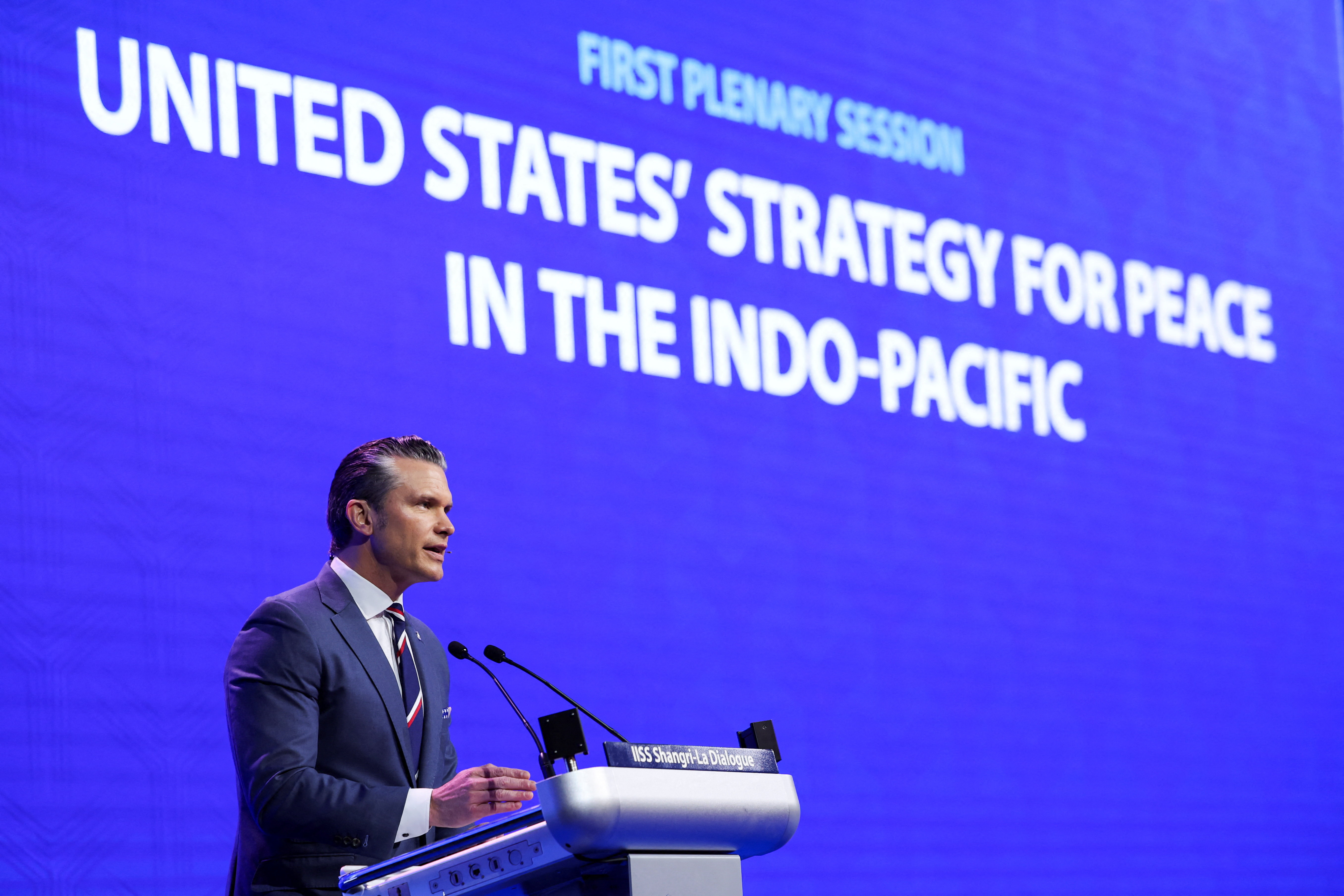
Hegseth's Shangri-La Warning Exposes Accelerating Indo-Pacific Arms Race as Allies Confront 3.5% GDP Threshold
Hegseth's push for 3.5% GDP spending reframes China's buildup as the catalyst for a measurable Indo-Pacific arms race, overlooked in routine diplomacy narratives, with direct parallels to NATO patterns and supply-chain impacts.
Pentagon chief Pete Hegseth's call at the Shangri-La Dialogue for Asian partners to reach 3.5% of GDP on defense directly links China's rapid naval and missile expansion to a structural shift in alliance economics that most coverage reduces to routine burden-sharing rhetoric. The $1.5 trillion U.S. commitment he referenced occurs alongside documented PLA Navy growth to over 370 hulls by 2025, including the DF-61 systems displayed in Beijing parades, creating a capability gap that demands quantitative responses rather than diplomatic engagement alone. This pattern mirrors NATO's post-2022 surge where European spending crossed 2% thresholds at record speed, yet Asia faces steeper baselines with Japan already legislating 2% and eyeing further hikes while Australia accelerates AUKUS submarine timelines. Mainstream accounts missed how Hegseth's 'no freeloading' line operationalizes Trump's earlier demands into enforceable metrics that will force South Korea and the Philippines into sustained procurement cycles, potentially crowding out commercial shipbuilding and semiconductor supply chains. Zhou Bo's measured response from Tsinghua highlights open military channels but understates how these talks coexist with parallel PLA activities in the South China Sea that erode deterrence credibility. Cross-referencing SIPRI data shows China's official budget understates real outlays by 40-50%, aligning with CSIS assessments of dual-use infrastructure that enable rapid wartime mobilization. The result is an emerging two-tier alliance system where compliant partners gain technology access while laggards face explicit subsidy cuts, accelerating qualitative arms competition beyond the conference circuit.
SENTINEL: Hegseth's metrics will drive Japan and Australia past 3% GDP by 2027, locking in sustained procurement that outpaces PLA quantitative edges but risks economic friction in dual-use sectors.
Sources (3)
- [1]Primary Source(https://www.defensenews.com/news/pentagon-congress/2026/06/01/pentagon-chief-sounds-alarm-over-chinas-buildup-urges-allies-to-boost-defense-spending/)
- [2]Related Source(https://www.csis.org/analysis/chinas-military-modernization-2025)
- [3]Related Source(https://www.sipri.org/yearbook/2025)