Continuing jobless claims jump to 1.763 million as low-hire, low-fire labor market holds
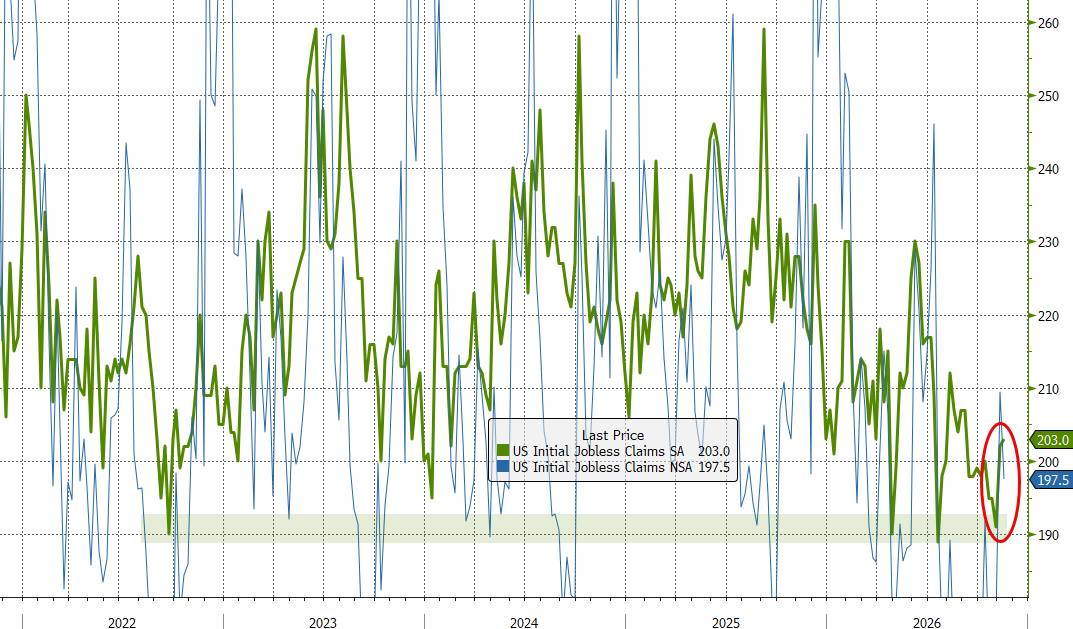
Official data show initial claims still near 203,000 while continuing claims jumped 70,000 to 1.763 million. That matches the documented low-hire, low-fire pattern: few layoffs, slower re-employment, and a harder market for people who are not already in a job.
Documented: The Labor Department reported that seasonally adjusted initial jobless claims rose by 1,000 to 203,000 in the week ended November 14, 2026, after the prior week was revised up to 202,000. The four-week average rose by 2,000 to 197,750. Continuing claims, a count of people still receiving benefits, jumped by 70,000 to 1.763 million in the week ended November 7, the highest since late August and above consensus. Reuters, the Associated Press, and Bloomberg all reported the same Labor Department figures. Claims remain historically low: filings have stayed under 220,000 for much of the year, and Axios noted that the prior week had extended a rare streak of readings at or below 200,000 in a series dating to 1967.
Documented, not a slogan: Mainstream coverage describes the same pattern as a “low-hire, low-fire” market. AP and Reuters said most employers are still holding workers, while some people who lose jobs are taking longer to find the next one. Heather Long of Navy Federal Credit Union called it a “medium-hire, low-fire” market and said it remains harder for young Americans to get onto the career ladder than for people already employed. The Richmond Fed mapped recent months into a quadrant of weak hiring and very low separations relative to the past quarter-century. The Cleveland Fed traced the phrase to then-Chair Jerome Powell’s April 2026 description of an “unusual and uncomfortable” balance in which people without jobs have a hard time breaking in. October payrolls of 165,000 and an unemployment rate of 4.1%, down from 4.2%, are also in the official and wire reporting; that headline strength coexists with the continuing-claims rise.
Claimed, not established by the claims print itself: ZeroHedge’s “low inspire” third leg—worker sentiment near record lows, a frozen quits rate, and a market that feels stagnant even when few people are fired—is a framing, not a Labor Department statistic. Related official and research data do support the stuck-in-place half of that story. JOLTS-based accounts from the regional Feds and private research put the hires rate well below the late-2010s pace while the layoff rate sits near the lows of the post-pandemic expansion. Quits have also been subdued, which means fewer openings created by people leaving. Work Insiders, using BLS figures, described late-2026 openings near 7.5 million against monthly hires stuck around 5.4 million: roles posted, not filled at the old pace.
What the numbers do and do not say: A 203,000 initial-claims week is not a layoff wave. A 70,000 rise in continuing claims is evidence that the stock of people already out of work grew, not that mass firing began. The insured unemployment rate holding near 1.1% in contemporaneous reporting keeps the level low even after the jump. The tension that matters for income is distributional. People with jobs have unusual protection from dismissal. People between jobs, new graduates, and workers trying to change employers face a thinner flow of hires. That is why a tight headline unemployment rate can still feel like stagnation: security for incumbents, slow re-entry for everyone else.
Speculated, and not settled by this release: Whether the continuing-claims uptick is noise, a longer spell of unemployment, or the first crack in low-fire conditions cannot be read from one week. Goldman’s rate path, as summarized in the ZeroHedge note, is a forecast, not a fact in the claims report. Reuters separately reported that labor-market resilience gives the Federal Reserve more room to focus on inflation. Those are different claims. The documented fact is narrower: firings remain scarce, rehiring is slow enough that the benefit rolls rose, and the institutions that track the labor market already treat that combination as the defining feature of 2026.
People who already have jobs are unusually unlikely to be laid off, but people who are unemployed or trying to switch jobs are waiting longer to get hired. That split sets job security for incumbents and slower income recovery for everyone outside a payroll.
Sources (7)
- [1]US weekly jobless claims edge up; labor market remains resilient(https://www.reuters.com/world/us/us-weekly-jobless-claims-increase-slightly-2026-11-19/)
- [2]Number of people seeking unemployment aid ticks higher yet still low historically(https://finance.yahoo.com/economy/articles/number-americans-seeking-unemployment-aid-133320661.html)
- [3]Unemployment Insurance Weekly Claims Report(https://www.dol.gov/newsroom/releases/eta)
- [4]US Weekly Jobless Claims Rise 1k to 203k(https://news.bloomberglaw.com/daily-labor-report/us-weekly-jobless-claims-rise-1k-to-203k-est-198k)
- [5]Visualizing the Low-Hire, Low-Fire Labor Market(https://www.richmondfed.org/research/national_economy/macro_minute/2026/visualizing_low-hire_low-fire_labor_market)
- [6]The “Low-Hire, Low-Fire” Labor Market(https://www.clevelandfed.org/publications/economic-commentary/2026/ec-202617-the-low-hire-low-fire-labor-market)
- [7]Historically low jobless claims are expected to continue(https://www.axios.com/2026/11/12/layoffs-unemployment-claims-benefits)