AfD's Historic Win in Saxony-Anhalt Signals Shifting European Political Landscape Amid Debt Debates
AfD's record 43.8% win in Saxony-Anhalt and Mélenchon's ECB debt cancellation push highlight eroding European political norms and rising anti-establishment forces, with credible mainstream reporting confirming the events and their context.
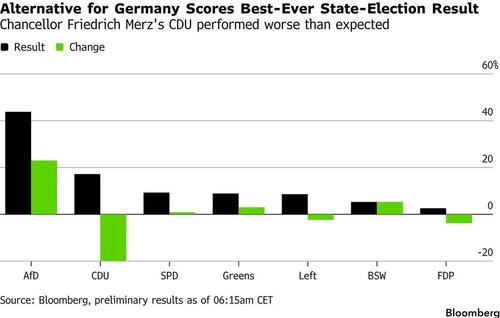
Recent state elections in Germany's Saxony-Anhalt have delivered a landmark victory for the far-right Alternative für Deutschland (AfD), which secured approximately 43.8% of the vote on September 6, 2026, more than doubling its previous share and emerging as the largest party. This result, falling just short of an outright majority with 39 of 83 seats, marks the strongest performance by a far-right party in a German state election since 1945 and challenges the post-war political consensus.
Mainstream parties, including the CDU (17.2%) and SPD (9.3%), have maintained their refusal to form coalitions with the AfD, raising the possibility of involvement from the populist BSW party (5.3%), which shares positions on immigration, Russia-Ukraine policy, and energy. Analysts note this could test Germany's 'firewall' against extremism, with potential implications for national stability and markets.
Concurrently, French far-left candidate Jean-Luc Mélenchon has revived proposals to cancel portions of French debt held by the ECB, arguing it represents debt owed to 'ourselves' within the eurozone system. The idea, floated in August 2026, has sparked backlash from government officials and economists, who warn of legal violations under EU treaties and risks to investor confidence. Polls indicate growing public support amid France's high debt levels exceeding 116% of GDP.
These developments occur against a backdrop of broader geopolitical fragmentation, echoing think-tank assessments that the post-Cold War world order is eroding. Economic pressures, including deindustrialization in Germany and fiscal strains in France, are amplifying populist appeals across the spectrum.
[Rabobank Analyst]: These eastern German shifts and French fiscal radicalism could accelerate market repricing of eurozone stability, with potential volatility in bonds and energy sectors if coalitions form or debt talks intensify.
Sources (6)
- [1]2026 Saxony-Anhalt state election - Wikipedia(https://en.wikipedia.org/wiki/2026_Saxony-Anhalt_state_election)
- [2]Far-right AfD scores landslide in eastern German election | Euractiv(https://www.euractiv.com/news/far-right-wins-big-in-eastern-german-state-election/)
- [3]Hard-left presidential candidate's plan to cancel French debt sparks backlash | Reuters(https://www.reuters.com/business/finance/hard-left-presidential-candidates-plan-cancel-french-debt-sparks-backlash-2026-08-26/)
- [4]Mélenchon tosses a debt bomb into France’s presidential debate – POLITICO(https://www.politico.eu/article/jean-luc-melenchon-tosses-a-debt-bomb-into-frances-presidential-debate/)
- [5]AfD wins record 44% in Saxony-Anhalt, testing Germany's far-right firewall | Axios(https://www.axios.com/2026/09/06/afd-saxony-anhalt-germany-far-right-firewall)
- [6]Germany’s far-right AfD scores its biggest win – POLITICO(https://www.politico.eu/article/exit-polls-germany-far-right-alternative-for-germany-afd-lead-saxony-anhalt-election/)