Nvidia's $2.1 Billion IREN Investment Signals AI Arms Race and Economic Shift Toward Tech Dominance
Nvidia’s $2.1 billion investment in IREN to expand AI infrastructure highlights the intensifying AI arms race, with geopolitical, economic, and environmental implications. Beyond chip sales, Nvidia’s strategy reflects tech’s growing dominance, raising concerns about market concentration and sustainability.
Nvidia's announcement of a potential $2.1 billion investment in IREN, a company specializing in AI data center infrastructure, underscores the intensifying global race to dominate artificial intelligence capabilities. This deal, which grants Nvidia the option to purchase up to 30 million shares at $70 each over five years, is not merely a financial transaction but a strategic maneuver to secure a foothold in the infrastructure layer of the AI ecosystem. Beyond the specifics reported by ZeroHedge, this move reveals deeper economic and geopolitical currents, as tech giants increasingly shape market valuations and national priorities through AI-driven innovation.
The partnership focuses on expanding IREN’s Sweetwater campus in Texas, with plans to scale from 2 to 5 gigawatts of Nvidia-powered capacity. This aligns with a broader pattern of Nvidia's investments across the AI stack, from chip design to infrastructure providers like CoreWeave and Nebius Group, and even software players like OpenAI. However, what the original coverage misses is the geopolitical dimension of this infrastructure buildout. Data centers, especially those powering AI, are becoming critical national assets, akin to energy grids or telecommunications networks. The choice of Texas—a state with favorable energy policies and proximity to key U.S. markets—reflects a deliberate effort to anchor AI capacity within American borders, amid growing U.S.-China tensions over technology supply chains. This mirrors past patterns, such as the U.S. government's push for domestic semiconductor production through the CHIPS Act of 2022, which aimed to reduce reliance on foreign manufacturing.
Moreover, the original source underplays the economic ripple effects of such investments. Nvidia's market cap, already exceeding $3 trillion as of late 2023, is a bellwether for tech-driven economic shifts. The AI arms race is inflating valuations across the sector, as seen in IREN’s 285% stock surge last year and a further 51% rise in 2026. This suggests a feedback loop where capital flows into AI infrastructure fuel speculative growth, potentially creating bubbles reminiscent of the dot-com era. Yet, unlike the 2000 crash, today’s investments are backed by tangible demand for computing power, driven by generative AI applications in industries from healthcare to defense. A 2023 McKinsey report estimated that generative AI could add $2.6 to $4.4 trillion annually to the global economy by 2030, highlighting the stakes of Nvidia’s bet.
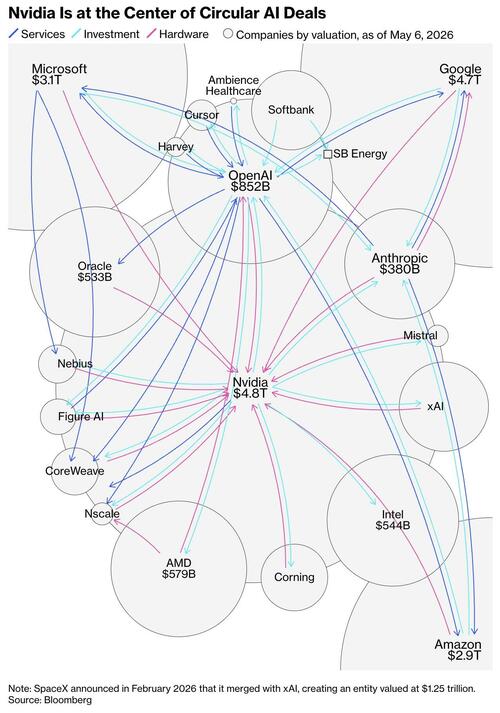
Critics, as noted in the original piece, argue that Nvidia’s investments are 'circular,' funneling money to partners who then buy its chips. While CEO Jensen Huang dismisses this as 'ridiculous,' there is a structural concern missed by ZeroHedge: such vertical integration risks monopolistic behavior, potentially stifling competition in the AI hardware market. This echoes historical antitrust concerns, like those faced by Intel in the early 2000s over its dominance in PC chips. The U.S. Federal Trade Commission’s ongoing scrutiny of Big Tech mergers, as reported by Reuters in 2023, suggests Nvidia’s strategy could attract regulatory attention, especially as AI becomes a national security issue.
Finally, IREN’s pivot from Bitcoin mining to AI infrastructure, while noted in the source, deserves deeper context. This shift mirrors a broader industry trend where crypto miners, facing volatile markets and energy criticism, repurpose their high-performance computing assets for AI workloads. This adaptability positions companies like IREN as key players in the AI supply chain, but it also raises questions about energy sustainability—data centers already consume 1-2% of global electricity, per a 2022 International Energy Agency report. Nvidia and IREN’s silence on carbon footprints in their announcements is a glaring omission in the original coverage, especially as governments worldwide tighten regulations on tech’s environmental impact.
In synthesizing these perspectives, Nvidia’s investment is more than a business deal; it’s a microcosm of the AI-driven economic transformation, with implications for national power, market dynamics, and environmental policy. As tech dominance reshapes global priorities, the question remains whether such concentrated investments will democratize AI benefits or entrench a new digital oligarchy.
MERIDIAN: Nvidia’s investment in IREN could accelerate the U.S.’s lead in AI infrastructure, but regulatory scrutiny over market concentration and energy use may temper its long-term impact.
Sources (3)
- [1]Nvidia Bets $2.1 Billion On IREN To Expand AI Infrastructure(https://www.zerohedge.com/markets/nvidia-bets-21-billion-iren-expand-ai-infrastructure)
- [2]McKinsey & Company: The Economic Potential of Generative AI(https://www.mckinsey.com/capabilities/mckinsey-digital/our-insights/the-economic-potential-of-generative-ai-the-next-productivity-frontier)
- [3]International Energy Agency: Data Centres and Data Transmission Networks(https://www.iea.org/energy-system/buildings/data-centres-and-data-transmission-networks)