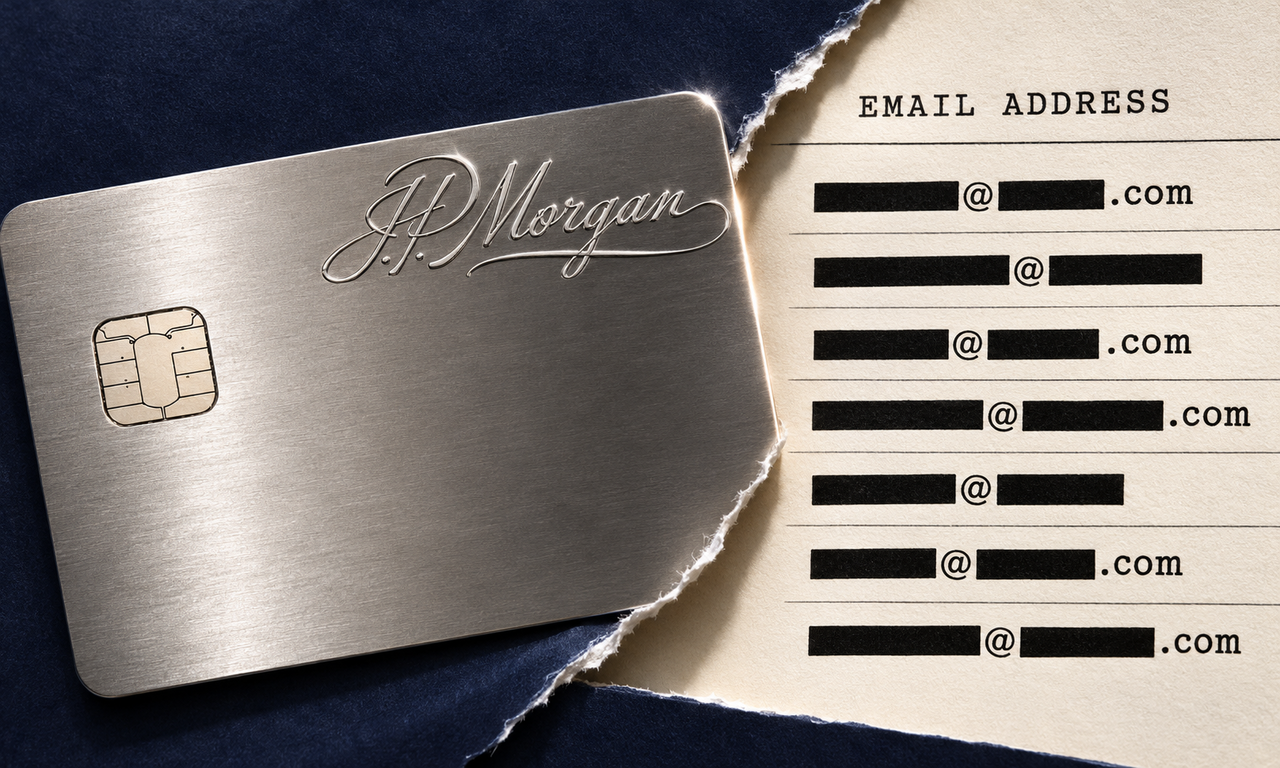
JPMorgan says vendor cyberattack may have exposed customer names and emails; researchers say leaked file ties to Reserve card program
JPMorgan confirmed a third-party cyberattack that may have exposed customer names and email addresses in vendor marketing data. Researchers say a gang published about 16,000 addresses tied to the bank’s Reserve card; the bank has not confirmed that link, the scale, or who is responsible.
Documented: On November 19, 2026, JPMorgan Chase said third parties that provide services to the firm were the target of a cyberattack. In a statement posted by the bank and confirmed to Reuters, the firm said its investigation so far indicates attackers accessed certain marketing data held by those vendors, which may include some customer names and email addresses. The bank said there was no disruption to its services, that it would contact affected customers where appropriate and offer support including complimentary credit monitoring, and that the incident had no connection to a service disruption some customers experienced earlier that week, which the bank attributed to a software bug.
Claimed, and only partly corroborated by the bank: Cybernews researchers said a ransomware gang calling itself n0n published a roughly 502-kilobyte dataset of about 16,000 customer email addresses that appears linked to JPMorgan Chase’s invitation-only Reserve card program, a Visa product the outlet associates with high-net-worth clients, typically at least $10 million in assets managed by the bank. Some records also contained phone numbers and account IDs, and researchers reported more than 100 bank employee email addresses in the material. Newsweek, The Verge, and PCMag reported the same Cybernews findings. JPMorgan has not named the vendors, has not confirmed n0n’s responsibility, and has not confirmed the 16,000 figure or the Reserve-program connection. Cybernews researchers said the file looked as if it came from a third party rather than from JPMorgan’s own systems, which is consistent with the bank’s account but does not prove the full contents of the dump.
Documented separately: Before the dump, n0n listed JPMorgan Chase among dozens of organizations and described engagement data from a premium Reserve card program—hundreds of thousands of marketing-campaign interactions across tens of thousands of cardholder email addresses, plus a member directory with categories and postal codes. Cybernews noted that description was not independently verified before publication, and the file later examined was only 502 KB. Researchers said they could not tell whether that file was the full theft or a sample. Visa told Newsweek and Cybernews that a third-party provider in the Asia-Pacific region was affected, that Visa’s systems were not involved, and that there was no indication payment data such as card numbers were affected. Mastercard told The Verge that a limited number of email addresses belonging to a small subset of cardholders in a specific benefit program were exposed.
What is not established: Nothing in the bank’s statement or the news reports shows that account balances, card numbers, or core banking systems were accessed in this incident. The coincidence of the November 16 leak-site listing and a Chase outage the same day is documented as timing only. JPMorgan said the outage was a software bug and unrelated; regulators’ earlier checks on that outage are not evidence about the marketing-data incident. Claims that the leak proves a coming crisis of trust in traditional banking, or that wealth-management systems themselves were breached, are speculation. What the record does show is a narrower, recurring pattern: marketing and card-program data about affluent customers sitting with unnamed vendors, then appearing in an extortion dump, while the bank’s own systems are reported unaffected.
The practical exposure, as described by Cybernews and echoed by Newsweek and PCMag, is identification and phishing, not demonstrated theft of funds. Email addresses, and in some records phone numbers and account identifiers, can be combined with public information to target people who are already known—or merely labeled—as wealthy. Employee addresses in the same file, if authentic, widen that to social engineering against staff. Whether the published set is a sample of a larger theft remains an open claim, not a finding.
People whose names and emails were held by JPMorgan’s marketing vendors may now be easier to target with phishing, and researchers say some of those records appear to belong to Reserve cardholders. The bank says services were not disrupted and has not confirmed that payment data or its own systems were involved.
Sources (6)
- [1]JPMorgan says third-party vendors targeted in cyberattack(https://www.reuters.com/legal/government/jpmorgan-says-third-party-vendors-targeted-cyberattack-2026-11-19/)
- [2]J.P. Morgan statement on X(https://x.com/jpmorgan/status/2123408240104853510)
- [3]Hacker leaks details of JPMorgan’s ultra-wealthy cardholders(https://cybernews.com/security/jpmorgan-chase-data-leak-non-ransomware-gang/)
- [4]Hackers Leak Data on Thousands of JPMorgan Chase’s Richest Customers(https://www.newsweek.com/hackers-leak-data-jpmorgan-thousands-richest-customers-12740448)
- [5]JPMorgan Chase reveals data breach, but says it’s unrelated to this week’s banking outage(https://www.theverge.com/tech/1037695/jpmorgan-chase-cyberattack)
- [6]Chase Bank: Our Partners Got Hacked, User Names and Email Addresses Exposed(https://www.pcmag.com/news/chase-bank-our-partners-got-hacked-user-names-and-email-addresses-exposed)