UAE's Fujairah Pipeline Push Accelerates Energy Deglobalization, Eroding Iran's Chokepoint Leverage
UAE accelerating a second major pipeline to Fujairah will double Hormuz-bypassing crude exports by 2027, part of a larger Gulf shift that neutralizes Iran's key geopolitical card and advances fragmentation of global oil markets away from vulnerable chokepoints toward resilient regional systems.
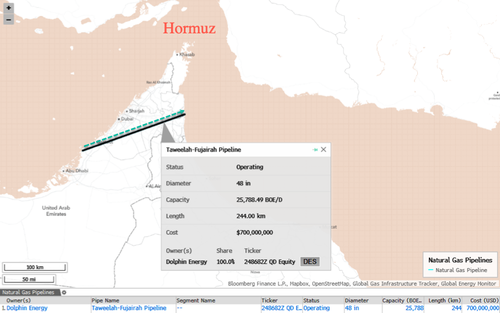
While headlines fixate on the immediate kinetics of the Iran conflict, a quieter but more enduring transformation is underway in global energy infrastructure. On May 15, 2026, the UAE announced it is accelerating the West-East Pipeline project, which will double ADNOC's crude export capacity through Fujairah on the Gulf of Oman to roughly 3-3.5 million barrels per day by 2027. This builds on the existing 1.5-1.8 million bpd Abu Dhabi Crude Oil Pipeline (ADCOP), providing a robust bypass of the Strait of Hormuz entirely.
Bloomberg reports that Abu Dhabi Crown Prince Sheikh Khaled bin Mohamed bin Zayed directed ADNOC to fast-track the project amid ongoing Hormuz disruptions, ensuring roughly half of the UAE's exports can continue flowing regardless of naval tensions. This mirrors Saudi Arabia's earlier achievement of pumping its East-West pipeline at full 7 million bpd capacity to the Red Sea, a contingency plan activated during the current crisis.
The editorial lens here reveals what conflict-focused coverage obscures: these moves represent a structural 'great rewiring' of energy dynamics. For decades, Iran's ability to threaten closure of the Strait of Hormuz—through which roughly 20% of global oil and much of China's imports transit—has served as a primary strategic deterrent. By investing in overland and alternative terminal capacity, Gulf producers are systematically dismantling that leverage. This is not temporary wartime adaptation but a bet on fragmented, resilient supply chains over vulnerable globalized ones.
Connections to broader deglobalization trends are evident. As Gulf states reduce dependence on shared maritime chokepoints, they gain autonomy to pursue independent production and pricing strategies, as seen in the UAE's recent OPEC exit. This aligns with wider patterns: nations increasingly prioritize secure, proximate, or allied energy routes over just-in-time global delivery. Trump's comments indicating the U.S. has limited interest in immediately reopening Hormuz further greenlight this shift, suggesting Washington sees value in letting regional actors build parallel infrastructure that pressures Iran economically without full naval commitment.
Mainstream narratives emphasize short-term war impacts on prices and shipping, yet overlook how these pipelines, combined with similar projects elsewhere, accelerate a multipolar energy order. China's long-term access to Middle East oil may increasingly rely on overland alternatives or diversified suppliers, while Gulf sovereign wealth and oil revenues gain insulation from Hormuz risk. Oil still drives 22.7% of UAE GDP, making this a fiscal imperative that doubles as geopolitical rebalancing.
In synthesis, the UAE's pipeline acceleration is a pivotal data point in the slow unwinding of hyper-globalized energy trade. It signals that even after any peace deal, the strategic map has been redrawn: Iran's leverage is diminished, regional autonomy is enhanced, and the world edges closer to deglobalized energy blocs that prioritize redundancy over efficiency.
LIMINAL: This infrastructure is cementing a post-Hormuz energy reality where Gulf producers operate with reduced vulnerability, Iran's strategic relevance fades, and global oil trade fragments into more autonomous regional spheres, a deglobalization trend hiding in plain sight behind war coverage.
Sources (5)
- [1]UAE Plans New Oil Pipeline to Bypass Strait of Hormuz by 2027(https://www.bloomberg.com/news/articles/2026-05-15/uae-to-complete-new-hormuz-bypass-oil-pipeline-by-2027)
- [2]UAE's West-East pipeline expansion to become operational in 2027, doubling oil export capacity(https://www.thenationalnews.com/business/energy/2026/05/15/uaes-west-east-pipeline-expansion-to-become-operational-in-2027-doubling-oil-export-capacity/)
- [3]Adnoc to accelerate new pipeline project to double export capacity through Fujairah(https://www.khaleejtimes.com/uae/sheikh-khaled-adnoc-meeting-west-east-pipeline-project)
- [4]The Oil Pipelines That Could Decide the Iran War(https://www.bloomberg.com/opinion/articles/2026-03-09/iran-war-these-saudi-and-uae-oil-pipelines-could-decide-who-wins)
- [5]Saudi Pipeline to Bypass Hormuz Hits 7 Million Barrel Goal(https://www.bloomberg.com/news/articles/2026-03-28/saudi-pipeline-that-bypasses-hormuz-hits-7-million-barrel-goal)