Hunter Wolf Trials: US Army Accelerates Path to Lethal Autonomy and the Erosion of Human Accountability in Warfare
Recent US Army trials of the armed Hunter Wolf UGV at JRTC signal accelerating militarization of lethal autonomy. While remotely operated now, integration of radar-equipped armed robots into real formations foreshadows Skynet-like systems that reduce human risk and erode accountability in future warfare, connecting logistics robots to broader AI arms race patterns.
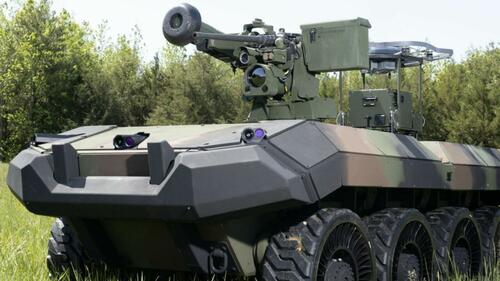
The U.S. Army's recent integration of the armed Hunter Wolf unmanned ground vehicle (UGV) into high-intensity combat simulations with the 101st Airborne Division at the Joint Readiness Training Center (JRTC) marks more than incremental progress in robotics. Official footage and imagery released in April 2026 depict the Hunter Wolf, developed by HDT Global (now BLADE), equipped with a remotely operated .50-caliber machine gun and EchoShield radar, performing overwatch, security, and logistics roles in realistic battlefield conditions at Fort Johnson, Louisiana. This is not isolated experimentation but deliberate embedding into brigade-level operations, signaling the normalization of armed unmanned systems alongside human soldiers.[1][2]
While currently remotely operated, the platform's pairing with advanced sensors capable of threat detection foreshadows greater autonomy. The Army selected the Hunter Wolf under the Small Multipurpose Equipment Transport (S-MET) program to reduce soldier load, yet its evolution into a mobile gun-and-radar platform blurs logistics with lethality. Defense analysts note this shift from safe tests to chaotic JRTC rotations demonstrates serious intent to fold such systems into tactical formations, enhancing mobility in contested environments dominated by drones and precision fires.[3]
Viewed through the lens of rapid militarization, these trials connect to deeper patterns of Skynet-style future warfare. As unmanned systems proliferate, the drive toward reduced human oversight becomes inevitable—particularly in electronic warfare scenarios where jammed communications could demand independent decision-making. This echoes long-standing concerns over lethal autonomous weapons systems (LAWS), where AI could select and engage targets without meaningful human control, diluting accountability. Historical U.S. Army strategies on robotic and autonomous systems have emphasized overmatch through increased tempo, lighter footprints, and protected forces, yet they sidestep the ethical void: when an algorithm pulls the trigger, who bears responsibility for misidentification or escalation?[4]
Connections others miss emerge in the convergence of supply and strike roles. What begins as a 'mule' for ammo and batteries evolves into forward scout and firer, lowering the threshold for lethal engagement by removing immediate human risk. This aligns with broader Pentagon AI adoption debates, where the focus on commercial tools risks not just 'killer robots' but degraded human judgment in oversight loops. Reduced accountability isn't a bug—it's the feature enabling persistent operations in high-casualty environments. Critics of lethal autonomy have warned of an AI arms race that could outpace ethics, with machines operating at superhuman speeds untethered from moral restraint. The Hunter Wolf, though not fully autonomous today, represents the on-ramp: today's remote .50-cal becomes tomorrow's AI-directed fire in the fog of war.[5]
Philosophically, this trajectory challenges the human monopoly on violence. Heterodox observers see it as the materialization of terminator archetypes into doctrine—warfare where distance, speed, and deniability erode the chain of command into diffuse networks of code and contractors. As units learn to 'weave robots into the fight,' the Army gains speed and survivability at the cost of transparent moral agency. Official releases emphasize soldier safety and effectiveness, yet the larger pattern points toward futures where combat accountability fragments across human operators, programmers, and autonomous subroutines. The trials at JRTC are not science fiction; they are the quiet prototype for a post-accountability battlefield.
LIMINAL: Hunter Wolf deployments will normalize armed UGVs in mixed human-robot units within 3-5 years, paving the way for supervised autonomy that quietly shifts lethal decisions into AI-assisted loops, ultimately fracturing command responsibility and accelerating unstoppable escalation dynamics in peer conflicts.
Sources (6)
- [1]DVIDS: 101st uses Hunter Wolf w/ remote operated .50-caliber machine gun at JRTC(https://www.dvidshub.net/video/1002645/101st-uses-hunter-wolf-w-remote-operated-50-caliber-machine-gun-jrtc)
- [2]U.S. Army Tests Armed Hunter Wolf UGV To Shape Future Frontline Logistics and Combat Security Roles(https://armyrecognition.com/news/army-news/2026/u-s-army-tests-armed-hunter-wolf-ugv-to-shape-future-frontline-logistics-and-combat-security-roles)
- [3]US Army tests armed Hunter Wolf robot for security, logistics drills(https://interestingengineering.com/military/hunter-wolf-combat-robot-us-army)
- [4]Pros and Cons of Autonomous Weapons Systems - US Army Military Review(https://www.armyupress.army.mil/Journals/Military-Review/English-Edition-Archives/May-June-2017/Pros-and-Cons-of-Autonomous-Weapons-Systems/)
- [5]The real danger of military AI isn't killer robots; it's worse human judgement(https://www.defenseone.com/technology/2026/03/military-ai-troops-judgement/412390/)
- [6]HDT Hunter WOLF® Official Product Page(https://www.hdtglobal.com/product/hdt-hunter-wolf/)