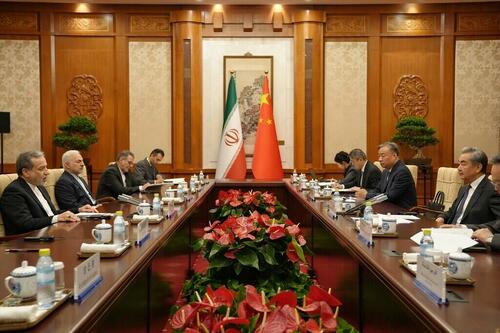
China's Diplomatic Push to End Iran War and Reopen Hormuz Strait: A Strategic Play Ahead of Trump-Xi Summit
China's call for an immediate end to the Iran war and reopening of the Hormuz Strait during FM Araghchi's Beijing visit is a strategic move to stabilize oil markets and assert diplomatic clout ahead of the Trump-Xi summit. Beyond the original coverage, this reflects Beijing's dual role as mediator and economic partner to Iran, amidst tensions with U.S. policy in the Gulf.
China's urgent call for an immediate ceasefire in the Iran conflict and the reopening of the Strait of Hormuz during Iranian Foreign Minister Abbas Araghchi's visit to Beijing signals a calculated move to shape Middle East dynamics and global economic stability. Hosted by Chinese Foreign Minister Wang Yi, the talks underscored Beijing's growing role as a mediator in a region critical to its energy security and geopolitical ambitions. While the original coverage by ZeroHedge highlights the timing of the visit ahead of the anticipated Trump-Xi summit on May 14-15, it misses the broader strategic context of China's actions, including its economic leverage over Iran and its nuanced positioning against U.S. policy in the Gulf.
The Strait of Hormuz, through which approximately 20% of the world's oil transits, remains a chokepoint for global markets. China's insistence on its reopening—echoed by Araghchi as reported by Xinhua—reflects not just humanitarian concern but a pragmatic need to secure Iranian oil supplies, which have been disrupted by U.S. naval blockades under 'Operation Epic Fury.' This blockade, as noted in U.S. Department of Defense briefings, aims to pressure Tehran on its nuclear program but risks spiking oil prices, a scenario China, as the world's largest oil importer, cannot afford. Beijing's 'four-point proposal' for peace, though vague in public readouts, likely includes provisions for de-escalation and economic incentives, aligning with its Belt and Road Initiative goals to stabilize trade routes.
What the initial reporting overlooks is how China's diplomacy here serves a dual purpose: countering U.S. influence while avoiding direct confrontation. By hosting Araghchi at Beijing's initiative, as noted by Nanyang Technological University's Hoo Tiang Boon, China positions itself as a neutral broker, a role it has cultivated since brokering the 2023 Saudi-Iran deal. This history suggests a pattern of China leveraging regional rivalries to expand its diplomatic footprint, a point missed in ZeroHedge's focus on immediate outcomes. Furthermore, the timing—days before the Trump-Xi summit—indicates Beijing's intent to present itself as a stabilizing force, potentially softening trade or tech disputes with Washington by offering cooperation on Middle East peace.
However, China's stance is not without contradictions. While Wang Yi expressed 'deep distress' over the war, per Phoenix TV footage, Beijing continues to flout U.S. sanctions by importing Iranian oil, as documented in 2025 U.S. Treasury reports. This duality—publicly advocating peace while economically sustaining Iran's war capacity—undermines claims of impartiality and was underreported in the original piece. Additionally, Iran's reiterated commitment to non-nuclear weaponization, praised by China, remains contentious given Tehran's refusal to cede enrichment rights, a sticking point in U.S.-Iran talks since the 2015 JCPOA collapse.
Looking ahead, China's push could influence the Trump-Xi summit by framing Beijing as indispensable to Gulf stability, a narrative that may resonate with a U.S. administration seeking an 'offramp' from the conflict, as hinted in recent White House statements. Yet, the risk of miscalculation looms: if Iran perceives China's mediation as aligning too closely with U.S. demands, or if Washington views it as interference, tensions could escalate. The interplay of oil economics, nuclear politics, and superpower rivalry makes this a pivotal moment, one where China's diplomatic gamble could either de-escalate the crisis or expose the limits of its influence.
MERIDIAN: China's mediation in the Iran conflict may yield short-term de-escalation in the Gulf, but its oil trade with Tehran risks undermining long-term credibility with the U.S. at the Trump-Xi summit.
Sources (3)
- [1]Chinese Foreign Ministry Statement on Araghchi Visit(http://www.fmprc.gov.cn/eng/zxxx_662805/202605/t20260506_11298765.html)
- [2]U.S. Department of Defense Briefing on Operation Epic Fury(https://www.defense.gov/News/Transcripts/Transcript/Article/3758924/press-briefing-by-pentagon-press-secretary/)
- [3]U.S. Treasury Report on Sanctions Evasion by China(https://home.treasury.gov/news/press-releases/jy1234)