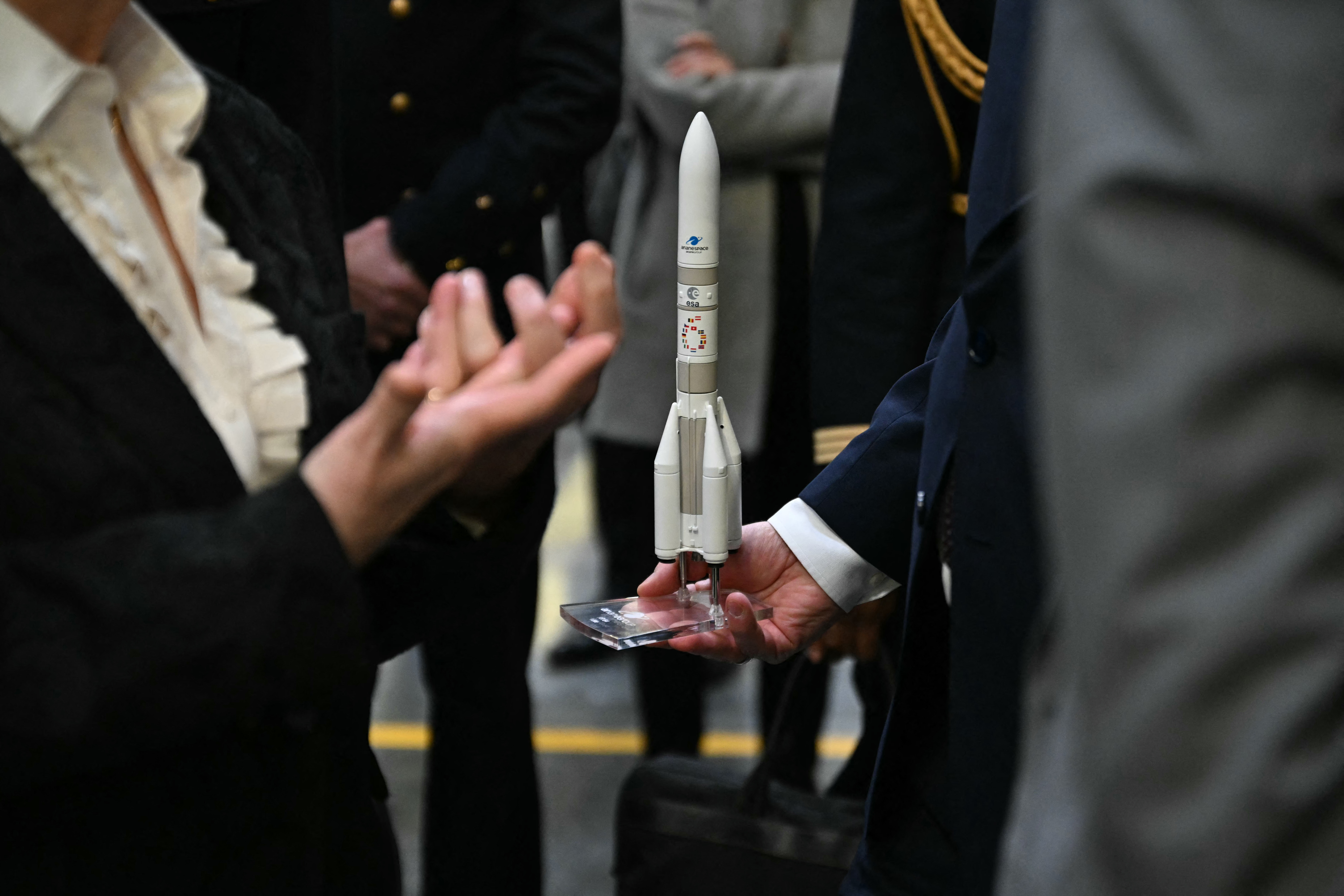
ArianeGroup's German Ballistic Missile Push: Europe's Historic Break from Strategic Dependence
ArianeGroup's exploration of ballistic missile production in Germany constitutes a historic policy reversal, enabling European conventional deep-strike autonomy against Russian threats and reducing dependence on U.S. systems amid shifting global priorities.
ArianeGroup's revelation that it is actively studying ballistic missile production on German soil marks a seismic policy rupture with postwar European norms. While the Les Echos interview with CEO Christophe Bruneau frames this as pragmatic Franco-German industrial cooperation, the deeper significance lies in Germany's willingness to host manufacturing of 2,500 km-range conventional ballistic systems. This directly confronts Berlin's decades-long taboo against long-range offensive strike capabilities, a self-restraint born from 1945 and reinforced through the INF Treaty era.
The original coverage correctly notes France's €1 billion investment and acceleration target of 2030, yet it misses the broader pattern: this is the material expression of Germany's 2022 Zeitenwende finally reaching strategic weapons. Since Russia's 2022 invasion of Ukraine, Moscow has fired over 10,000 missiles and drones, exposing NATO's acute shortfall in conventional deep-strike options. A 2023 IISS Strategic Dossier on 'The Future of European Deterrence' documented how European inventories of systems like Storm Shadow and Taurus are measured in the low hundreds, while Russia maintains thousands of precision ballistic and cruise missiles. The report warned that without rapid investment in indigenous long-range fires, Europe's eastern flank risks deterrence by default.
What mainstream reporting has largely overlooked is the dual-use technology transfer from ArianeGroup's M51 submarine-launched ballistic missile and Ariane 6 launcher programs. The same propulsion, guidance, and re-entry vehicle expertise that guarantees French nuclear deterrence is now being adapted for conventional deep strike. This blurs traditional distinctions and creates a flexible escalation ladder that strengthens conventional deterrence while preserving nuclear ambiguity. It also connects to France's quiet offer of extended nuclear deterrence to partners and Germany's increasing willingness to discuss burden-sharing beyond financial contributions.
Synthesizing the Defense News report with a 2024 RAND Corporation study on 'European Strategic Autonomy After Ukraine' and recent analyses from the French Directorate General for Armament reveals a clear trajectory: Europe is hedging against both Russian revanchism and American distraction. The RAND paper specifically flags that U.S. munitions stocks would likely prioritize a Taiwan contingency, leaving European allies exposed. ArianeGroup's move, despite past collapses in FCAS and MGCS cooperation, demonstrates selective convergence where mutual vulnerability is highest. Germany taking a larger development role without equity stakes cleverly sidesteps political landmines while building sovereign industrial capacity.
This development carries risks. Russia will frame it as destabilizing, potentially justifying further INF Treaty violations or preemptive deployments in Kaliningrad and Belarus. Proliferation concerns exist, though the systems remain conventionally armed. Most significantly, it accelerates the quiet emergence of a European strategic pillar inside NATO that is less deferential to U.S. preferences. By 2030-2035, integrated Franco-German ballistic systems married to future satellite targeting from Ariane 6 launches could provide the credible deep-strike backbone Europe has lacked since the Cold War.
The original story presents this as business-as-usual defense industrial talk. In reality, it represents a historic normalization of Germany as a full-spectrum military power and Europe's concrete step toward reduced reliance on American extended deterrence. The age of strategic parasitism is ending; the age of European strategic responsibility is beginning.
SENTINEL: This marks Europe's decisive step toward independent conventional deterrence architecture. By 2032, Franco-German ballistic systems produced in Germany will likely form the backbone of a European strike capability that operates with reduced U.S. oversight, fundamentally altering NATO burden-sharing negotiations.
Sources (3)
- [1]ArianeGroup studying ballistic-missile production in Germany: Les Echos(https://www.defensenews.com/global/europe/2026/04/24/arianegroup-studying-ballistic-missile-production-in-germany-les-echos/)
- [2]IISS: The Future of European Deterrence and the Russia Threat(https://www.iiss.org/publications/strategic-dossiers/2023/european-deterrence-post-ukraine)
- [3]RAND: Pathways to European Strategic Autonomy in High-Intensity Conflict(https://www.rand.org/pubs/research_reports/RRA2080-1.html)