IPCC Scenario Overhaul Exposes Implausible Foundations of Net-Zero Policies
IPCC-affiliated modelers have declared extreme emissions scenarios like RCP8.5 implausible, undermining alarmist projections that shaped net-zero mandates, Met Office forecasts, and global regulations for two decades. European media coverage highlights the shift, while major outlets stay silent.
A significant update in climate modeling scenarios for the IPCC's forthcoming AR7 assessment has formally deemed the high-emissions pathway RCP8.5 (and its successor SSP5-8.5) implausible, based on observed trends in renewable energy costs, policy implementation, and actual emissions trajectories. This development, detailed in a paper published in Geoscientific Model Development by lead author Detlef van Vuuren and colleagues, marks what independent analyst Roger Pielke Jr. has called one of the most important shifts in climate science in decades. The scenarios, which assumed massive coal expansion and population growth far exceeding current demographic realities, had dominated thousands of research papers, media headlines, and policy documents for nearly 20 years despite early warnings about their detachment from reality.
Pielke, writing in Issues in Science and Technology and on his Substack, has long documented how RCP8.5 was mislabeled as a 'business-as-usual' baseline despite not being designed for policy forecasting. Instead, it served modeling needs for a strong 'signal-to-noise' ratio in simulations. This choice cascaded through institutions: the UK Met Office prominently featured RCP8.5 in its UKCP18 projections, forecasting extreme temperature rises of over 5°C in UK summers by 2070, heightened drought and flood risks, and using these as 'plausible' inputs for government adaptation and mitigation planning. Such outputs influenced regulations across industry, finance, and energy sectors, embedding net-zero mandates that impose substantial economic costs.
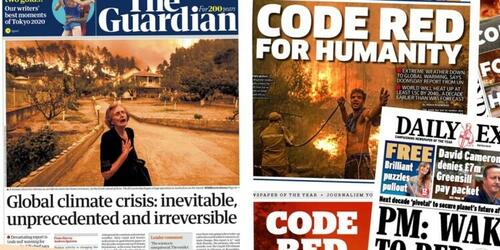
European outlets have begun to acknowledge the implications. De Volkskrant ran a front-page story titled 'UN Climate Panel Drops Doomsday Scenario,' with journalist Maarten Keulemans noting that much prior coverage of climate futures now requires revision. Publications like Berliner Zeitung and Die Welt similarly observed that extreme scenarios had oversized roles in public discourse and politics for too long. In contrast, major English-language outlets like the New York Times, BBC, and Guardian—historically reliant on RCP8.5-derived studies—have remained largely silent, as Pielke has highlighted.
This ruling connects to deeper issues in how climate science interfaces with policy. Papers in AEI and analyses by Michael Liebreich underscore that reliance on these extremes provided an 'attack surface' for critics while justifying urgent, transformative policies like rapid fossil fuel phaseouts regardless of practical impacts on energy reliability or developing economies. While some researchers argue RCP8.5 retains value for stress-testing physical climate responses at regional scales (as noted in critiques from Progressive Reform), its retirement as a central reference scenario forces a reckoning: many net-zero justifications rested on futures now officially labeled impossible. This opens space for recalibrating policies toward more measured adaptation and technology-driven mitigation aligned with actual trajectories, rather than fear-driven extremes that mainstream scrutiny often bypassed. The episode illustrates how heterodox critiques of scenario plausibility, once marginalized, have been validated by the scientific community's own scenario developers.
[LIMINAL]: This implausibility ruling pulls back the curtain on how extreme assumptions drove costly net-zero policies; expect growing pressure to audit and scale back regulations as real-world emissions and tech progress continue diverging from the old doomsday baselines.
Sources (5)
- [1]RCP8.5 Is Officially Dead(https://rogerpielkejr.substack.com/p/rcp85-is-officially-dead)
- [2]ScenarioMIP6: Scenario design for the IPCC's sixth coupled model intercomparison project(https://gmd.copernicus.org/articles/19/2627/2026/)
- [3]How Climate Scenarios Lost Touch With Reality(https://issues.org/climate-change-scenarios-lost-touch-reality-pielke-ritchie/)
- [4]Climate scientists admit doomsday scenario no longer plausible(https://www.gbnews.com/science/apocalypse-forecasts-climate-scientists)
- [5]RCP8.5 Is Officially Dead(https://www.aei.org/articles/rcp8-5-is-officially-dead/)