Army major tells 60 Minutes leaders dismissed drone warnings before six soldiers died at Kuwait port
A wounded Army major told 60 Minutes and Congress that commanders dismissed warnings about missing counter-drone defenses before an Iranian drone killed six reservists at Port Shuaiba. The deaths and the complaint are documented; negligence has not been officially found.
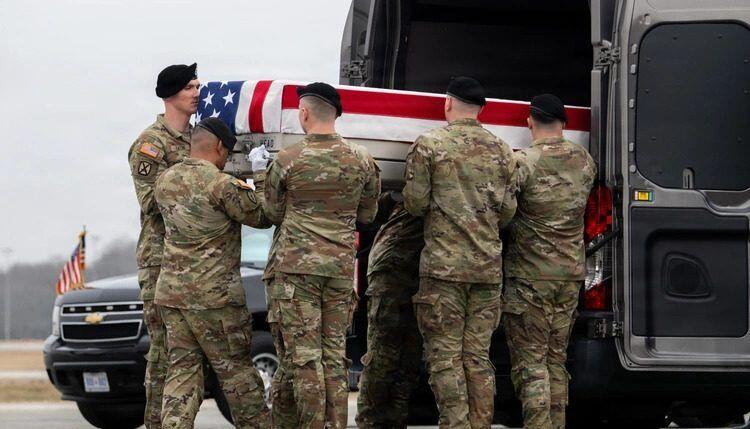
Documented: On March 1, 2026, an Iranian one-way attack drone struck a U.S. Army tactical operations center at Port Shuaiba, Kuwait, on the second day of Operation Epic Fury. Six Army Reserve soldiers assigned to the 103rd Expeditionary Sustainment Command were killed—the first U.S. military fatalities of the war—and more than two dozen others were wounded. The dead have been identified in Pentagon and news reports as Capt. Cody Khork, Sgt. 1st Class Noah Tietjens, Sgt. 1st Class Nicole Amor, Sgt. Declan Coady, Maj. Jeffrey O’Brien, and Chief Warrant Officer Three Robert Marzan. CBS News, CNN, Stars and Stripes, the Associated Press, and others have reported the strike, the unit, and the casualty count.
Claimed: Army Maj. Stephen Ramsbottom, deputy chief of operations for the 103rd and a survivor of the strike, told CBS’s 60 Minutes that the post’s barriers were built for ground threats such as car bombs and that “there was nothing there designed to protect from an aerial attack.” He said he raised the gap in meetings, including with Maj. Gen. John Hinson, the logistics officer for U.S. Central Command, and was told not to worry about protection. He said a counter-drone system was discussed but never arrived, and that it is unclear whether it was ordered. A whistleblower disclosure he submitted to the House and Senate Armed Services Committees, obtained by CBS and CNN, further alleges the site had no physician, no fixed aid station, and only one ambulance. Ramsbottom has also asked the Pentagon inspector general for an independent review, according to Stars and Stripes. He called the episode a tactical failure by the Army, its leadership, and himself. Other soldiers interviewed by 60 Minutes said they had seen intelligence identifying the port as a possible Iranian target. Joey Amor, husband of Nicole Amor, told 60 Minutes that command of the 103rd “killed my wife,” and said survivors were left searching for hospitals. Sen. Richard Blumenthal, after reviewing the complaint, demanded information from Defense Secretary Pete Hegseth.
Documented contrast: The day after the attack, Hegseth described the operations center as fortified. President Trump, responding to the 60 Minutes segment on Truth Social, did not address the force-protection allegations. He said that of thousands of Iranian drones and about 2,000 ballistic missiles fired since February 28, only a handful caused U.S. fatalities, including the Kuwait strike. That statistical claim is his assertion; it does not answer whether this particular site lacked dedicated counter-drone protection.
Speculated, not established: No public finding by the Pentagon inspector general, a court, or a congressional committee has yet determined that named commanders were negligent or that different fortifications would have prevented the deaths. The causal leap from ignored warnings to “they killed” these soldiers is a family’s accusation and a survivor’s allegation, not an adjudicated fact. What is on the record is narrower and still serious: a logistics command post close to Iran was hit in the opening hours of a war whose drone threat was already known; a wounded officer says aerial defenses and medical capacity were inadequate and that superiors waved off the concern; Congress and the IG have been asked to investigate; and official language the day after the strike described the same site as fortified.
The institutional question the record supports is not a general indictment of the defense industry. It is whether a sustainment headquarters was left in a known threat environment with protections matched to an older threat, and whether the chain of command treated one-way attack drones as someone else’s problem until the first American deaths of the war.
Six American reservists are dead and dozens were wounded at a Kuwait port whose aerial defenses a surviving officer says commanders treated as unnecessary. Families, Congress, and the Pentagon inspector general now have a formal complaint asking whether those deaths were a planning failure, not only an enemy strike.
Sources (6)
- [1]Army whistleblower alleges senior military officials ignored warnings ahead of deadly attack in Kuwait(https://www.cbsnews.com/news/army-whistleblower-military-officials-kuwait-attack-iran-war/)
- [2]Military families want answers on Iran war deaths(https://www.cbsnews.com/news/military-families-want-answers-on-iran-war-deaths-60-minutes/)
- [3]Army soldier files whistleblower complaint over deadly Iranian strike(https://www.cnn.com/2026/11/15/politics/army-soldier-whistleblower-complaint)
- [4]Officer wounded in Kuwait drone strike asks Pentagon watchdog to investigate(https://www.stripes.com/theaters/middle_east/2026-11-16/iran-drone-attack-whistleblower-complaint-23482266.html)
- [5]Soldiers and families press Army leaders after deadly Iranian drone strike(https://apnews.com/article/iran-war-port-shuaiba-attack-soldiers-29f34587c6361261f6e803aff6791e8f)
- [6]2026 Port Shuaiba drone attack(https://en.wikipedia.org/wiki/2026_Port_Shuaiba_drone_attack)