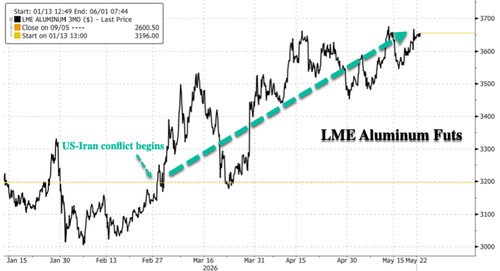
Aluminum Supply Crunch Accelerates: Middle East Disruptions, Guinea Export Curbs, and Chinese Curbs Signal Prolonged Pain for EVs, Construction, and Defense
Multiple converging disruptions—from Hormuz blockade and Gulf smelter outages to Guinea's bauxite export limits and Chinese production curbs—are creating a severe, potentially multi-year aluminum deficit. This under-tracked crunch threatens to raise costs and delay production across electric vehicles, construction, renewables, and defense manufacturing, exposing deep vulnerabilities in globalized critical supply chains.
A convergence of geopolitical shocks, resource nationalism, and regulatory tightening is pushing the global aluminum market into what major commodity traders describe as a 'black swan' supply crisis—the largest base metals shock since 2000. London Metal Exchange aluminum prices have surged to four-year highs near $3,600–$3,700 per ton, driven by multiple compounding factors that extend far beyond temporary shipping disruptions.[1]
Mercuria, Goldman Sachs, and JPMorgan have all issued stark warnings. Mercuria's head of metals research called the situation a literal 'black swan event' triggered by the U.S.-Iran conflict, force majeure declarations at Gulf smelters, and the effective closure of the Strait of Hormuz chokepoint, which has severed flows representing roughly 7–9% of global primary aluminum supply. Analysts forecast deficits of 1.1–2 million tons or more in 2026, with limited inventory buffers to absorb the hit. Even if maritime routes reopen, JPMorgan described the market as entering a 'black hole' of prolonged outage.[2]
This Middle East shock collides with developments on the raw material side. Guinea, the world's top bauxite producer and China's dominant supplier (accounting for over 70% of its imports in recent years), is actively curtailing exports. Mines Minister Bouna Sylla confirmed plans to reduce volumes after 2025 shipments surged 25% to 183 million tons, driving prices too low. 'Supply mustn’t exceed demand,' Sylla stated, with curbs rolling out in stages from April into June to stabilize the market and protect smaller producers. Reuters and industry reports note this directly threatens China's alumina refiners and primary aluminum output.[3][4]
Compounding the issue, Chinese authorities are cracking down on overproduction and energy-intensive smelting amid swelling inventories, environmental inspections, and emissions targets. A smelter in Baise, Guangxi, has already curtailed molten aluminum output, while broader curbs target the sector alongside steel and refining. China's bauxite supply is already tight domestically due to environmental regulations, with stockpiles at multi-year lows and reliance on Guinean imports hitting record levels. Kpler analysis warns that seasonal rainy season declines in Guinea exports could turn this tightness into outright constraints on primary aluminum production.[5]
Few analysts are fully connecting the downstream dots. Aluminum is indispensable for electric vehicles—EV models use approximately 25% more aluminum than traditional combustion engines for lightweighting, battery enclosures, and structural components. Major carmakers have already signaled production cuts pending supply clarity. In construction, higher prices feed directly into building materials, wiring, and facades at a time of global infrastructure push. Most critically for national security, defense manufacturing depends on aluminum for aircraft, missiles, vehicles, and electronics. U.S. strategic vulnerability is now exposed: domestic primary production covers only about 16% of needs, with one operating alumina refinery creating a single point of failure. Ongoing Middle East conflict has highlighted how foreign dependence (75%+ of supply) undermines readiness.[6][7]
This crisis intersects with the energy transition paradox: aluminum is vital for solar frames, wind components, EV adoption, and data center expansion, yet its production is among the most energy-intensive. China's dual role as both dominant producer and now regulator creates systemic risk. Western reshoring efforts remain slow due to high power costs and permitting. The result could be sustained higher prices—potentially testing $4,000 per ton—driving inflation in green tech, delayed defense contracts, and accelerated but painful supply chain fragmentation. While banks and traders are sounding alarms, the full strategic implications for industrial policy and critical minerals security remain under-discussed.
LIMINAL: This aluminum supply crunch is poised to inflate costs for EVs, solar infrastructure, and military hardware while accelerating Western efforts to rebuild domestic capacity, ultimately revealing how dependent the green transition and defense readiness have become on fragile Sino-African commodity flows.
Sources (5)
- [1]Guinea to curb bauxite exports by April to stabilize prices, minister says(https://www.reuters.com/world/africa/guinea-curb-bauxite-exports-by-april-stabilize-prices-minister-says-2026-03-18/)
- [2]Aluminum faces 'black swan' supply shock, Mercuria says(https://www.mining.com/web/aluminum-faces-black-swan-supply-shock-mercuria-says/)
- [3]With Aluminum in Short Supply, Regional Price Risks Emerge(https://www.cmegroup.com/openmarkets/metals/2026/With-Aluminum-in-Short-Supply-Regional-Price-Risks-Emerge.html)
- [4]Aluminum prices are surging. Here's how companies are responding(https://www.cnbc.com/2026/05/05/aluminum-prices-hormuz-ford-molson-coors.html)
- [5]China's aluminium industry now has a bauxite tightness headache(https://www.kpler.com/blog/chinas-aluminium-industry-now-has-a-bauxite-tightness-headache)