NASA's Psyche Mission Mars Flyby: A Window into Navigation Precision and Solar System Origins
NASA’s Psyche mission captured Mars during a gravity assist on May 3, 2026, offering more than a striking image. Beyond calibrating instruments for its 2029 asteroid target, the flyby refines interplanetary navigation and provides unexpected Martian atmospheric data, contributing to solar system science.
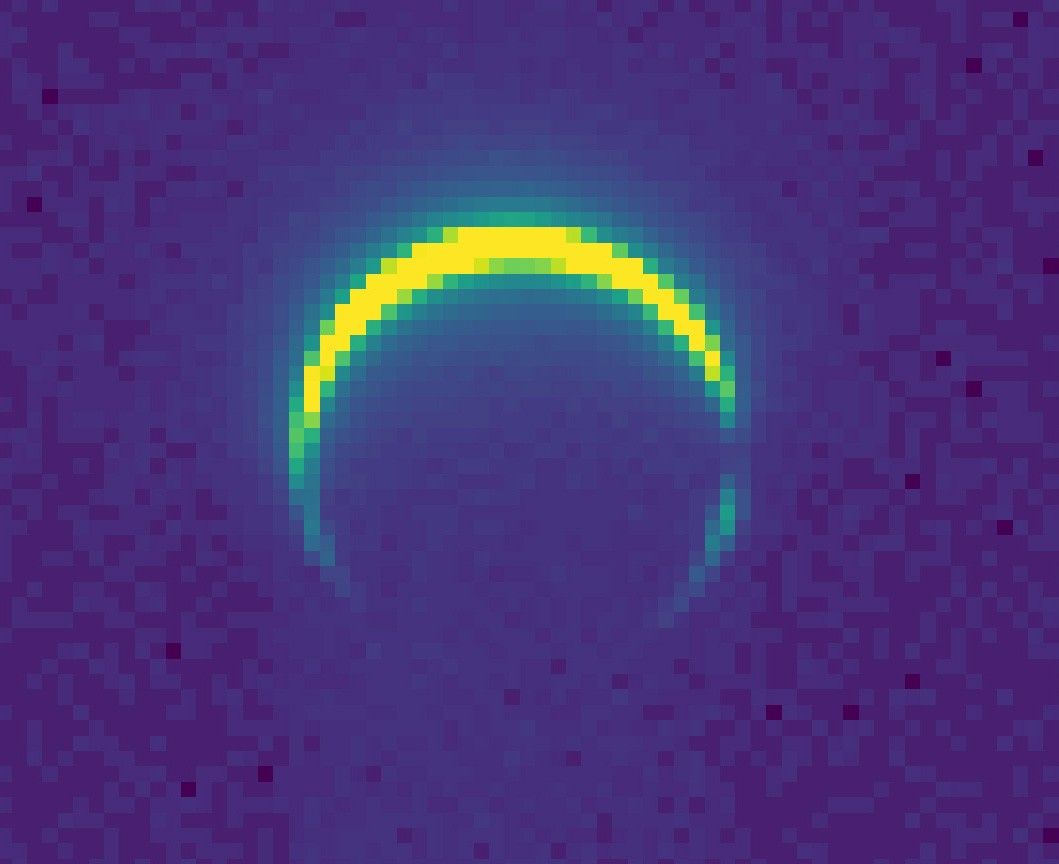
NASA’s Psyche spacecraft, en route to the metal-rich asteroid Psyche, recently captured a striking image of Mars on May 3, 2026, from a distance of 3 million miles (4.8 million kilometers). This observation, taken during a gravity assist maneuver set for May 15, 2026, showcases Mars as a thin crescent due to the high-phase angle of the spacecraft’s approach. Beyond the visual spectacle, this event offers critical insights into interplanetary navigation, instrument calibration, and the broader quest to understand solar system formation. The image, acquired using the spacecraft’s multispectral imager with a 2-millisecond exposure, reveals sunlight reflecting off Mars’ surface and scattering through its dusty atmosphere, with a notable gap near the north polar cap potentially indicating seasonal clouds or hazes.
While the original NASA coverage focuses on the image’s aesthetic and calibration purposes, it overlooks the deeper implications of this gravity assist for future deep-space missions. Gravity assists are a cornerstone of interplanetary travel, allowing spacecraft to gain speed and adjust trajectories without expending additional fuel. The Psyche mission’s precise navigation past Mars—relying on complex orbital mechanics—demonstrates advancements in trajectory modeling since earlier missions like Voyager or Cassini. This flyby also serves as a real-world testbed for Psyche’s instruments, particularly the multispectral imager, which will be pivotal in analyzing the asteroid’s composition in 2029. Unlike Mars, asteroid Psyche is believed to be a remnant of a planetary core, offering a rare glimpse into the building blocks of rocky planets. The calibration data from Mars, a well-studied body, will refine our ability to interpret Psyche’s data, potentially reshaping theories of planetary differentiation.
What’s missing from initial reports is the broader context of atmospheric science revealed by the Mars image. The observed scattering of sunlight due to atmospheric dust, and the hypothesized seasonal effects near the polar cap, align with ongoing research into Martian climate variability. Studies from NASA’s MAVEN mission (Mars Atmosphere and Volatile Evolution) have shown that dust storms and atmospheric loss are dynamic processes tied to solar activity and seasonal shifts. Psyche’s snapshot, though brief, contributes a data point to this evolving picture, especially as it captures Mars during a winter phase in the northern hemisphere. This intersection of planetary science and mission technology underscores an underreported synergy: deep-space missions like Psyche can double as opportunistic observers of other solar system bodies, enriching datasets beyond their primary objectives.
Moreover, the mission’s timeline—arriving at asteroid Psyche in 2029—positions it within a wave of asteroid exploration, including NASA’s OSIRIS-REx and the upcoming Lucy mission. Each targets different asteroid types, collectively building a mosaic of solar system history. Psyche’s focus on a metallic asteroid contrasts with OSIRIS-REx’s sampling of carbon-rich Bennu, yet both aim to decode early solar system conditions. The Mars flyby, while a navigational stepping stone, also highlights a pattern: gravity assists often yield unexpected scientific dividends, as seen with Galileo’s Earth flybys revealing atmospheric anomalies in the 1990s. This pattern suggests Psyche’s journey may uncover more surprises before reaching its destination.
Methodology and Limitations: The Psyche image was captured using a panchromatic filter with a short exposure, as reported by NASA, though specific sample size or statistical analysis isn’t applicable for a single observation. Limitations include the oversaturation of parts of the image due to Mars’ brightness, which could obscure finer details, and the speculative nature of interpretations (e.g., polar cap hazes) pending further data. This is a primary observation, not yet peer-reviewed, though it builds on established imaging techniques.
In synthesizing sources, the primary NASA release is complemented by insights from MAVEN mission findings on Martian atmospheric dynamics (published in peer-reviewed journals like Science) and historical data on gravity assist outcomes from the Voyager program (archived in NASA’s Planetary Data System). Together, these frame Psyche’s flyby as more than a photo op—it’s a nexus of navigation innovation, planetary science, and solar system archaeology. The mission’s success in leveraging Mars’ gravity could refine models for future missions to the outer solar system, while its incidental Mars data reminds us that every encounter in space, however brief, adds a piece to the cosmic puzzle.
HELIX: The Psyche mission’s Mars flyby could refine navigation models for future deep-space missions, potentially reducing fuel costs and travel time. Incidental data on Mars’ atmosphere may also inform climate models during its seasonal shifts.
Sources (3)
- [1]NASA’s Psyche Mission Captures Mars During Gravity Assist Approach(https://science.nasa.gov/photojournal/nasas-psyche-mission-captures-mars-during-gravity-assist-approach/)
- [2]MAVEN Mission Overview and Atmospheric Findings(https://science.nasa.gov/mission/maven/)
- [3]Voyager Program Gravity Assist Data, Planetary Data System(https://pds.nasa.gov/)