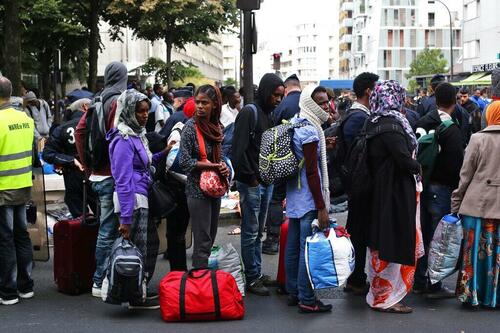
Near 50% French Backing for National Rally Signals Accelerating European Populist Backlash to Immigration Policies Long Ignored by Elites
Corroborated polls show RN nearing 50% consideration for 2027 with immigration as the unifying foundation across diverse voter blocs; this mirrors and accelerates a Europe-wide populist surge against long-ignored migration and identity concerns, potentially upending mainstream politics as the "republican front" weakens.
A recent Ipsos poll for the Jean-Jaurès Foundation, Le Monde, and Cevipof reveals that 45% of French voters are now considering support for the National Rally (RN) in the 2027 presidential election, with the party uniting disparate groups around core concerns over immigration and national identity. The study identifies four voter profiles: traditional "identity-based liberals," economically vulnerable "forgotten France" demanding both social protection and radical identity policies, politically disengaged "shifting France," and a growing "opportunistic radical right" of more affluent, educated voters who have shifted from mainstream conservative parties. Across three of these groups, agreement that "there are too many immigrants in France" exceeds 96%, while strong majorities no longer "feel at home" in their country. This expansion beyond the RN's historical base highlights a deeper dynamic: decades of elite dismissal of public concerns regarding rapid demographic change, integration failures, and cultural cohesion have normalized what was once a pariah party. Jordan Bardella, the telegenic face of the modern RN, now leads hypothetical 2027 matchups against all mainstream rivals, according to multiple surveys. This is not an isolated French phenomenon but part of a broader continental pattern. Far-right and populist parties are simultaneously topping polls in Germany (AfD), France (RN), and the UK (Reform UK) for the first time in modern history, fueled by post-2015 migration surges, economic pressures, and a sense of elite betrayal on border control. Sources across the spectrum note how mainstream parties' strategy of moral condemnation rather than policy response has backfired, eroding the "republican front" that once blocked RN advances. Connections others miss include the class-transcending nature of the revolt—affluent voters joining working-class ones over identity—and the self-reinforcing cycle where ignored grievances strengthen populist narratives, further polarizing societies. As RN normalizes anti-mass-migration positions once deemed extreme, Europe faces a potential realignment: either mainstream parties adopt stricter policies or populist forces gain executive power, reshaping EU migration frameworks. Recent municipal and parliamentary results, alongside Le Monde's own 2026 electoral survey showing deep desire for change and favorable RN perceptions, underscore that the backlash has accelerated beyond what centrists anticipated, with 2027 looming as a possible inflection point for the continent.
LIMINAL: Near-50% RN support reveals elite dismissal of immigration and cultural concerns has created an unstoppable populist momentum, likely fracturing traditional coalitions and forcing a Europe-wide policy reckoning or further radicalization by 2027-2030.
Sources (4)
- [1]Once a pariah, the National Rally is now France's most popular party(https://www.economist.com/briefing/2025/12/11/once-a-pariah-the-national-rally-is-now-frances-most-popular-party)
- [2]One year ahead of French presidential election, survey shows deep desire for change(https://www.lemonde.fr/en/politics/article/2026/04/14/one-year-ahead-of-french-presidential-election-survey-shows-deep-desire-for-change_6752389_5.html)
- [3]Far-right populists top polls in Germany, France and Britain for the first time(https://www.nbcnews.com/world/europe/far-right-populists-top-polls-germany-france-britain-first-time-rcna224706)
- [4]French far-right leader tells BBC he shares US warnings on immigration(https://www.bbc.com/news/articles/cz7nrze7g8wo)