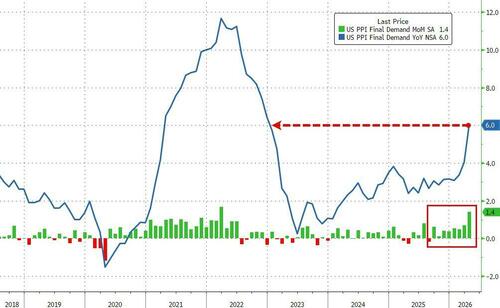
Exploding Producer Prices in April Signal Deepening Inflation Pressures with Far-Reaching Market Implications
April’s explosive 1.4% MoM PPI increase signals persistent inflation, pushing Treasury yields above 4.00% and pressuring the Fed to tighten policy. Beyond immediate market reactions, global supply chain strains, geopolitical risks, and potential emerging market fallout reveal deeper implications overlooked in initial coverage.
The April Producer Price Index (PPI) report, showing a staggering 1.4% month-over-month increase and a 6.0% year-over-year surge, has sent shockwaves through financial markets, with 2-year Treasury yields spiking above 4.00%—their highest since March. While the original ZeroHedge coverage highlights the immediate yield reaction and the role of energy and services in driving the PPI surge, it misses critical downstream effects and broader geopolitical and policy contexts that could amplify or mitigate these inflationary pressures. Beyond the headline numbers, the data reveals a complex interplay of domestic and global forces that could reshape Federal Reserve policy, bond markets, and even international trade dynamics.
First, the ZeroHedge report underplays the structural nature of the inflation pipeline. While it notes that energy costs may have stabilized, it overlooks how supply chain bottlenecks—still lingering from post-COVID disruptions and exacerbated by geopolitical tensions in key oil-producing regions—could sustain upward pressure on input costs. For instance, ongoing conflicts in the Middle East and sanctions on Russian energy exports continue to constrain global supply, as detailed in the U.S. Energy Information Administration’s (EIA) April 2023 Short-Term Energy Outlook. These factors suggest that even if crude oil prices plateau, the pass-through effects on manufacturing and transportation costs could persist for quarters, embedding inflation deeper into the economy than the report implies.
Second, the coverage glosses over the Federal Reserve’s delicate balancing act. With core PPI spiking 1.0% month-over-month—more than triple the expected 0.3%—the Fed faces mounting pressure to tighten monetary policy further, despite political headwinds from the incoming administration. ZeroHedge mentions the diminished likelihood of rate cuts under a potential Trump-influenced Fed chair like Kevin Warsh, but it fails to connect this to the broader bond market dynamics. A sustained rate hike cycle could invert the yield curve further, signaling recession risks—a pattern observed in 2006-2007 before the financial crisis, as documented in Federal Reserve historical data. Moreover, higher yields could attract foreign capital, strengthening the dollar but potentially harming U.S. export competitiveness at a time when trade tensions with China are already simmering.
Third, the report’s ‘silver lining’—that components feeding into Personal Consumption Expenditures (PCE) inflation were tame—may be overly optimistic. While portfolio management fees and medical care costs showed restraint, the broader services sector, which constitutes over 60% of U.S. GDP, is showing contagion from energy-driven inflation, as noted in the original data. This trend aligns with patterns seen in the 1970s stagflation period, where energy shocks bled into wages and services, creating a feedback loop. If this persists, the Fed’s preferred PCE gauge could surprise to the upside, forcing a more hawkish stance than markets currently anticipate.
Lastly, an underexplored angle is the global ripple effect. Rising U.S. yields and a stronger dollar could strain emerging markets with dollar-denominated debt, as seen during the 2013 Taper Tantrum. Countries like Turkey and Argentina, already grappling with currency depreciation, could face capital outflows, potentially triggering localized crises that feed back into global risk sentiment. This dynamic, absent from the original coverage, underscores how U.S. inflation data is not just a domestic story but a geopolitical one.
In synthesizing these insights with primary data from the Bureau of Labor Statistics (BLS) PPI report and the EIA’s energy outlook, alongside historical Fed policy patterns, it’s clear that April’s PPI surge is not a transient blip but a signal of entrenched inflationary forces. Markets may be underpricing the risk of a prolonged tightening cycle, while policymakers face a narrowing window to act before inflation expectations unanchor. The interplay of domestic policy, global supply chains, and financial market reactions will define the trajectory of this story in the months ahead.
MERIDIAN: The Federal Reserve is likely to adopt a more hawkish stance in the near term, with a rate hike probable by mid-2023 if PPI pressures continue, potentially deepening yield curve inversion and heightening recession risks.
Sources (3)
- [1]Bureau of Labor Statistics - Producer Price Index April 2023(https://www.bls.gov/news.release/ppi.nr0.htm)
- [2]U.S. Energy Information Administration - Short-Term Energy Outlook April 2023(https://www.eia.gov/outlooks/steo/)
- [3]Federal Reserve Historical Data on Yield Curves(https://www.federalreserve.gov/data.htm)