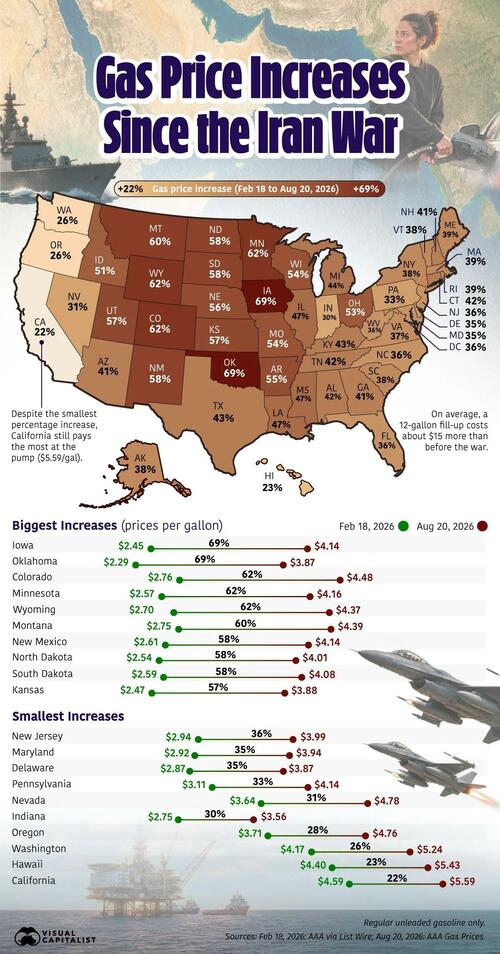
Strait of Hormuz Closure Lifts US Gasoline Prices 44 Percent, With Midwest States Absorbing Largest Percentage Gains
Iran's closure of the Strait of Hormuz removed 10 million barrels daily and produced a $1.25 per gallon national gasoline increase. Midwest states starting from low baselines absorbed the largest percentage rises. The move trades Iranian bargaining power for higher global prices and added costs to US consumers and downstream industries.
The price shock followed documented Iranian action to interdict tanker traffic through the Strait after escalation with US and allied naval forces. AAA data show the national average moved from roughly $2.85 to $4.10 per gallon, adding an estimated $560 in annual fuel costs per vehicle at 450 gallons yearly consumption. States with the lowest pre-war baselines recorded the largest percentage jumps: Iowa rose 69.1 percent to $4.14, Oklahoma 68.8 percent to $3.87. Higher-tax states with rigid blending rules such as California recorded smaller percentage increases but retained the highest absolute prices at $5.59.
Iran gains short-term leverage over Gulf export volumes and forces higher global crude benchmarks that benefit its remaining sanctioned sales. The United States faces direct consumer cost pass-through plus secondary effects on plastics, logistics, and inflation metrics that pressure domestic political support for sustained naval operations. Primary records from the Department of Energy and tanker tracking data confirm the volume loss; no compensating surge from other OPEC+ members has yet offset the gap.
Future price trajectories hinge on whether Iranian forces maintain physical control of the Strait or accept monitored passage under new terms. Sustained closure would require the United States and partners to accelerate alternative supply routes and strategic reserve releases, while any reopening would test Iranian willingness to accept reduced export revenues in exchange for sanctions relief.
EIA: US Gulf crude imports will exceed 1.8 million barrels per day by December 2026 if Hormuz transit remains below 5 million barrels daily.
Sources (2)
- [1]Primary Source(https://www.eia.gov/petroleum/gasdiesel/)
- [2]Supporting Source(https://www.iea.org/reports/oil-market-report)