US Energy Secretary's Normalization Claims on Strait of Hormuz Oil Flows Challenged by EIA Data and Tanker Tracking Amid Renewed Tensions
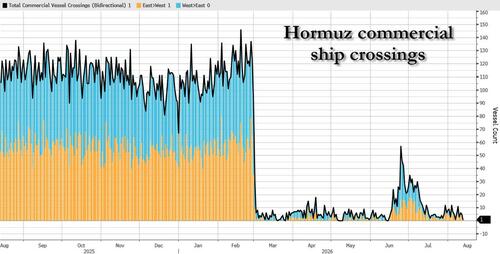
Wright's August 11 claims of normalized Middle East oil exports via Hormuz and pipelines are directly contradicted by EIA's August STEO on persistent shut-ins and Kpler/Reuters tanker data showing minimal transits, highlighting fragile energy markets amid Iran-related tensions.
US Secretary of Energy Chris Wright asserted on August 11, 2026, via X that oil flows from the Arabian Gulf had normalized, citing a seven-day average of nearly 9 million barrels per day (bpd) transiting the Strait of Hormuz, plus 5-7 million bpd via pipelines, for a regional total of about 15 million bpd—with over 20 million barrels exiting on Sunday alone, exceeding pre-conflict averages. These figures, attributed to US military and Gulf ally coordination, appear at odds with independent monitoring and official forecasts. The US Energy Information Administration (EIA) in its August Short-Term Energy Outlook (STEO) explicitly raised estimates of Middle East shut-in crude production, assuming severe constraints on Hormuz transits would persist through August and lead to ongoing disruptions of roughly 0.6 million bpd through 2027 even as most output recovers by early 2027.[1][2]
Tanker analytics firm Kpler reported sharply lower traffic, with only six commodity vessels transiting the strait on Monday (down from an 11-ship 10-day average) and just one on Wednesday, aligning with Reuters coverage of declining movements as hopes for a sustained US-Iran deal faded.[3] Earlier statements by Wright in June and July 2026 similarly touted recovering flows (e.g., 7-14 million bpd ranges or 20 million barrels in 24 hours), but Chevron CEO Mike Wirth publicly questioned comparable assertions, noting smaller observed volumes.[4][5]
These discrepancies underscore persistent geopolitical risks in the region, where even partial reopenings remain vulnerable to renewed attacks or insurance-driven pullbacks. Economically, constrained Hormuz shipments—handling roughly 20% of global oil trade—support elevated Brent prices near $85-87/bbl in Q3 2026 forecasts, with knock-on effects for inventories, inflation, and energy security far beyond the Gulf.[6]
Energy Analyst: Persistent Hormuz constraints will sustain upward pressure on global oil prices and accelerate diversification away from Gulf supplies, amplifying volatility in energy markets through late 2026.
Sources (6)
- [1]US EIA raises Brent outlook to $87/b on Hormuz shipping constraints(https://www.spglobal.com/energy/en/news-research/latest-news/crude-oil/081126-us-eia-raises-brent-outlook-to-87b-on-hormuz-shipping-constraints)
- [2]Some Middle East oil output will stay shut through next year, US EIA says(https://www.reuters.com/business/energy/some-middle-east-oil-output-will-stay-shut-through-next-year-us-eia-says-2026-08-11/)
- [3]Short-Term Energy Outlook(https://www.eia.gov/outlooks/steo/)
- [4]US energy chief says oil flows from Gulf at 15M barrels per day(https://www.anews.com.tr/world/2026/08/11/us-energy-chief-says-oil-flows-from-gulf-at-15m-barrels-per-day/amp)
- [5]Oil tanker traffic through Hormuz at near standstill as attacks strain Iran truce(https://www.reuters.com/world/middle-east/oil-tanker-traffic-through-hormuz-near-standstill-attacks-strain-iran-truce-2026-07-09/)
- [6]U.S. energy secretary says 7 million barrels of oil exiting Persian Gulf daily, but Chevron CEO rebuts the claim(https://fortune.com/2026/06/12/u-s-energy-secretary-says-7-million-barrels-of-oil-exiting-persian-gulf-daily-but-chevron-ceo-rebuts-the-claim/)