America's Fertility Paradox: Strong Desire for Larger Families Meets Record-Low Birth Rates and Cultural Erosion
Polls from Gallup and conservative readers show Americans idealize 2.7+ children and link family importance to faith and values, yet CDC data shows fertility at 1.6 amid economic pressures, declining religiosity, feminism, and cultural shifts. This paradox signals deepening demographic decline with major economic and societal risks, revealing a values-realization gap others overlook.
A significant disconnect has emerged in American society: while polls consistently show most people view having children as central to a fulfilling life and idealize families of three or more kids, the U.S. fertility rate has collapsed to a record low of 1.6 births per woman. This gap between aspiration and reality points to deeper demographic, economic, and cultural forces reshaping the nation's future.
Recent Gallup polling reveals that Americans' ideal family size has stabilized at an average of 2.7 children, even as actual fertility hit new lows in 2024. This preference has held relatively steady for decades, exceeding the 2.1 replacement level needed for population stability without immigration. Yet completed fertility lags far behind, with many adults ending their reproductive years with fewer children than desired. Heritage Foundation analysis confirms this widening chasm: ideal family size has remained roughly constant since the late 1970s while total fertility rates have declined sharply since 2007, suggesting Americans are increasingly revising expectations downward due to practical barriers rather than shifting ideals.
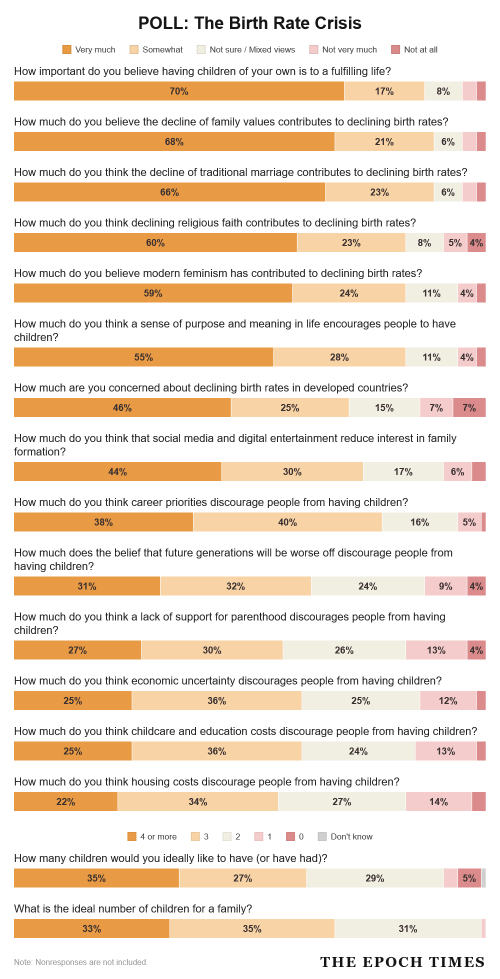
The Epoch Times reader poll aligns with these broader trends but emphasizes cultural drivers. Respondents overwhelmingly linked declining birth rates to erosion of religious faith (83%), traditional marriage (89%), family values (89%), and modern feminism (83%). Economic factors like housing costs, childcare, education expenses, and career priorities also ranked high, alongside social media's role in reducing interest in family formation. These views echo expert analyses: Gallup notes that high costs for housing, childcare, healthcare, and education, combined with delayed marriage, declining religiosity, and cultural headwinds, suppress births despite persistent pro-family attitudes.
CDC data confirms the collapse, with the 2024 total fertility rate at 1.6 and general fertility rate falling to 53.8 births per 1,000 women aged 15-44. Johns Hopkins and Pew Research highlight how economic insecurity, student debt, wage stagnation, and shifting gender roles contribute. A growing share of Americans now see low birth rates as negatively impacting the country (53% in recent Pew surveys), raising alarms about future strains on Social Security, labor markets, and economic growth.
Deeper connections reveal political and worldview divergences often missed in mainstream coverage. Research from the Institute for Family Studies and American Compass documents a rising "conservative fertility advantage," with counties voting heavily Republican showing fertility rates around 1.8 compared to 1.3 in strongly Democratic areas. This ties into the original poll's emphasis on faith and values: religiosity strongly correlates with higher desired and actual family sizes. Meanwhile, broader cultural shifts toward individualism, careerism, digital distraction, and postponed family formation amid housing unaffordability exacerbate the collapse.
The implications extend beyond economics to civilizational questions. Persistent gaps between ideal and realized fertility suggest not just policy failures but a profound values crisis—where stated desires for larger families clash with incentives shaped by late-modern culture. Without addressing root drivers like economic precarity for young families, declining social trust, and secularization, the U.S. risks accelerated aging, fiscal insolvency, and reliance on immigration that may further alter cultural cohesion. Some see early signs of a pronatalist resurgence among certain political and religious groups, but reversing entrenched trends will require more than rhetoric.
LIMINAL: This aspiration-reality chasm accelerates population aging and fiscal crises while fueling underground pronatalist and traditionalist movements that could reshape cultural conflicts in the coming decade.
Sources (5)
- [1]Americans' Ideal Family Size Remains Above Two Children(https://news.gallup.com/poll/694640/americans-ideal-family-size-remains-above-two-children.aspx)
- [2]Americans Have Not Been Able to Have the Number of Children They Want(https://www.heritage.org/sites/default/files/2025-03/BG3886_0.pdf)
- [3]Is the U.S. Birth Rate Declining?(https://publichealth.jhu.edu/2026/is-the-us-birth-rate-declining)
- [4]Growing share of Americans say fewer people having kids would negatively impact the U.S.(https://www.pewresearch.org/short-reads/2025/09/30/growing-share-of-americans-say-fewer-people-having-kids-would-negatively-impact-the-us/)
- [5]Births Data Brief 535(https://www.cdc.gov/nchs/products/databriefs/db535.htm)