Trump's Naval Surge: Maritime Rearmament as the Linchpin of Long-Term China Containment
Trump's FY2027 proposal doubles naval ship requests to 34 vessels with $65.8B, marking a strategic shift to counter China's superior fleet numbers and industrial output. Analysis reveals critical industrial base gaps, logistical priorities, and Taiwan contingencies missed in original coverage, synthesizing CRS, RAND, and CSIS reporting to assess long-term deterrence viability.
President Trump's proposal to allocate $65.8 billion for shipbuilding in the 2027 defense budget, requesting 18 battle force ships and 16 non-battle force vessels, represents far more than the doubling of prior requests detailed in Defense News. It signals a decisive strategic pivot toward maritime primacy explicitly calibrated to counter China's People's Liberation Army Navy (PLAN) in a protracted great-power competition. While the original coverage accurately reports the jump from the FY2026's $27.2 billion and 17 ships, it understates the historical patterns, industrial base realities, and operational imperatives that make this announcement a potential inflection point.
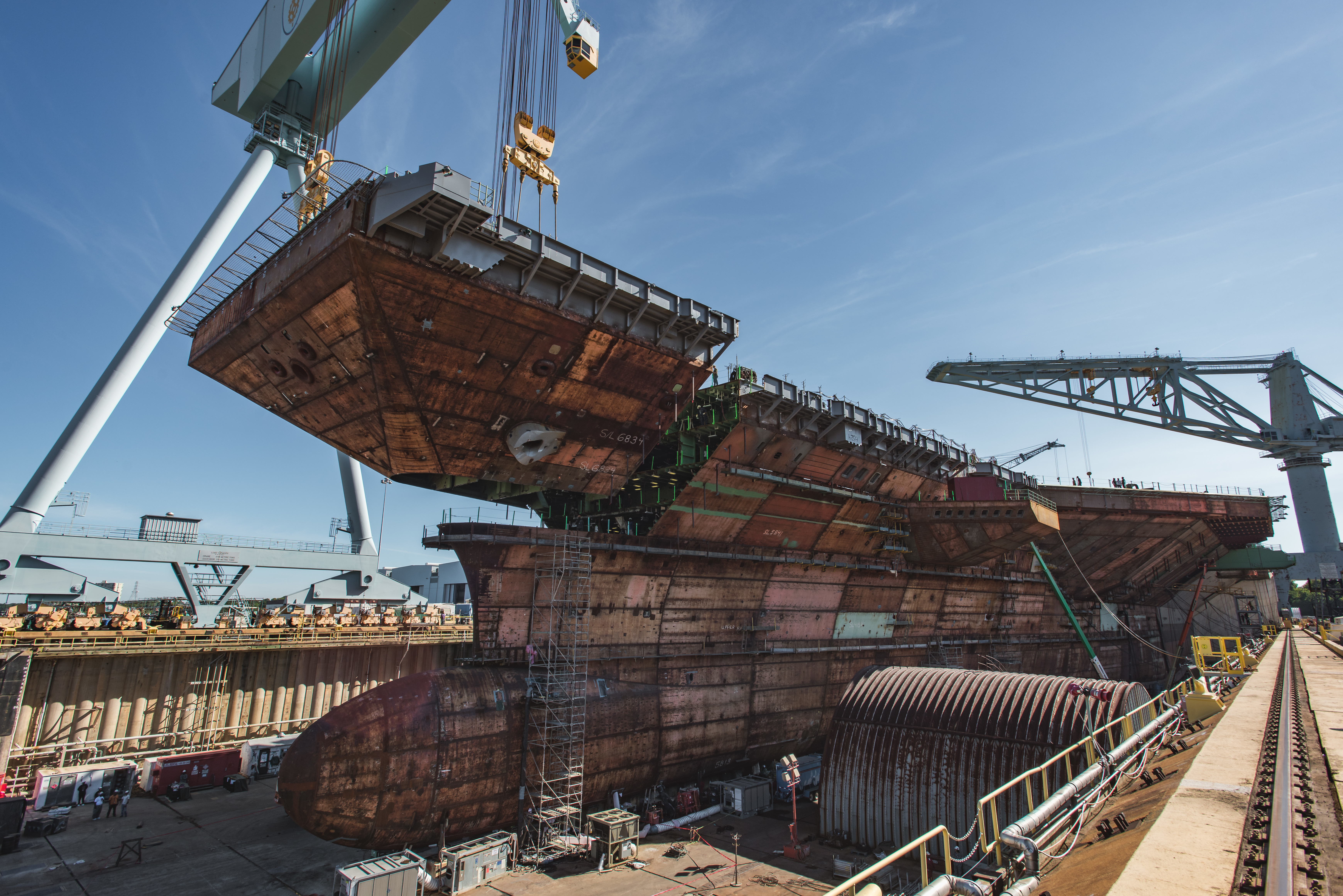
China's naval trajectory provides the essential context. According to the Congressional Research Service report "China Naval Modernization: Implications for U.S. Navy Capabilities" (RL33153, updated 2024) by Ronald O'Rourke, the PLAN has reached approximately 370 battle force ships, outnumbering the U.S. Navy, with projections exceeding 400 hulls by 2030. Beijing's shipyards deliver vessels at a rate five-to-six times faster than America's, per RAND Corporation analysis in "Leveraging the U.S. Shipbuilding Industrial Base" (2023). The original piece glosses over this asymmetry and the atrophied state of U.S. public shipyards, which suffer from workforce shortages, aging infrastructure, and supply chain chokepoints.
Trump's "Golden Fleet" concept, including two so-called Trump-class battleships touted as "100 times more powerful" than predecessors, mixes rhetorical flourish with substantive intent. The emphasis on easier-to-build logistics vessels, sealift, hospital ships, submarine tenders, and replenishment tankers reveals an understanding that sustained combat power projection depends on robust sustainment, a nuance missed by much of the initial reporting. CSIS's "U.S. Naval Force Structure and Shipbuilding Plans" assessments highlight that without expanded sealift and forward logistics, U.S. forces risk being outlasted in any Western Pacific high-intensity scenario, particularly a Taiwan contingency where distance and anti-access/area-denial systems favor Beijing.
This plan connects directly to long-term patterns in great-power rivalry. It echoes the 600-ship Navy ambitions of the 1980s but occurs in a far more constrained fiscal and industrial environment. The budget also accelerates Columbia-class ballistic missile submarines and Virginia-class attack boats, critical for undersea dominance against China's growing submarine fleet. However, systemic delays documented by Government Accountability Office reports on Columbia (already years behind) illustrate that funding alone cannot instantly restore capacity. The coverage fails to probe whether Congress will sustain this trajectory across administrations or if deficit politics will produce another hollow buildup.
Deeper analysis reveals this as a recognition that maritime domain awareness and deterrence cannot be maintained through quality alone. Unmanned systems, distributed lethality, and hypersonic integration must complement hull numbers. The proposal's focus on increasing public shipyard capacity is a belated but necessary corrective to decades of outsourcing and consolidation that left America vulnerable. If executed, it complicates Chinese planning for gray-zone coercion in the South China Sea and potential blockade operations against Taiwan. Yet risks abound: escalation in an arms race, opportunity costs to other services, and the danger that symbolic "Trump-class" vessels distract from investment in resilient networks and autonomous platforms.
Ultimately, this maritime pivot acknowledges a central geopolitical truth: in competition with a continental power turned maritime challenger, control of the sea lines remains the decisive theater. Success will be measured not by 2027 budget headlines but by whether American shipyards can deliver credible mass and technological edge before the window for effective deterrence narrows decisively in the early 2030s.
SENTINEL: Trump's naval doubling is a necessary recognition of China's shipbuilding dominance, but without sustained multi-year funding and rapid industrial base expansion, it risks becoming another unfulfilled fleet plan that leaves U.S. forces outmatched in a Taiwan crisis by the mid-2030s.
Sources (3)
- [1]Trump seeks to double number of ship requests with 2027 defense budget(https://www.defensenews.com/news/pentagon-congress/2026/04/03/trump-seeks-to-double-number-of-ship-requests-with-2027-defense-budget/)
- [2]China Naval Modernization: Implications for U.S. Navy Capabilities(https://crsreports.congress.gov/product/pdf/RL/RL33153)
- [3]Leveraging the U.S. Shipbuilding Industrial Base(https://www.rand.org/pubs/research_reports/RRA2083-1.html)