Bond Market Stress Foreshadows Fiscal Crisis as Rising Yields Threaten Washington's Spending Power
Rising Treasury yields amid Iran conflict spending and chronic deficits signal mounting risks of a fiscal crisis that could limit U.S. government borrowing capacity and reflect larger ignored debt cycle turning points, corroborated by CRFB, CBO, Reuters, and major financial outlets.
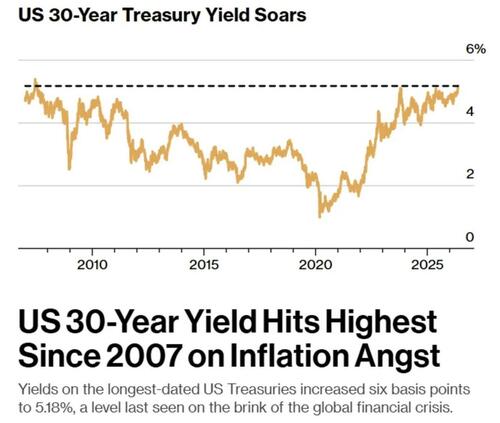
The U.S. Treasury market is flashing increasingly urgent warning signs that decades of escalating deficits, war-driven borrowing, and persistent inflation are pushing the federal government's fiscal position toward a breaking point. While legacy media focuses on geopolitical headlines from the ongoing Iran conflict, the bond market—often described as the ultimate arbiter of fiscal reality—is demanding higher yields that could soon constrain Washington's ability to fund both defense and domestic priorities.
As of mid-May 2026, the 10-year U.S. Treasury yield has climbed to around 4.6%, reaching one-year highs amid fears that the Iran war will deliver a lasting inflationary shock. This surge coincides with average G7 borrowing rates approaching 4%, up significantly since the conflict escalated in late February. Reuters reports that these moves threaten a severe hit to government spending power precisely when deficits are already structurally entrenched near $2 trillion annually in peacetime conditions.
The Committee for a Responsible Federal Budget (CRFB) has outlined what a full fiscal crisis might entail: a loss of investor confidence in Treasuries triggering spikes in interest rates, market panic, asset devaluation, and a potential interest-debt spiral. Their analysis warns that while markets have so far absorbed current debt levels, confidence can evaporate rapidly, especially with debt-to-GDP ratios climbing and interest costs already rivaling or exceeding major budget categories like national defense. CBO projections reinforce this, forecasting net interest payments as the fastest-growing budget item, potentially exceeding $1 trillion annually soon and crowding out other expenditures.
This stress connects to deeper, often overlooked debt-cycle dynamics. Goldman Sachs has noted that elevated budget deficits are driving up term premiums on longer-maturity Treasuries, weakening the dollar and pressuring equities as investors question long-term debt sustainability. The New York Times highlighted how recent tax legislation deepening deficits has caused the bond market to "shudder," with Federal Reserve officials openly calling for greater fiscal discipline from Washington. Al Jazeera has framed the Treasury sell-off as a more reliable predictor of crisis than stock market volatility, noting that sustained yield spikes raise borrowing costs across the economy and heighten default risks on over $36 trillion in debt.
Unlike the post-WWII era of rapid growth and low starting debt, today's backdrop features an aging population, high existing leverage, and foreign demand for U.S. debt that is waning. War financing adds fuel: borrowing to sustain conflict risks forcing monetary accommodation, perpetuating inflation in a self-reinforcing loop the original ZeroHedge analysis aptly described as "math getting ugly." Historical debt supercycles suggest such moments—when interest expenses consume 20%+ of revenues and bond vigilantes reassert control—often precipitate regime shifts, whether through austerity, currency debasement, or geopolitical retrenchment. Legacy outlets have underplayed these structural patterns in favor of short-term narratives, but the bond market does not negotiate with political timelines.
If yields continue their ascent without offsetting spending restraint or growth surprises, the result could shatter Washington's fiscal flexibility, forcing de-escalation in foreign conflicts and domestic program cuts alike. The Treasury market's message is clear: the current path of deficit spending is incompatible with long-term stability.
LIMINAL: Bond market pressure is likely to force Washington into de-escalation abroad and spending restraint at home, accelerating the end of the post-2008 debt expansion cycle in ways mainstream analysis continues to minimize.
Sources (6)
- [1]What Would a Fiscal Crisis Look Like?(https://www.crfb.org/papers/what-would-fiscal-crisis-look)
- [2]As bond yields surge, investors grow wary of a global inflationary shock from war in Iran(https://www.reuters.com/world/europe/global-bond-rout-deepens-inflation-fears-mount-2026-05-18/)
- [3]Bond Market Shudders as Tax Bill Deepens Deficit Worries(https://www.nytimes.com/2025/05/22/us/politics/bond-market-debt-deficit.html)
- [4]The Long-Term Budget Outlook: 2025 to 2055(https://www.cbo.gov/publication/61270)
- [5]How US Fiscal Concerns Are Affecting Bonds, Currencies, Stocks(https://www.goldmansachs.com/insights/articles/how-us-fiscal-concerns-are-affecting-bonds-currencies-stocks)
- [6]Why bonds, not stocks, could predict the next economic crisis in the US(https://www.aljazeera.com/economy/2025/4/15/why-bonds-not-stocks-could-predict-the-next-economic-crisis-in-the-us)