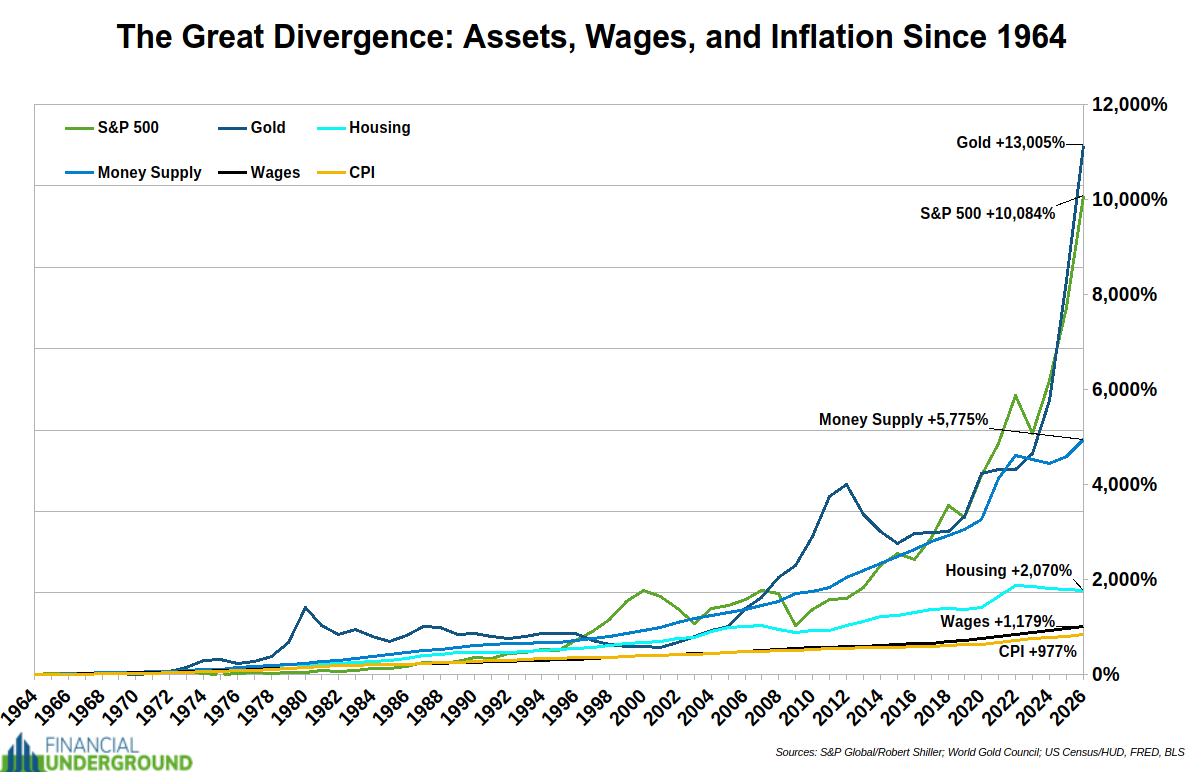
US M2 Expansion Since 1999 Reaches 427 Percent While BLS Median Wages Rise 140 Percent
Federal data confirm currency expansion has outrun wage growth by a factor of three since 1999, locking in a structural transfer to asset owners. Government borrowing requirements and central-bank operating procedures sustain the incentive. No reversal appears in current fiscal or monetary plans.
The documented shift traces to sustained Federal Reserve balance-sheet expansion after 2008 and 2020, with M2 rising from roughly 4.5 trillion to over 21 trillion dollars. Primary records, including FOMC transcripts and Treasury borrowing schedules, confirm the mechanism: deficit financing through debt monetization. Wage series from the Bureau of Labor Statistics fail to match this expansion once housing and equity components are removed from CPI weighting.
Government incentives favor continued debasement because it reduces real debt service costs and supports asset prices that collateralize bank balance sheets. Wage earners hold no comparable claim on those assets, producing the observed divergence. Historical inflection points in 1971 and 2008 show the same pattern: each episode ratcheted the money-supply growth rate higher without corresponding wage adjustment.
Forward indicators point to sustained pressure. Treasury issuance schedules through 2026 require net borrowing above 1.8 trillion dollars annually; absent offsetting fiscal contraction, M2 growth will remain above wage growth. Asset ownership therefore continues to determine relative position in the distribution of claims on real output.
Sources (3)
- [1]Primary Source(https://fred.stlouisfed.org/series/M2SL)
- [2]Supporting Source(https://www.bls.gov/cps/earnings.htm)
- [3]Supporting Source(https://home.treasury.gov/system/files/136/Debt-to-the-Penny-2024)