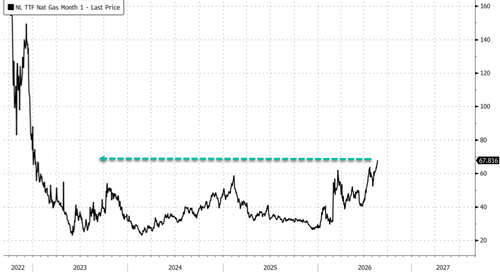
Goldman Warns of €100/MWh Gas Prices as Europe Faces Winter Storage Shortfall Amid Hormuz Disruptions
Goldman Sachs flags potential doubling of European gas prices to over €100/MWh by Dec 2026 due to Hormuz LNG disruptions and low storage; corroborated by Bloomberg and industry reports, highlighting geopolitical ripple effects on global energy.
Goldman Sachs commodities analyst Samantha Dart has highlighted the risk that European natural gas (TTF) prices could exceed €100 per megawatt-hour by December 2026 if LNG flows through the Strait of Hormuz recover only gradually, more than doubling her base-case forecast of around €50/MWh. This comes as EU storage levels sit at approximately 58-62%—well below the 15-year seasonal average of ~72%—with injection shortfalls widening due to constrained Qatari LNG exports and competition from Asian buyers.
The warning ties directly into a broader geopolitical energy shock stemming from the Iran conflict, which has disrupted roughly 20% of global LNG supply transiting the chokepoint. Bloomberg reports confirm Goldman’s March 2026 analysis projecting prices could surge 130% to ~$25/mmBtu even in a one-month halt scenario, with longer disruptions pushing TTF above €100/MWh and Asian JKM toward $35/mmBtu to induce demand destruction. Recent data from Energy Aspects and the Oxford Institute for Energy Studies show EU storage ~15 bcm below the five-year average as of mid-2026, with northwest European LNG imports missing targets and leaving inventories critically thin ahead of winter.
Beyond immediate price spikes, this exposes systemic vulnerabilities: low storage amplifies reliance on volatile LNG markets, potentially cascading into diesel shortages and higher power costs across Europe. Connections to global markets include reduced Qatari loadings forcing Europe-Asia bidding wars, while a new US-supervised shipping corridor off Oman has seen surging transits—suggesting Tehran’s leverage may be eroding but not eliminating risks. Goldman notes low conviction in demand response at these historic highs, echoing the 2022 crisis. These dynamics underscore how Middle East instability can tighten global energy supplies, pressuring economies through inflation and supply-chain strains well into 2027.
Goldman Sachs: Prolonged Hormuz constraints could force Europe into aggressive LNG competition, driving price discovery that tests demand elasticity and exposes storage shortfalls as a persistent global energy risk factor.
Sources (5)
- [1]Goldman Says Europe May Need €100 Gas to Build Winter Inventory(https://www.bloomberg.com/news/articles/2026-08-24/goldman-says-europe-may-need-100-gas-to-build-winter-inventory)
- [2]The Risks to Energy Prices From Iran - Goldman Sachs Research(https://www.gspublishing.com/content/research/en/reports/2026/03/01/f7158465-390f-485e-af6d-ae5c390b240a.html)
- [3]Goldman Sachs hikes European gas price forecast on Hormuz disruption(https://www.hellenicshippingnews.com/goldman-sachs-hikes-european-gas-price-forecast-on-hormuz-disruption/)
- [4]Europe's Winter Fuel Buffer Is Starting to Look Uncomfortably Thin(https://www.investing.com/analysis/europes-winter-fuel-buffer-is-starting-to-look-uncomfortably-thin-200685409)
- [5]Europe gas storage shortfall and TTF price outlook - Energy Aspects(https://www.energyaspects.com/resources/insights/europe-gas-storage-ttf-outlook-summer-2026)