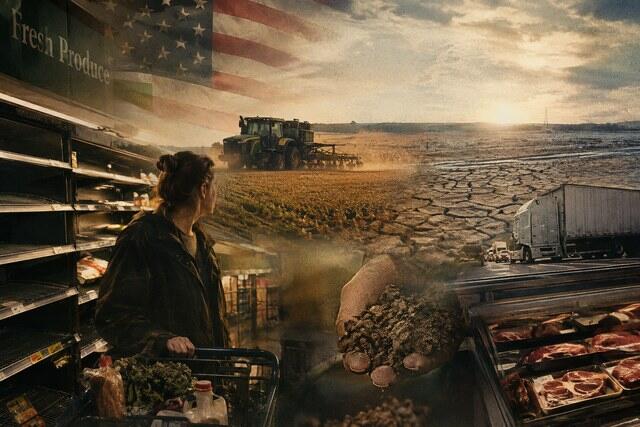
US Food System's Just-in-Time Model and Structural Pressures Reveal Growing Fragility
Credible evidence from USDA reports, peer-reviewed studies in Nature and Frontiers, and ERS analyses corroborates key vulnerabilities in US food logistics, farming demographics, water resources, and processing concentration, supporting analysis of systemic fragility without predicting collapse.
The US food supply operates on highly efficient just-in-time logistics with minimal inventory buffers, a design that keeps costs low but leaves little room for disruption. Academic analyses identify structural chokepoints in transportation and processing networks that concentrate flows through key hubs like Los Angeles and Chicago, making the system vulnerable to compound shocks from weather, labor issues, or port delays.[1][2]
Demographic trends add pressure: USDA data shows the average age of farm producers rising to 58.1 years by 2022, with the sector representing the nation's oldest workforce.[3][4] Environmental constraints are evident in the High Plains, where Ogallala Aquifer depletion has been shown to nonlinearly increase drought-related losses in corn and soybean yields, forcing adaptations like reduced irrigated acreage.[5][6]
Industry concentration compounds risks, with the four largest beef packers handling approximately 85% of steer and heifer slaughter, a level stable since the 1990s and linked to reduced redundancy.[7][8] Recent studies and reports from USDA and academic sources highlight ongoing efforts to bolster resilience through diversified markets and infrastructure, acknowledging that efficiency has traded off against shock absorption capacity.[9]
These documented trends align with the source's distinction between measurable facts (aging demographics, aquifer drawdown, packer concentration, logistics design) and interpretive scenarios of gradual erosion of buffers. No evidence supports imminent collapse, but the system shows reduced tolerance for overlapping stressors.
Liminal: Layered stresses on US agri-food networks may manifest as higher prices, reduced variety, and localized shortages during shocks, rather than overt scarcity, eroding the unnoticed reliability of the system over time.
Sources (6)
- [1]Structural chokepoints determine the resilience of agri-food supply chains in the United States(https://www.nature.com/articles/s43016-023-00793-y)
- [2]America's Farms and Ranches at a Glance: 2025 Edition(http://www.ers.usda.gov/publications/113786)
- [3]Aquifer depletion exacerbates agricultural drought losses in the US High Plains(https://www.nature.com/articles/s44221-023-00173-7)
- [4]Concentration in U.S. Meatpacking Industry and How It Affects Competition and Cattle Prices(https://www.ers.usda.gov/amber-waves/2024/january/concentration-in-u-s-meatpacking-industry-and-how-it-affects-competition-and-cattle-prices)
- [5]Transforming American’s Food System to Withstand Crises(https://www.usda.gov/about-usda/general-information/priorities/more-better-and-new-market-opportunities/transforming-americans-food-system-withstand-crises)
- [6]Tracking U.S. Food Supply Chains Through Recent Shocks– Part 1(https://farmdocdaily.illinois.edu/2026/07/tracking-us-food-supply-chains-through-recent-shocks-part-1.html)