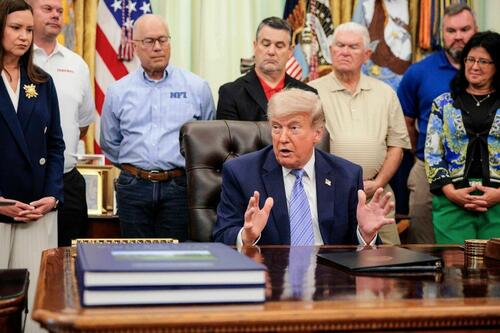
Trump's AI Cyber Defense Order Signals Underplayed Shift in Emerging Tech Governance
Trump's June 2, 2026 executive order creates voluntary pre-release government review for frontier AI models, an AI cybersecurity clearinghouse for vulnerability patching, and mandates accelerated federal cyber defenses—representing a concrete if underreported policy shift toward integrated AI-national security governance with significant long-term implications.
President Donald Trump signed an executive order on June 2, 2026, titled 'Promoting Advanced Artificial Intelligence Innovation and Security,' establishing a voluntary framework for AI companies to submit frontier models for federal review up to 30 days before public release. The order directs the Pentagon, Department of Homeland Security, Cybersecurity and Infrastructure Security Agency (CISA), and other agencies to prioritize cyber defense of federal systems using AI-enabled tools and establishes an 'AI cybersecurity clearinghouse' for voluntary collaboration with industry to identify, validate, and patch vulnerabilities in advanced models.[1][2]
This represents a notable policy evolution from earlier Trump administration skepticism toward heavy AI regulation. Initial drafts reportedly considered longer 90-day review periods and faced last-minute industry lobbying, leading to a postponement in May before the scaled-back version was signed privately. It builds on Commerce Department partnerships with Google, Microsoft, and xAI for pre-release testing and follows concerns over models like Anthropic's Claude Mythos Preview, which heightened fears of AI discovering critical software exploits. The administration had previously restricted Anthropic's federal dealings over access disputes, yet talks continued.[3][4]
Mainstream coverage often frames the order as largely voluntary and industry-accommodating, potentially underplaying its role as a foundational shift in embedding national security reviews into the AI development lifecycle. By creating structured channels for government access—subject to confidentiality and IP protections—it sets precedents for future mandatory frameworks, as urged by groups like the Alliance for Secure AI. The clearinghouse aims to operationalize AI's dual-use nature: harnessing frontier models to scan for vulnerabilities while mitigating the risks they themselves pose to critical infrastructure.[5][6]
Deeper connections reveal this as more than incremental cybersecurity policy. It intersects with ongoing debates over AI's capacity to automate offensive cyber operations, zero-day discovery, and infrastructure attacks—risks amplified by rapid model scaling. By tasking agencies with benchmarks for AI cyber capabilities and expedited defensive tooling, the order implicitly acknowledges that voluntary industry self-governance may prove insufficient against adversarial nation-states or non-state actors leveraging these tools. Long-term implications include accelerated federal AI adoption for defense, potential standardization of pre-deployment evaluations, and a rebalancing of innovation speed versus security in emerging tech governance. While not codifying mandatory oversight today, it creates infrastructure that Congress could build upon, marking a pragmatic national security pivot that could influence global AI norms.[7]
Liminal: This order quietly establishes the scaffolding for mandatory AI oversight in national security contexts, shifting from pure deregulation toward structured collaboration that could harden defenses against AI-augmented cyber threats while influencing how Big Tech develops future frontier systems.
Sources (5)
- [1]Promoting Advanced Artificial Intelligence Innovation and Security(https://www.whitehouse.gov/presidential-actions/2026/06/promoting-advanced-artificial-intelligence-innovation-and-security/)
- [2]Trump signs an executive order to vet top AI models for security risks(https://apnews.com/article/trump-ai-executive-order-e41af74f7b0865482f07d10fe7a50fe3)
- [3]Trump signs EO seeking early government access to powerful AI models(https://www.cybersecuritydive.com/news/trump-ai-security-executive-order/821755/)
- [4]Trump Signs Previously Shelved AI Executive Order(https://www.techpolicy.press/trump-signs-previously-shelved-ai-executive-order/)
- [5]Trump's new AI safety order seeks voluntary review of frontier models(https://www.npr.org/2026/06/02/nx-s1-5844347/ai-safety-trump-executive-order)