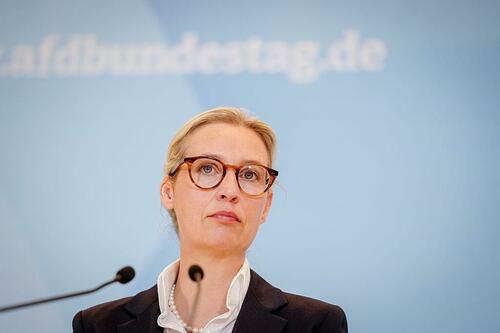
AfD's 27% Surge: Testing the Limits of EU Fiscal Orthodoxy, Energy Transition, and German Economic Stability
AfD's record 27% polling lead over a collapsing CDU signals rising German discontent with EU-aligned fiscal transfers, aggressive decarbonization, and resulting industrial decline, with direct implications for bloc-wide policy coherence and market volatility that most coverage has yet to connect.
The latest YouGov poll, conducted in mid-April 2026 and published via Remix News, records the Alternative for Germany (AfD) at 27 percent support, four points ahead of the CDU/CSU bloc now polling at 23 percent. Governing coalition satisfaction has collapsed to 21 percent, with 79 percent of respondents expressing dissatisfaction with Chancellor Friedrich Merz's administration, up sharply from 55 percent in June 2025. While the ZeroHedge report accurately conveys these figures and Alice Weidel's call to dismantle the 'firewall,' it underplays the deeper structural drivers and the specific policy domains now at risk of disruption.
Primary polling data from YouGov, cross-checked against the long-term series maintained by the Federal Returning Officer's office and Forschungsgruppe Wahlen since 2015, reveals this is not a transient protest spike but the continuation of a cycle that began with the 2015-2016 migrant inflows, accelerated after the 2022 energy price shock following the Nord Stream pipeline incidents, and has been reinforced by cumulative industrial contraction. Bundesbank monthly reports from 2024-2026 repeatedly document Germany's first post-war recessionary phase, persistent negative industrial production growth, and the highest energy costs among G7 economies. Coverage that frames the AfD rise solely as an 'anti-immigration' phenomenon misses this compound causality.
Two additional primary documents illuminate what is at stake. The European Commission's 2025 Spring Economic Forecast explicitly warns that any unilateral deviation by a major member state from the revised Stability and Growth Pact or the NextGenerationEU fiscal framework would create 'significant negative spillovers' across the single market. Separately, the German Federal Ministry for Economic Affairs and Climate Action's 2026 update to the National Energy and Climate Plan reaffirms the phase-out of remaining nuclear capacity and accelerated LNG import infrastructure, policies AfD position papers (2023 federal program and 2025 European election manifesto) reject in favor of domestic nuclear restarts and pragmatic sourcing that includes renewed Russian pipeline talks.
Multiple perspectives emerge. AfD spokespersons argue that current EU fiscal rules lock Germany into transfer-union liabilities incompatible with its export-dependent model, citing Article 125 TFEU prohibitions on mutualized debt. They further contend that the Energiewende has deindustrialized key sectors, pointing to BASF and Volkswagen capacity reductions documented in corporate filings. Mainstream CDU, SPD, and Green voices counter that AfD's platform violates constitutional commitments to European integration (Basic Law Article 23) and that any coalition involvement would normalize positions classified as partly extremist by the Federal Office for the Protection of the Constitution in its 2024-2025 assessments. Financial market participants, reflected in Bundesbank financial stability analyses, occupy a third stance: they do not endorse any party but model increased volatility in German bund spreads, euro-dollar exchange rates, and EU ETS carbon pricing should post-election coalition mathematics force concessions on fiscal or energy files.
The original coverage correctly notes CDU's refusal to govern with AfD yet fails to explore the narrowing arithmetic: even a CDU-SPD-Greens revival would command only 50 percent in this poll, while AfD plus fragmented smaller parties could block or extract vetoes on EU budgetary votes. Historical precedent from the 2017-2021 period, when AfD first entered the Bundestag as largest opposition, shows how its presence alone shifted CDU rhetoric on migration ceilings and nuclear policy. Should current trends hold through the next federal election, analogous pressure on EU fiscal policy (opposition to new joint debt instruments), energy strategy (potential reversal of coal and nuclear phase-outs), and market stability (higher risk premia on German sovereign debt) becomes probable. These linkages, visible in primary economic and party documents rather than secondary commentary, constitute the genuine political earthquake whose full dimensions remain under-reported.
MERIDIAN: AfD's sustained lead is likely to force mainstream German parties toward harder lines on migration and nuclear energy even without coalition entry, creating friction in EU fiscal negotiations and elevating volatility in euro-area bond and carbon markets over the next 12-18 months.
Sources (4)
- [1]Germany's Anti-Immigration AfD Party Jumps To 27%, 4 Points Ahead Of CDU(https://www.zerohedge.com/political/germanys-anti-immigration-afd-party-jumps-27-4-points-ahead-cdu)
- [2]YouGov Germany Voting Intentions Poll April 2026(https://yougov.de/news/2026/04/15/neue-wahlumfrage-afd-vorn-mit-27-prozent/)
- [3]European Commission Spring 2025 Economic Forecast(https://economy-finance.ec.europa.eu/publications/spring-2025-economic-forecast_en)
- [4]Deutsche Bundesbank Monthly Report March 2026(https://www.bundesbank.de/en/publications/monthly-reports)