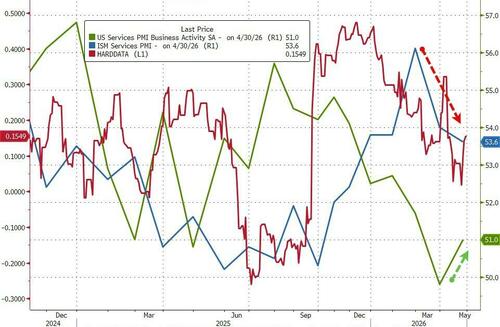
US Services Surveys Signal Stagflation Risks, Exposing Broader Economic Fragility and Policy Dilemmas
April's disappointing US services surveys (S&P Global PMI at 51.0, ISM PMI at 53.6) signal stagflation risks with slowing growth and rising prices. Beyond geopolitical factors, domestic policy uncertainty and historical parallels to the 1970s highlight deeper economic fragility and Federal Reserve dilemmas.
The disappointing US services sector surveys for April, as reported by S&P Global and the Institute for Supply Management (ISM), paint a troubling picture of an economy grappling with stagflationary pressures—slowing growth paired with persistent inflation. S&P Global's Services PMI fell to a final reading of 51.0, indicating marginal expansion, while ISM Services PMI dropped to 53.6, below expectations, driven by a sharp decline in new orders and sustained high prices. Beyond these headline numbers, the data reveal deeper structural weaknesses that could reshape Federal Reserve policy and investor sentiment in the coming months.
A closer examination of the surveys uncovers a dual challenge: demand is faltering across consumer-facing and financial services, while input costs and wages continue to drive inflationary pressures. S&P Global's Chris Williamson noted a direct link between weakened demand and geopolitical tensions, particularly the war in the Middle East, which has spiked fuel costs and disrupted travel and transport sectors. However, this analysis misses a critical domestic dimension—rising uncertainty over monetary policy itself is likely exacerbating the drop in financial services demand, as businesses and consumers brace for prolonged high interest rates amid sticky inflation.
Contextualizing these findings against recent economic patterns, the services sector's slowdown aligns with broader indicators of cooling economic momentum. The US GDP growth rate for Q1 2023 was a tepid 1.6% annualized, per the Bureau of Economic Analysis, far below the 2.5% expected, signaling that the economy may already be on a weaker footing than previously assumed. This underperformance, coupled with the services sector's role as a dominant driver of US economic activity (accounting for roughly 70% of GDP), suggests that the current stagflationary signals could herald a more pronounced downturn if not addressed. The original coverage by ZeroHedge, while highlighting the 'stench of stagflation,' overlooks this interplay between domestic policy uncertainty and external shocks, focusing narrowly on geopolitical factors.
Moreover, the persistent rise in input costs and wages, as flagged in the surveys, challenges the Federal Reserve's delicate balancing act. The Fed's latest minutes from the March 2023 FOMC meeting reveal growing concern among policymakers about inflation remaining above the 2% target, with some members open to further rate hikes if price pressures do not abate. Yet, with employment in the services sector contracting for the second consecutive month, per ISM data, tightening monetary policy risks stifling growth further—potentially deepening stagflationary conditions. This policy dilemma is a critical omission in the original reporting, which does not connect the survey results to the Fed's ongoing internal debates or the potential for missteps in response to mixed economic signals.
Drawing on historical patterns, the current environment echoes elements of the 1970s stagflation crisis, where high oil prices and wage-price spirals confounded policymakers. While today's geopolitical drivers differ, the combination of supply-side shocks and weakening demand could similarly entrench inflation even as growth stalls. This historical parallel suggests that markets may be underpricing the risk of a prolonged stagflationary episode, a perspective absent from the initial coverage.
In conclusion, the April services surveys are not merely a snapshot of sectoral weakness but a warning of systemic economic fragility. They underscore the urgent need for policymakers to navigate between curbing inflation and supporting growth, while investors must recalibrate expectations for a potentially rockier economic path ahead. The interplay of domestic policy uncertainty, geopolitical disruptions, and historical stagflationary risks paints a more complex picture than the original reporting suggests, demanding a broader lens to fully grasp the implications.
MERIDIAN: The Federal Reserve may face increasing pressure to maintain or raise interest rates to combat persistent inflation, but this risks further slowing growth, potentially locking the US economy into a stagflationary cycle through late 2023.
Sources (3)
- [1]US Services Surveys Disappoint In April Amid Stench Of Stagflation(https://www.zerohedge.com/economics/us-services-surveys-disappoint-april-amid-stench-stagflation)
- [2]Federal Reserve FOMC Meeting Minutes, March 2023(https://www.federalreserve.gov/monetarypolicy/fomcminutes20230322.htm)
- [3]Bureau of Economic Analysis - US GDP Q1 2023 Report(https://www.bea.gov/news/2023/gross-domestic-product-first-quarter-2023-advance-estimate)