Meta's $13 Billion Texas Data Center SPV: AI Infrastructure Boom Meets Rising Credit Risks
Meta's $13 billion SPV for a Texas data center underscores Big Tech's AI infrastructure push amid rising credit risks, with record-high CDS levels signaling investor unease. Beyond financing, geopolitical stakes, regional vulnerabilities, and systemic debt risks highlight unaddressed challenges in the tech sector's expansion.
Meta's latest move to raise $13 billion through a special purpose vehicle (SPV) for a data center in El Paso, Texas, named 'Sopaipilla,' reflects the accelerating race among Big Tech firms to build AI infrastructure amid a volatile financial landscape. This follows a similar $27.3 billion SPV, 'Project Beignet,' for a Louisiana data center in 2025, highlighting Meta's reliance on off-balance-sheet debt to fund capital-intensive projects without directly impacting its financial statements. While the original coverage by ZeroHedge focuses on the scale of the financing and Meta's record-high Credit Default Swaps (CDS), it misses broader geopolitical and economic implications, as well as the systemic risks tied to the tech sector's debt-fueled expansion.
First, the geopolitical angle: Data centers like Sopaipilla, expected to be operational by 2028, are not just infrastructure but strategic assets in the global AI race. The U.S. government's push for technological sovereignty, evidenced by policies like the CHIPS Act of 2022, incentivizes domestic semiconductor and data infrastructure growth to counter China's advancements in AI and computing power. Meta's choice of Texas, a state with favorable energy policies and proximity to renewable energy sources, aligns with national priorities for energy-efficient, scalable tech hubs. However, this concentration of critical infrastructure in the U.S. Southwest raises unaddressed risks of regional over-reliance and potential vulnerabilities to climate-related disruptions, such as water scarcity or extreme heat, which are not mentioned in the original reporting.
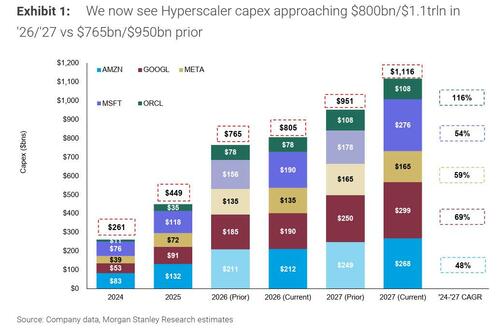
Second, the financial context: Meta's escalating use of SPVs, facilitated by major banks like Morgan Stanley and JPMorgan, underscores a broader trend in the tech sector. The AI infrastructure boom, projected to reach $1.1 trillion in capex by 2027, is increasingly debt-driven, as noted in the original article. But what ZeroHedge overlooks is the parallel rise in investor skepticism, reflected in Meta's CDS hitting record levels. According to Bloomberg data, the cost to insure Meta's debt against default has spiked, signaling market concerns over whether these massive AI investments will yield returns. This mirrors patterns seen in the dot-com bubble, where over-leveraged tech firms collapsed under unprofitable capex. Unlike Project Beignet, where PIMCO anchored the debt, Sopaipilla lacks a clear anchor lender, forcing syndication to a fatigued investor base—a detail hinting at potential liquidity risks not fully explored in the source.
Third, the systemic risk: The tech sector's debt bubble, now surpassing banking as the largest sector in high-yield markets with over $20 billion in bonds and loans issued recently, poses a broader threat to financial stability. This connects to a 2023 Federal Reserve report warning of rising corporate debt levels in non-financial sectors, particularly tech, as a potential trigger for systemic stress in a high-interest-rate environment. Meta's strategy of using SPVs to keep debt off-balance-sheet may obscure true leverage levels, a tactic reminiscent of pre-2008 financial engineering that amplified the mortgage crisis. The original article flags investor fatigue but fails to connect this to regulatory gaps—neither the SEC nor international bodies have clear frameworks for monitoring SPV-related risks in tech infrastructure financing.
Synthesizing these perspectives, Meta's Sopaipilla project is both a microcosm of Big Tech's AI ambitions and a warning sign of overextension. While the U.S. gains strategic ground through domestic data centers, the financial mechanisms underpinning this growth—off-balance-sheet debt, SPVs, and syndicated loans—echo historical patterns of speculative bubbles. The lack of regulatory oversight and the regional concentration of infrastructure add layers of risk that neither Meta nor market analysts have fully accounted for. As AI capex surges, the question remains whether these investments will drive innovation or destabilize markets through unchecked leverage.
MERIDIAN: Meta's reliance on SPVs for AI infrastructure may face increasing scrutiny as debt levels rise, potentially triggering tighter regulatory oversight or market corrections if AI returns falter.
Sources (3)
- [1]Meta Raising $13 Billion SPV For Texas Data Center As Its CDS Hits Record(https://www.zerohedge.com/markets/meta-raising-13-billion-spv-texas-data-center-its-cds-hits-record)
- [2]Federal Reserve Financial Stability Report, November 2023(https://www.federalreserve.gov/publications/files/financial-stability-report-20231117.pdf)
- [3]Bloomberg: Meta Plans $13 Billion Financing for Texas Data Center(https://www.bloomberg.com/news/articles/2026-01-30/meta-plans-13-billion-financing-for-texas-data-center)