From 'Don't Be Evil' to AI Kill Chains: Eric Schmidt's Project Eagle and the Corporate Capture of Lethal Autonomy
Eric Schmidt's Project Eagle has deployed AI interceptor drones like Merops with U.S. troops in Europe and the Middle East after combat testing in Ukraine. This evolution from Google's 'Don't Be Evil' ethos exposes the merger of surveillance capitalism with autonomous warfare, where Silicon Valley data practices now optimize lethal targeting while evading deeper ethical scrutiny over AI kill chains and tech oligarch influence.
Eight years after Google formally retired its 'Don't Be Evil' motto, former CEO Eric Schmidt has emerged as a central figure in the rapid proliferation of AI-enabled drone warfare. What was once framed as a principled stand against unethical applications of technology has given way to a network of ventures turning Ukraine's battlefields into laboratories for autonomous intercept systems now protecting U.S. troops.
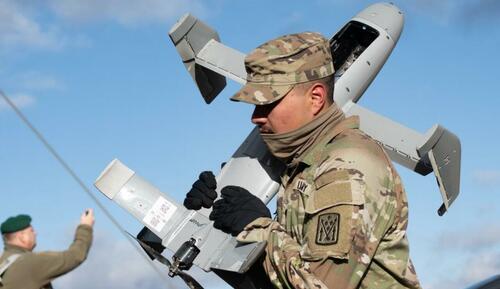
At the center is Project Eagle, Schmidt's initiative that evolved from 'White Stork' after his 2022 meetings with Ukrainian officials. Operating through companies including Swift Beat, Aurelian Industries, and Volya Robotics, it developed the Merops AS-3 Surveyor - a low-cost, AI-guided interceptor drone capable of countering Shahed-type threats. Each unit costs around $15,000, with expectations of sub-$10,000 pricing at scale - a fraction of traditional missile interceptors. By late 2025, Ukrainian forces credited it with over 1,000 intercepts. In 2026, the U.S. Army rapidly deployed thousands to the Middle East within days of Iranian drone attacks and positioned systems with troops in Germany. Army Secretary Daniel Driscoll highlighted the cost advantage in congressional testimony: procuring 13,000 units quickly to achieve dominance on 'the right end of the cost curve.'[1][1]
This is not mere defense contracting. It represents the deep fusion of Silicon Valley's surveillance capitalism with modern warfare. The same data-extraction logics that powered Google's advertising empire - harvesting signals, optimizing algorithms, iterating on user (or target) behavior - are now applied to lethal autonomous systems. Engineers recruited from Google, Apple, and SpaceX are building AI that learns from real-world kills in Ukraine, creating feedback loops where battlefield data refines commercial and military AI alike. Schmidt, who previously chaired the National Security Commission on Artificial Intelligence and advised the Pentagon, embodies the revolving door between Big Tech and the military-industrial complex. His Financial Times comments reveal the vision: 'Future wars are going to be defined by unmanned weapons. The winner of those drone battles will then be able to advance with unmanned ground and maritime vehicles.'[2]
Connections missed by mainstream coverage abound. Ukraine has served as an unparalleled testing ground for Western 'war unicorns,' accelerating technologies that evade traditional arms control debates around lethal autonomous weapons systems (LAWS). By framing these as 'defensive interceptors' against Shahed drones, ethical questions about AI targeting decisions, accountability chains, and proliferation risks are sidelined. This fits a broader pattern: surveillance capitalism mutating into 'targeting capitalism,' where perpetual data collection justifies endless conflict preparation. The low price point democratizes drone swarms not for peace, but for a future where tech oligarchs supply both the threats and the countermeasures, profiting from the escalation ladder. Deployments to CENTCOM, NATO's eastern flank in Poland and Romania, and rapid scaling under the current administration signal a permanent shift toward a drone-centric war economy.
The retirement of 'Don't Be Evil' was not an accident but a prerequisite. As Schmidt's ventures recruit from the very firms once hesitant about military AI (recall Google's Project Maven exodus), the fusion reveals how heterodox critiques of technocratic power were correct: when profit aligns with state violence, ethical guardrails dissolve into national security imperatives. What emerges is a privatized AI arms race where former search engine executives determine the future of human conflict - one increasingly detached from human oversight.
LIMINAL: Schmidt's drone empire foreshadows a future where ex-tech executives command autonomous weapons markets, turning surveillance capitalism's data hunger into perpetual, low-cost conflict that erodes human moral accountability in warfare while concentrating power among unaccountable billionaires.
Sources (5)
- [1]Eric Schmidt's drone killer is now protecting U.S. troops in Germany(https://defence-blog.com/eric-schmidts-drone-killer-is-now-protecting-u-s-troops-in-germany/)
- [2]Ukraine’s no man’s land is the future of war(https://www.ft.com/content/9c7542d4-1b2b-4062-b53d-bb02b5f12851)
- [3]Pentagon Deploys Merops Drone Interceptor System to Counter Iranian Shahed Threat(https://insideunmannedsystems.com/pentagon-deploys-merops-drone-interceptor-system-to-counter-iranian-shahed-threat/)
- [4]US sends 10000 Ukraine-tested interceptor drones to Middle East(https://www.pravda.com.ua/eng/news/2026/03/13/8025437/)
- [5]How U.S. Army Secretary Driscoll Is Forging A New Business Model(https://www.forbes.com/sites/zitaballingerfletcher/2026/02/25/how-us-army-secretary-driscoll-is-forging-a-new-business-model/)