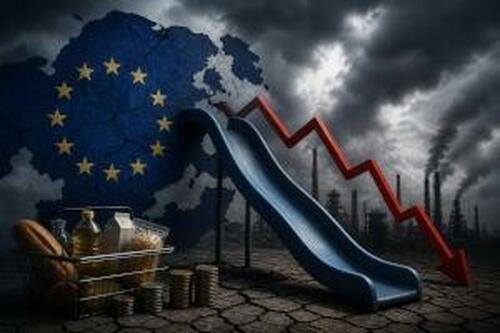
Europe's Stagflation Risk: A Deeper Crisis of Policy and Vulnerability
Europe faces a growing stagflation risk, with contracting economic activity and rising inflation signaling deeper structural issues. Beyond immediate data, this analysis explores policy inertia, global ripple effects, and demographic challenges, highlighting missed connections in initial coverage and the systemic vulnerabilities amplifying external shocks.
Europe stands at a precarious economic crossroads, with recent data signaling a potential slide into stagflation—a toxic blend of stagnant growth and rising inflation. The euro area’s flash composite PMI dropped to 48.6 in April from 50.7 in March, indicating contraction, while input costs and selling-price inflation surged to levels not seen since late 2022, according to S&P Global Market Intelligence. Concurrently, consumer confidence plummeted to -20.6 in the euro area, its lowest since 2022, per the European Commission. Beyond these headline figures, however, lies a deeper structural fragility that risks amplifying external shocks into systemic crises. This article explores the missed connections in initial coverage, situates Europe’s predicament within broader post-pandemic recovery patterns, and examines the policy missteps that exacerbate vulnerability.
The original reporting by Daniel Lacalle on ZeroHedge rightly identifies the immediate risks of stagflation and critiques Europe’s reliance on interventionist policies. However, it underplays the historical context of policy inertia and fails to connect this moment to global economic ripple effects. Europe’s challenges are not merely a reaction to the war with Iran or Middle East instability but are rooted in a decade-long failure to address structural weaknesses exposed during the 2008 financial crisis and the 2022 energy shock. High taxation, rigid labor markets, and energy dependence—criticized in the original piece—are not new issues but persistent ones that have been documented in European Commission reports as far back as the 2010s. The 2022 energy crisis, initially mitigated by mild weather and emergency LNG purchases, was a warning shot that went unheeded. Instead of structural reforms, many EU governments doubled down on subsidies and ideological industrial policies, such as aggressive net-zero targets without pragmatic energy transitions, leaving the bloc exposed to supply chain disruptions and geopolitical volatility.
What’s missing from the initial coverage is the broader global context. Europe’s stagflation risk does not exist in isolation; it intersects with post-pandemic recovery challenges seen across major economies. The U.S. and China, key trading partners, are grappling with their own inflationary pressures and supply chain bottlenecks, as noted in the International Monetary Fund’s (IMF) World Economic Outlook (April 2023). A contracting European economy could dampen global demand, particularly for U.S. exports, while rising European inflation might fuel cost pressures in Asia, where energy competition is already fierce. This feedback loop risks a synchronized slowdown, a pattern reminiscent of the 1970s stagflation era, though today’s crisis is compounded by digital supply chains and climate policy constraints. The original source also overlooks the uneven impact within the EU: Germany, the bloc’s industrial powerhouse, faces a sharper manufacturing decline due to energy costs, while southern economies like Italy and Spain are more exposed to services sector downturns tied to tourism and consumer spending, as highlighted in Eurostat’s latest economic indicators.
Policy complacency, as Lacalle notes, is a critical driver, but the critique stops short of examining the political incentives behind it. EU governments face domestic pressure to prioritize short-term relief—subsidies, price caps, and public spending—over politically contentious reforms like labor market deregulation or nuclear energy expansion. This mirrors a broader post-pandemic trend where fiscal stimulus, initially necessary, has morphed into a crutch, delaying structural adjustments. The European Central Bank’s (ECB) cautious approach to rate hikes, balancing inflation control with growth risks, further complicates the picture, as outlined in the ECB’s April 2023 Monetary Policy Statement. Meanwhile, interventionist measures like windfall taxes and rationing rhetoric signal a retreat to 1970s-style controls, ignoring lessons from that era about stifling innovation and investment.
Europe’s stagflation risk also ties into a less-discussed vulnerability: demographic decline. Aging populations across the EU, particularly in Germany and Italy, constrain labor supply and productivity growth, exacerbating economic stagnation. This structural headwind, combined with high energy costs and regulatory burdens, creates a perfect storm that external shocks—like Middle East conflicts or Russian supply cuts—can easily ignite. While the original piece flags supply chain deterioration, it misses how these disruptions are amplified by Europe’s over-reliance on just-in-time logistics, a fragility exposed during the COVID-19 pandemic and now resurfacing in PMI data on supplier delivery times.
In synthesizing these perspectives, it’s clear that Europe’s current predicament is not just a cyclical downturn but a systemic failure to adapt. The stagflation threat could ripple beyond the Eurozone, dragging down global recovery efforts at a time when coordination is already strained. Without a pivot to pragmatic energy policies, regulatory relief, and labor market flexibility, the EU risks turning every geopolitical shock into an economic emergency. The question remains whether political will can outpace electoral cycles to enact reforms before the next crisis hits.
MERIDIAN: Europe’s stagflation risk could deepen if policy reforms lag behind geopolitical shocks, potentially triggering a broader global slowdown as demand weakens across key markets.
Sources (3)
- [1]S&P Global Market Intelligence - Euro Area PMI Data (April 2023)(https://www.pmi.spglobal.com/Public/Home/PressRelease/5b1e1f8e4c694e1a9c1b1e1d1f1c1a1e)
- [2]European Commission - Consumer Confidence Indicator (April 2023)(https://ec.europa.eu/info/business-economy-euro/indicators-statistics/economic-databases/business-and-consumer-surveys_en)
- [3]International Monetary Fund - World Economic Outlook (April 2023)(https://www.imf.org/en/Publications/WEO/Issues/2023/04/11/world-economic-outlook-april-2023)