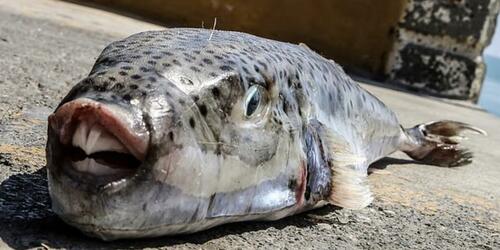
Invasive Silver-Cheeked Toadfish Expands Across Mediterranean, Prompting Beach Barriers, Bounties, and Tourist Warnings
Corroborated reports confirm the spread of toxic invasive pufferfish in the Mediterranean, driving targeted interventions like bounties and barriers amid documented fishery damage and bite risks for beachgoers.
The silver-cheeked toadfish (Lagocephalus sceleratus), a toxic invasive species native to the Indian and Pacific Oceans, has rapidly colonized the eastern Mediterranean via the Suez Canal, aided by warming sea temperatures. Scientific literature documents its establishment in Greek waters since at least 2005, with subsequent spread to Cyprus, Turkey, Italy, and beyond, including recent northern Adriatic records.[1][2]
The fish carries tetrodotoxin, rendering it lethal if consumed, while its powerful beak-like teeth enable it to sever fishing nets, destroy catches, and inflict serious wounds on humans. Greek authorities have issued public warnings urging immediate medical attention for bites, following incidents such as an elderly woman requiring stitches near Athens.[3][4]
To mitigate impacts on tourism and fisheries, Greece has deployed floating protective barriers—originally for jellyfish—at beaches including off Evia, with expansions planned. Cyprus implemented a bounty program in 2024 that has removed over 103 tons of the species, while Greece launched payments of €5.33 per kilogram in June 2026, alongside fuel subsidies under EU-supported efforts.[5][6]
Peer-reviewed studies highlight the species' ecological and economic harms, including biodiversity disruption and fishery losses, with ongoing research into invasion forecasting and management. While some advocate control over eradication, officials emphasize caution for swimmers and divers in affected coastal areas popular with tourists.[7]
[Liminal Analyst]: Widespread adoption of barriers and bounties signals escalating management costs that could subtly deter Mediterranean tourism bookings for 2026-2027 peak season unless public awareness campaigns prove highly effective.
Sources (6)
- [1]The Guardian(https://www.theguardian.com/world/2026/jul/06/greece-floating-barrier-pufferfish-warming-waters)
- [2]Ynetnews(https://www.ynetnews.com/environment/article/sytxutrgfl)
- [3]Ekathimerini(https://www.ekathimerini.com/economy/1307893/cash-bounty-on-toxic-toadfish-comes-into-effect/)
- [4]Greek Reporter(https://greekreporter.com/2026/06/23/greece-plans-paid-fishing-program-to-tackle-invasive-pufferfish/)
- [5]NeoBiota (scientific paper)(https://neobiota.pensoft.net/article/71767/)
- [6]Wikipedia (with references to primary records)(https://en.wikipedia.org/wiki/Lagocephalus_sceleratus)