AI Data Center Financing Echoes Fannie Mae Risks as Private Credit Fills Trillions in Gaps
Corroborated reporting shows AI infrastructure debt mirroring historical systemic risks, with Karp's nationalization comments, Morgan Stanley's capex projections, and Meta's off-balance-sheet Hyperion deal providing factual anchors for private credit exposure and potential sovereign backstops.
Palantir CEO Alex Karp has publicly argued that frontier AI labs face liabilities too vast for public markets, suggesting nationalization as the only viable path to manage 'unlimited risks' and potential lawsuits. In September 2026 CNBC interviews, Karp stated that labs like Anthropic may seek government intervention precisely to shield against client litigation over IP and harms, framing safety debates as liability maneuvers rather than pure regulation.[1][2]
This liability logic extends downstream to the physical infrastructure. Morgan Stanley forecasts $2.9 trillion in global data center capex through 2028, split between $1.6 trillion in chips/servers and $1.3 trillion in buildings, with hyperscalers self-funding only ~$1.4 trillion via cash flows. This leaves a $1.5 trillion external financing gap, with private credit expected to supply roughly $800 billion through asset-specific structures.[3][4]
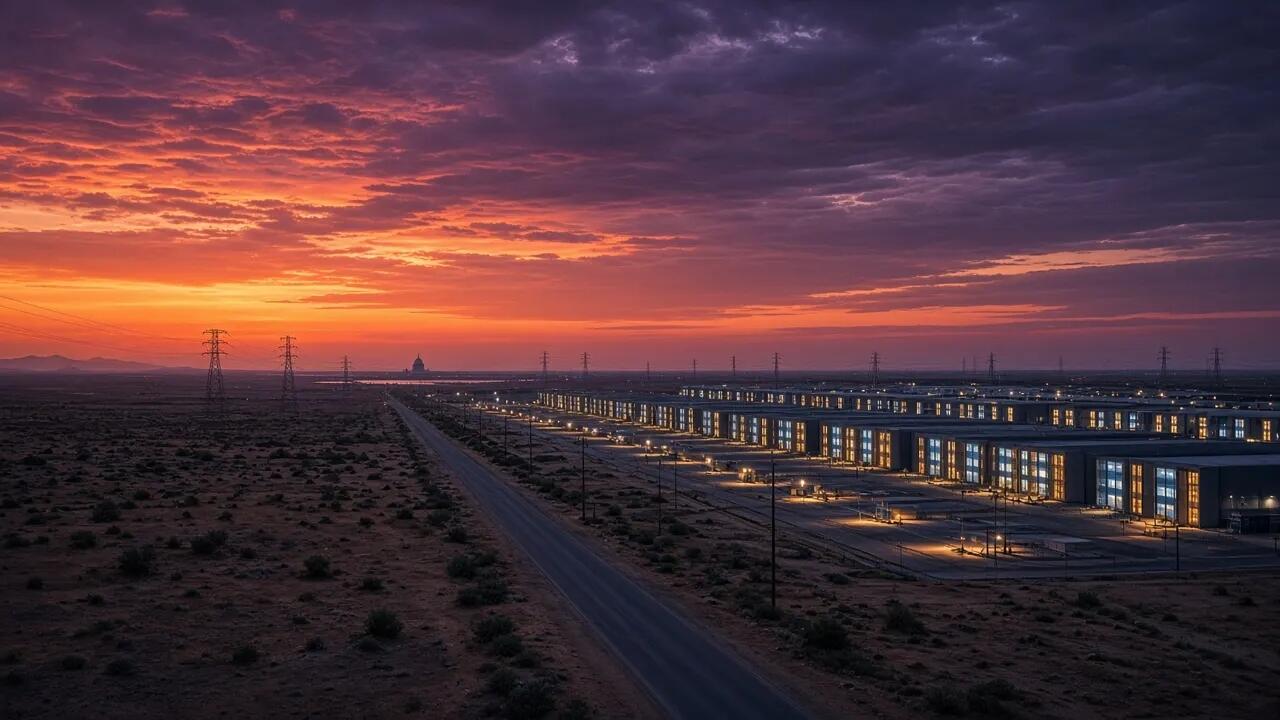
Meta's Hyperion campus in Louisiana exemplifies the model: a joint venture where Blue Owl funds hold 80% equity and Meta 20%, financed by a $27.3 billion A+ rated bond issuance anchored by PIMCO (with BlackRock participation). Meta leases on an initial four-year term with renewals, carrying residual value guarantees up to tens of billions across ventures—total maximum exposure reached $68.4 billion by September 2026—while keeping the debt off its balance sheet. Similar structures appear in other projects, with tech firms shifting over $120 billion off-balance-sheet in data center financing.[5][6]
Critics draw parallels to pre-2008 mortgage securitization: short-duration tenant commitments against rapidly depreciating GPUs, concentrated tenant risk (hyperscalers), and potential stranded assets if demand shifts. Secondary market trading shows some bonds dipping below par amid repricing, though no widespread defaults yet. Washington has signaled compute as strategic infrastructure, raising questions of implicit backstops akin to Fannie/Freddie, though none are explicitly planned.[7]
Connections to surveillance capitalism emerge in the concentration: private credit vehicles tie returns to hyperscaler contracts and Nvidia roadmaps, while data centers enable unprecedented data processing centralization. This architecture could embed social engineering incentives if public backstops materialize, prioritizing scale over privacy safeguards.
[Financial Regulators]: Expect scrutiny of data center SPVs and residual guarantees to intensify if secondary bond prices continue softening, potentially prompting stress tests modeled on post-2008 mortgage reforms.
Sources (5)
- [1]Palantir CEO Karp: Leading AI labs may need to be nationalized(https://www.cnbc.com/2026/09/17/ai-safety-palantir-karp.html)
- [2]Morgan Stanley sees $2.9 trillion in data center spending, and a $1.5 trillion hole(https://cryptobriefing.com/morgan-stanley-data-center-capex-forecast/)
- [3]Meta Hyperion: the $27bn data center bond, explained for private credit(https://privatecreditprep.com/deals/meta-hyperion-27bn-off-balance-sheet)
- [4]Meta Puts Maximum Exposure to Two Data Center Ventures at $68.4 Billion(https://www.tokenpost.com/news/business/40326)
- [5]Private credit roundup: CoreWeave's debt stress tests private credit's AI financing boom(https://www.reuters.com/legal/transactional/private-credit-roundup-coreweaves-debt-stress-tests-private-credits-ai-financing-2026-10-16/)