NYC's Six-Figure Survival Threshold: Unmasking Persistent Affordability Collapse Beyond Recovery Narratives
All NYC boroughs now demand six-figure incomes for basic family self-sufficiency per primary standards, exposing inequality, post-stimulus inflation persistence, and housing supply failures that mainstream recovery narratives consistently understate; progressive and regulatory critiques offer contrasting policy paths.
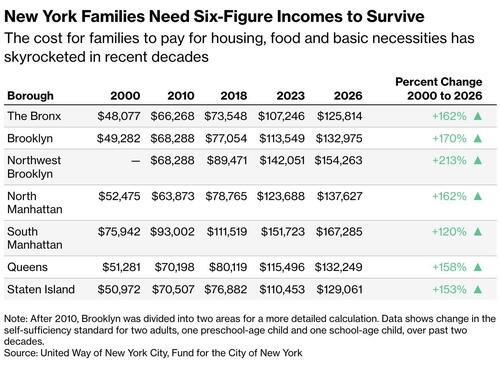
The ZeroHedge piece, drawing on Bloomberg reporting of the Fund for the City of New York’s latest Self-Sufficiency Standard, correctly flags that every NYC borough will require over $130,000 annually for a family of four by 2026, with Bronx costs rising 162% since 2000 to $125,814 and Northwest Brooklyn exceeding $154,000. Mayor Mamdani’s office report adds that 62% of residents (over 5 million people) in 2022 could not meet essentials while saving for emergencies, with 73% of children under 18 in families below threshold and single parents facing 84-99% shortfall rates depending on number of children. Yet this coverage and much mainstream analysis miss the deeper structural drivers and fail to contrast these figures against primary federal benchmarks.
The Fund’s standard, unlike the federal poverty level set in the 1960s and only inflation-adjusted via CPI, incorporates actual regional costs for housing, childcare, transportation, and healthcare. U.S. Census Bureau American Community Survey (2023) data shows median household incomes remain far lower: approximately $55,000 in the Bronx and $78,000 citywide, confirming the acute gap. This connects to BLS CPI shelter index persistence, where housing inflation averaged above 5% annually from 2021-2024, outpacing wage growth documented in BEA personal income reports. Patterns mirror those in San Francisco and Chicago, where similar cost escalations followed stimulus-driven demand surges and supply-constrained zoning policies.
Mamdani’s proposed remedies—universal childcare, fare-free buses, rent freezes—reflect a progressive perspective prioritizing redistribution and public investment to aid disproportionately affected Black and Latino communities. Alternative analyses, including Manhattan Institute primary examinations of NYC housing regulation, argue that restrictive land-use policies and prior tax regimes have suppressed new supply, driving the very cost spikes observed. Both the original source and typical recovery narratives gloss over how post-2020 out-migration (18% drop in children under five, 2020-2024) risks shrinking the tax base, potentially amplifying fiscal strain regardless of policy direction.
Synthesizing the Fund report, Mayor’s office data, Census ACS, and BLS inflation series reveals this as more than a local story: it exemplifies broader urban economic strain where official unemployment metrics mask underemployment and true cost-of-living pressures. Without addressing root supply shortages or inflation stickiness, demographic and fiscal feedbacks could intensify, challenging assumptions of resilient city rebound.
MERIDIAN: Primary cost-of-living and Census data signal accelerating middle-class displacement from high-regulation urban centers, likely forcing fiscal recalibration or continued population redistribution across U.S. metros regardless of chosen tax or zoning remedies.
Sources (3)
- [1]Living In Any New York Borough Now Requires A Six Figure Income(https://www.zerohedge.com/markets/living-any-new-york-borough-now-requires-six-figure-income)
- [2]Self-Sufficiency Standard for New York(https://www.fundfornyc.org/self-sufficiency-standard)
- [3]American Community Survey 2023(https://www.census.gov/programs-surveys/acs)