Task Exposure vs. Job Displacement: Unpacking AI Automation's Uneven Economic Repercussions
AI task exposure does not equal job loss; outcomes hinge on job dimensionality, demand elasticity, and firm incentives. Coverage often misses historical patterns and general-equilibrium dynamics documented in foundational economic papers.
The ZeroHedge piece by Alex Imas and Soumitra Shukla, drawing directly from the 2023 paper 'GPTs are GPTs' by Eloundou, Manning, Mishkin, and Rock, cautions against misinterpreting AI exposure metrics as inevitable job loss. The primary document (arXiv:2303.10130) explicitly defines exposure as whether LLMs could reduce task completion time by at least 50%, noting that roughly 80% of U.S. workers might see 10% of tasks affected while 19% could experience impacts on half or more. It stops short of forecasting displacement.
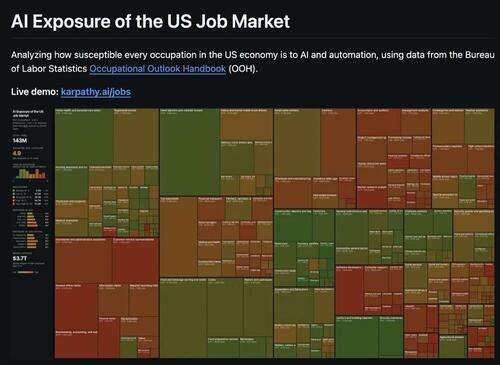
This coverage correctly identifies the common error seen in the viral spread of Andrej Karpathy's informal dashboard, where 'exposure' was widely read as 'elimination.' However, the article underplays longer-term general equilibrium effects and historical parallels. The 2013 Frey and Osborne Oxford Martin School paper 'The Future of Employment' estimated 47% of U.S. jobs at high risk from computerisation using a different task-based methodology focused on substitutability, a primary source that highlights recurring overestimation of rapid displacement during technological transitions.
A third primary lens comes from Daron Acemoglu and Pascual Restrepo's NBER working papers on automation (e.g., 2019 'Automation and New Tasks'), which distinguish between displacement effects and productivity-reinstating tasks. They document that while technology displaces labor in specific roles, it can create new tasks that increase labor demand elsewhere. Perspectives differ sharply: optimistic analyses emphasize augmentation in high-dimensionality occupations such as project management or creative strategy, where freed time boosts overall output and wages. Pessimistic views, often from labor organizations, stress that low-dimensional jobs in warehousing, trucking, and routine data processing face stronger automation incentives once adoption costs fall.
The original source rightly flags two underappreciated variables: consumer demand elasticity and job task dimensionality. When productivity gains lower prices but demand remains inelastic, sector-wide employment can contract even if individual workers become more valuable. Corporate investment strategies reflect this; firms prioritize full-job automation over partial task support when human labor costs rise, a pattern observed in manufacturing robotics data from the International Federation of Robotics annual reports.
Policy discussions reveal competing approaches. Some economists advocate broad retraining and wage subsidies to accelerate labor reallocation, while others warn of rising inequality as gains concentrate among high-skill workers and capital owners. Historical industrial revolutions showed net job creation over decades but significant short-term dislocations and regional distress. Current AI-driven shifts may follow similar trajectories, though at potentially faster speeds due to the general-purpose nature of large language models.
Ultimately, primary research indicates outcomes remain contingent rather than deterministic. Exposure metrics alone provide limited predictive power without incorporating firm-level cost-benefit analyses and macroeconomic demand responses. Labor market implications will likely vary sharply across sectors, skill levels, and national policy environments.
MERIDIAN: AI automation will produce divergent effects across job types, with complex multidimensional roles seeing productivity gains while simpler task-heavy positions in logistics face higher displacement pressure, requiring targeted policy adaptation.
Sources (3)
- [1]GPTs are GPTs: An Early Look at the Labor Market Impact Potential of Large Language Models(https://arxiv.org/pdf/2303.10130)
- [2]How Will AI-Driven Automation Actually Affect Jobs?(https://www.zerohedge.com/economics/how-will-ai-driven-automation-actually-affect-jobs)
- [3]The Future of Employment: How Susceptible Are Jobs to Computerisation?(https://www.oxfordmartin.ox.ac.uk/downloads/academic/The_Future_of_Employment.pdf)