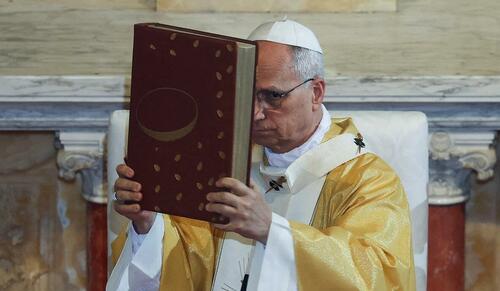
Breach of the Holy See: US Espionage Apparatus Targets Pope Leo XIV, Revealing Enduring Deep State Priorities and Centuries of Great-Power Interference
Ken Klippenstein's investigation exposes longstanding US spying on the Vatican—CIA human sources, NSA intercepts, FBI and State Department operations—escalated after Trump's criticism of Pope Leo XIV's foreign policy stances on Iran and Venezuela. Framed against Cold War history of mutual intelligence engagement and Soviet disinformation, this constitutes a sovereignty breach reflecting deep-state efforts to neutralize papal moral authority, a pattern of great-power interference spanning centuries.
The exposure of an extensive US intelligence network embedded within the Vatican—complete with CIA human sources inside the Holy See bureaucracy, NSA interception of papal communications, FBI liaison operations, and State Department analytical units dedicated to Vatican affairs—represents far more than a contemporary political spat. Investigative journalist Ken Klippenstein's reporting, based on documents and sources within the US national security apparatus, reveals that President Trump's public criticism of Pope Leo XIV as 'terrible on foreign policy' and 'weak on crime' was interpreted as a directive to escalate spying. This includes prioritizing signals intelligence on Vatican emails, texts, and diplomatic channels, alongside longstanding human intelligence penetrations. What legacy media overlooks is the profound violation of sovereignty against the world's oldest continuous religious institution, one whose soft power influences billions and has historically checked secular empires.
This is no aberration but the latest chapter in a centuries-long pattern of great-power meddling in Vatican affairs. From medieval European monarchs vying to install compliant popes, through 20th-century totalitarian regimes, to Cold War machinations, intelligence services have viewed the papacy as a geopolitical chess piece. During the Cold War, the Reagan administration and CIA Director William Casey cultivated close ties with Pope John Paul II, sharing briefings on Strategic Defense Initiative and channeling support to Solidarity in Poland through Catholic networks. Yet when papal voices critique US foreign policy—as Pope Leo has on the Iran conflict, Venezuela, and 'the delusion of omnipotence' driving war—the apparatus flips from ally to adversary. Declassified histories and analyses document how both US and Soviet intelligence targeted the Holy See: the KGB's 'Seat 12' disinformation campaign sought to smear Pius XII, while American operatives mobilized Catholic organizations against perceived communist threats in Latin America.
Klippenstein details how routine cooperation—FBI threat briefings for papal travel, joint cybersecurity projects against intrusions, State Department daily Vatican news digests, and even a US military linguistic designation 'QLE' for Ecclesiastical Latin—serves as 'convenient cover' for intelligence collection. This dual-use architecture illuminates deep-state priorities: neutralizing any moral authority that might constrain American power projection, whether on Iran nukes, Venezuelan regime change, or broader critiques of 'tyrants' dominating global affairs. Pope Leo's December address to Italian intelligence officials, warning that 'in several countries, the Church is the victim of intelligence services that act for nefarious purposes, oppressing its freedom,' and calling for strict oversight to prevent blackmail and manipulation, demonstrates the Vatican's acute awareness. His clarification that recent remarks were not personal jabs at Trump but pre-written indictments of war and idolatry only heightened tensions.
Connections others miss include the irony of an American-born pope (the first in history) now subjected to intensified surveillance by his native country's agencies, and the risk this poses to Catholic service members and global faithful amid narratives framing US wars as 'divinely ordained.' Legacy outlets have downplayed the story, focusing on Trump-Pope rhetoric rather than the systemic breach. This episode underscores how intelligence communities treat sovereign religious entities not as sacred but as potential threats to unipolar dominance—echoing patterns from Operation Gladio-era alliances to modern penetration ops. The Holy See's own discreet intelligence capabilities suggest this shadow war is mutual, yet the asymmetry of US technological reach poses unique challenges to papal independence.
Ultimately, this revelation demands scrutiny of how 'national security' rationalizes undermining one of humanity's oldest independent powers, potentially eroding the Vatican's ability to speak prophetically on war, migration, and ethics without fear of compromised networks or manufactured scandals.
Vatican Intelligence Analyst: This public exposure will prompt the Holy See to aggressively compartmentalize its networks, pursue counter-intelligence partnerships with non-Western states, and amplify independent moral critiques, accelerating erosion of US soft power among global Catholic populations.
Sources (4)
- [1]U.S. Spies on the Vatican(https://www.kenklippenstein.com/p/us-spies-on-the-vatican)
- [2]'Spies inside the Holy See': Report reveals US espionage campaign targeting Pope Leo XIV(https://thecradle.co/articles/spies-inside-the-holy-see-report-reveals-us-espionage-campaign-targeting-pope-leo-xiv)
- [3]Espionage and the Catholic Church from the Cold War to the Present(https://warontherocks.com/2019/06/espionage-and-the-catholic-church-from-the-cold-war-to-the-present/)
- [4]Tensions between President Trump and Pope Leo XIV on display(https://www.kosu.org/religion/2026-04-13/tensions-between-president-trump-and-pope-leo-xiv-on-display)