America's Deadliest Jobs in 2024: Logging Tops Fatality Rates as Total Workplace Deaths Decline
BLS 2024 data confirms logging as America's deadliest job by fatality rate (110.4/100k), with total deaths down to 5,070; analysis reveals gaps between rates and totals, older worker risks, and nonfatal vs. fatal disconnects.
As Labor Day prompts reflection on American workers, federal data reveals persistent hazards in specific occupations despite an overall drop in workplace fatalities. According to the U.S. Bureau of Labor Statistics (BLS) Census of Fatal Occupational Injuries (CFOI) for 2024, there were 5,070 fatal work injuries—a 4% decline from 5,283 in 2023 and the second consecutive annual decrease. The national fatality rate fell to 3.3 per 100,000 full-time equivalent workers from 3.5 the prior year.[1][2]
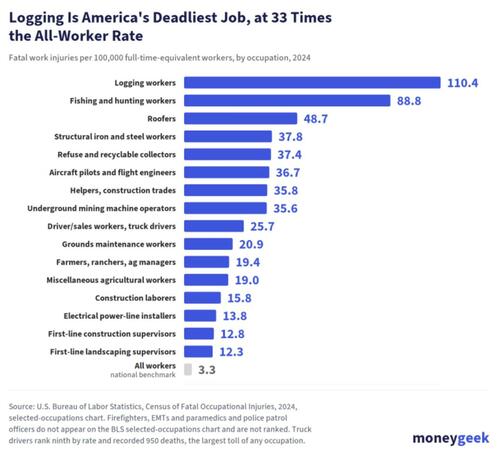
A MoneyGeek analysis of BLS data ranks logging workers as the deadliest occupation, with a fatality rate of 110.4 per 100,000—more than 33 times the national average—with 51 deaths, primarily from contact with objects and equipment. Fishing and hunting workers followed at 88.8 (24 deaths), roofers at 48.7 (104 deaths, mostly falls), structural iron and steel workers at 37.8, and refuse and recyclable material collectors at 37.4. These top five exceeded 11 times the national rate.[3][3]
Notably, high-rate jobs differ from those with the highest absolute deaths. Driver/sales workers and truck drivers recorded 950 fatalities (rate 25.7), the largest total, while construction laborers had 334 deaths (rate 15.8). Transportation incidents caused 1,937 deaths nationwide (38%), the leading cause across many occupations.[4]
Deeper patterns emerge in demographics and contrasts: Workers 65+ saw 824 fatalities, a five-year high and 21.9% rise since 2020, comprising 16.3% of deaths. Nonfatal injury rates tell a different story—logging's was below average at 1.3 per 100 workers versus 2.3 industry-wide—highlighting how fatality-focused data misses chronic risks in fields like waste collection. State variations, such as Wyoming's 13.9 rate versus Rhode Island's 1.1, reflect industry concentrations. Life insurance underwriting, per Ethos, evaluates specific tasks like heights or machinery rather than job titles alone, with high approval rates for hazardous roles.[3]
These trends underscore that while aggregate safety improves, targeted interventions in high-risk niches remain critical amid an aging workforce and varying exposure profiles.
BLS Analyst: Persistent rate disparities in niche occupations like logging signal need for targeted tech and training, even as broad declines continue; older worker uptick may strain safety nets.
Sources (4)
- [1]National Census of Fatal Occupational Injuries in 2024(https://www.bls.gov/news.release/cfoi.nr0.htm)
- [2]Most Dangerous Jobs in America (2026 Report)(https://www.moneygeek.com/insurance/life/most-dangerous-jobs-in-america/)
- [3]Fatal work injuries down in 2024(https://www.bls.gov/opub/ted/2026/fatal-work-injuries-down-in-2024.htm)
- [4]Federal data shows logging and fishing jobs have highest death rates(https://www.yahoo.com/news/us/articles/federal-data-shows-logging-fishing-152856248.html)