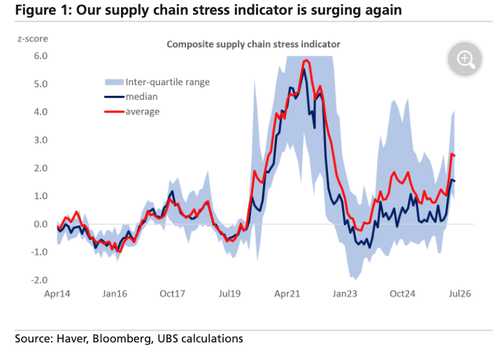
UBS Supply Chain Stress Index Signals Renewed Global Trade Vulnerabilities Amid Middle East Disruptions
UBS index reactivation revives overlooked early-warning metrics for trade disruptions driven by Middle East conflicts, synthesizing shipping, energy, and macroeconomic primary sources to reveal divergent policy and market implications.
The reactivation of UBS's Global Supply Chain Stress Index highlights accelerating pressures from Red Sea rerouting and Strait of Hormuz tensions, with the index rising 1.2 standard deviations in March-April—the second-largest two-month surge since July 2020. Primary shipping data from Maersk's Q1 2024 filings and UNCTAD's Review of Maritime Transport 2023 document extended transit times and inventory buildup patterns that echo 2021 disruptions but originate from distinct geopolitical chokepoints rather than pandemic lockdowns. Multiple perspectives emerge: logistics executives emphasize capacity constraints and insurance cost spikes as documented in IMO circulars on Hormuz navigation, while central bank analyses in the ECB's May 2024 Economic Bulletin project contained inflation pass-through assuming swift de-escalation. Energy market reports from the IEA's Oil Market Report underscore risks of crude shortages extending into June if maritime access remains limited, contrasting with views from trade ministries prioritizing diplomatic channels over immediate rerouting mandates. This coverage extends beyond initial logistics alerts by linking sustained stress to broader growth forecasts in the IMF's April 2024 World Economic Outlook, which flagged under-monitored supply indicators since early 2024 as potential amplifiers of stagflationary pressures.
MERIDIAN: Sustained Hormuz disruptions could elevate global inflation readings by mid-2025 if primary trade data confirm prolonged delivery delays beyond current diplomatic efforts.
Sources (3)
- [1]Primary Source(https://www.zerohedge.com/markets/ubs-reactivates-supply-chain-stress-watch-after-detecting-alarmingly-rapid-deterioration)
- [2]Related Source(https://unctad.org/system/files/official-document/rmt2023_en.pdf)
- [3]Related Source(https://www.imf.org/en/Publications/WEO/Issues/2024/04/16/world-economic-outlook-april-2024)