America's Job Market Diverges: Southern and Midwestern States Lead Hiring Rebound as Coastal Markets Cool
Regional job openings data confirms a reversal favoring Southern and select Midwestern states due to industrial investment and migration, while Western tech-heavy areas contract—signaling shifting opportunities for American workers.
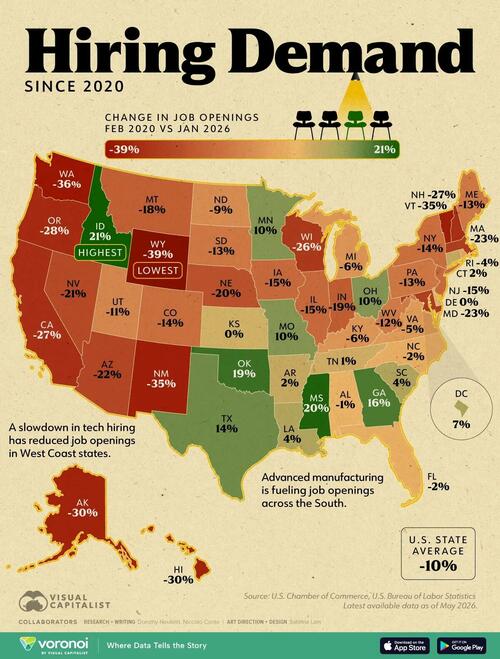
Data from the U.S. Chamber of Commerce, analyzed by Visual Capitalist, reveals a stark regional split in job openings since February 2020. As of January 2026, states like Idaho (+20.5%), Mississippi (+19.6%), Oklahoma (+18.8%), Georgia (+16.0%), and Texas (+14.2%) show sustained or increased demand, driven by manufacturing investments in semiconductors, EVs, and reshoring, alongside population inflows to lower-cost areas. In contrast, Western states including Wyoming (-38.9%), Washington (-36.3%), California (-27.0%), and Oregon (-28.4%) have seen sharp reversals, reflecting post-pandemic tech and white-collar retrenchment amid higher interest rates and efficiency cuts. Nationally, job openings have declined about 9.6% on average. This pattern aligns with BLS JOLTS trends showing cooling national openings after 2022 peaks, with Chamber data highlighting persistent state-level variances in labor shortages. The divergence influences migration, wages, and local economies, favoring Sun Belt growth hubs over high-cost coastal markets.
LIMINAL: Lower-cost Southern and Mountain states will continue attracting workers and investment through 2027, widening the gap in employment access between regions.
Sources (4)
- [1]America’s Hiring Map Has Flipped Since 2020(https://www.zerohedge.com/personal-finance/americas-hiring-map-has-flipped-2020)
- [2]Mapped: Where Workers Outnumber Jobs in America(https://www.visualcapitalist.com/mapped-where-workers-outnumber-jobs-in-america/)
- [3]America Works Data Center(https://www.uschamber.com/workforce/america-works-data-center)
- [4]Job Openings and Labor Turnover Summary(https://www.bls.gov/news.release/jolts.nr0.htm)