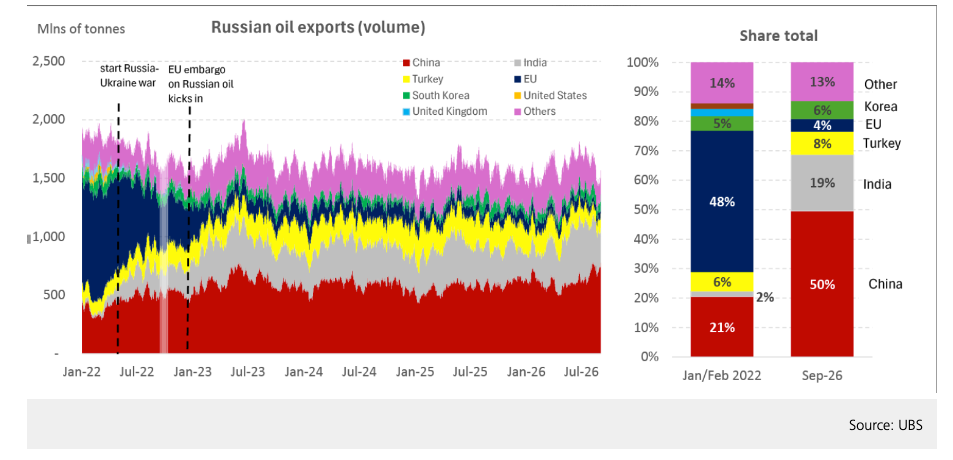
Russian Oil Exports Redirected Eastward: UBS Data Confirms Sanctions Reshaped Global Supply Chains Without Crippling Volumes
UBS analysis and supporting data from CREA, EIA, and KSE confirm Russian oil exports have shifted dramatically to Asia, maintaining near pre-war volumes via shadow fleets while exposing sanctions' redistribution effects over outright reduction.
New analysis from UBS chief economist Arend Kapteyn, highlighted in recent reporting, shows that Western sanctions and the G7 price cap have primarily redistributed Russian crude oil flows rather than substantially reducing them. Pre-war, the EU accounted for 48% of Russian crude exports; by September 2026, that share had fallen to just 4%. Meanwhile, China, India, and Turkey's combined share surged from 29% to 77%, according to trade-partner import data since Russia ceased publishing its own figures in 2022. Overall Russian crude export volumes remain only about 10% below pre-war levels, with an estimated 61% now transported via the shadow fleet operating outside Western insurance and financing systems. Kapteyn noted the fungibility of oil markets: sanctions intended to constrain revenue instead rerouted supplies, boosting Russia's share of imports in China (from ~18% to 27%) and India (from ~1% to 24%), displacing suppliers like Saudi Arabia and others. Russia has also begun importing significant volumes of refined products amid Ukrainian drone strikes on its refineries, an unusual move for a major exporter that helps sustain elevated global gasoline prices. Corroborating data from the Centre for Research on Energy and Clean Air (CREA) shows China, India, and Turkey dominating recent fossil fuel purchases, while the U.S. Energy Information Administration (EIA) documents Europe's share of Russian crude dropping from 51% in 2020 to 11-12% in 2024-2025, with Asia rising to 81%. The KSE Institute's shadow fleet trackers indicate 48-75% of Russian seaborne oil exports in mid-2026 relied on such vessels, underscoring the limits of jurisdictional sanctions. This pivot highlights deeper geopolitical realignments, including emerging buyer-seller networks in Asia and the resilience of parallel trade systems amid ongoing conflicts and market disruptions.
UBS Kapteyn: Sanctions on Russian energy have proven more effective at redrawing global supply maps than at starving Moscow's revenues, accelerating multipolar energy trade patterns that may outlast current conflicts.
Sources (6)
- [1]Who's Buying Russian Oil? UBS Has The Answer(https://www.zerohedge.com/energy/whos-buying-russian-oil-ubs-has-answer)
- [2]UBS Data: Russian Oil Near Pre-War Levels as Trump Deals(https://www.tftc.io/russian-crude-pre-war-volumes-ubs-trump-sanctions-waiver-petrodollar)
- [3]Who buys Russian oil and gas?(https://kyivindependent.com/who-buys-russian-oil-and-gas/)
- [4]Russia’s oil exports have decreased modestly since 2022, shifting toward Asia(https://www.eia.gov/todayinenergy/detail.php?id=65885)
- [5]September 2026 — Monthly analysis of Russian fossil fuel exports and sanctions(https://energyandcleanair.org/september-2026-monthly-analysis-of-russian-fossil-fuel-exports-and-sanctions/)
- [6]Russia Shipped 80% of its 2025 Oil Exports to China and India(https://oilprice.com/Latest-Energy-News/World-News/Russia-Shipped-80-of-its-2025-Oil-Exports-to-China-and-India.html)