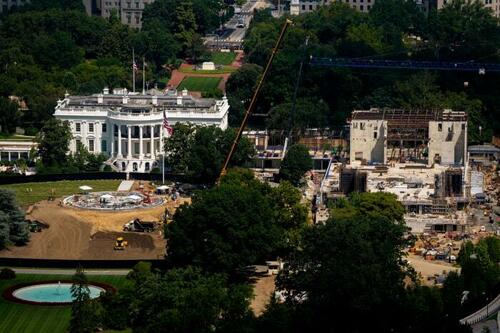
SCOTUS Stays Lower Court Order, Allowing Trump White House Ballroom Construction to Proceed Amid Executive Power Debate
SCOTUS 5-4 stay permits Trump ballroom project to advance, spotlighting executive overreach concerns as Roberts dissents with liberals on historic preservation and congressional authority.
In a 5-4 decision issued around August 31, 2026, the U.S. Supreme Court granted the Trump administration's emergency request to stay a lower court's order halting above-ground construction on a 90,000-square-foot ballroom project at the White House, effectively permitting work to continue while litigation proceeds. The unsigned opinion, joined by the Court's six Republican-appointed justices, declined to rule on the project's ultimate legality but found that the National Trust for Historic Preservation likely lacked standing to challenge it and that halting construction posed risks of irreparable harm, including structural vulnerabilities. Chief Justice John Roberts joined the three liberal justices in dissent, arguing the project was 'likely unlawful' and emphasizing the need to protect the White House's historic integrity under congressional oversight.
The ruling builds on a timeline beginning with the demolition of the East Wing in late 2025 to make way for the project, initially announced in July 2025 as a solution for larger events but later expanded and reframed by the administration as an integrated national security and military complex including underground bunkers. Lower courts, including U.S. District Judge Richard Leon and a D.C. Circuit panel, had ruled that the president lacked unilateral authority to demolish and rebuild without explicit congressional approval, citing the White House as 'the People’s House' under congressional control over federal property. The appeals court decision on August 7, 2026, upheld the block but paused enforcement to allow Supreme Court review.
This case highlights tensions over executive authority, where national security rationales and private funding claims (initially $200 million, later estimates reaching $400-600 million) intersect with historic preservation laws. Critics, including the suing group, argue it tests limits on presidential power to alter iconic federal structures without legislative consent, potentially setting precedents for future administrations to bypass Congress on major projects by invoking security or urgency. The majority's focus on standing narrows judicial review avenues for preservation challenges, while the dissent underscores risks of irreversible changes to national symbols. Broader context includes prior disputes over White House modifications and ongoing congressional scrutiny of donor influences, with some reports noting corporate donors linked to government contracts.
Construction, reportedly 65% complete per administration filings (though independent analyses suggest lower progress based on spending data), could reach substantial completion before merits resolution, illustrating how procedural stays can functionally resolve disputes in favor of the executive branch.
Liminal Analyst: The decision reinforces executive momentum on unilateral projects by prioritizing procedural hurdles like standing over substantive review, potentially emboldening future claims of inherent presidential authority over federal property when framed as security imperatives, while exposing fault lines in congressional oversight of the executive branch.
Sources (6)
- [1]Supreme Court allows White House ballroom construction to continue for now(https://www.scotusblog.com/2026/08/supreme-court-allows-white-house-ballroom-construction-to-continue-for-now/)
- [2]Supreme Court clears way for White House ballroom construction to continue(https://www.washingtonpost.com/politics/2026/08/31/supreme-court-clears-way-work-white-house-ballroom-now/)
- [3]Supreme Court rules for Trump and his ballroom, dismisses legal challenge(https://www.latimes.com/politics/story/2026-08-31/supreme-court-rules-for-trump-his-ballroom-dismisses-legal-challenge)
- [4]Supreme Court allows Trump to continue building White House ballroom(https://www.cnn.com/2026/08/31/politics/supreme-court-white-house-ballroom-trump)
- [5]Supreme Court Allows Trump to Keep Building White House Ballroom(https://www.wsj.com/us-news/law/supreme-court-allows-trump-to-keep-building-white-house-ballroom-d45a7c1c)
- [6]Appeals Court Upholds Block on Trump Ballroom Construction(https://www.nytimes.com/2026/08/07/us/politics/trump-ballroom-appeals-court.html)