Iran's Expanded Strait of Hormuz Control Triggers Shipping Collapse and Dubai Vessel Cluster as Ceasefire Frays
Commercial shipping has abandoned the Strait of Hormuz following Iran's release of an expanded control map and renewed attacks, driving vessels to cluster off Dubai. U.S. 'Project Freedom' escorts have seen limited success amid fragile ceasefire conditions, with broader risks to global oil flows underreported relative to general war coverage.
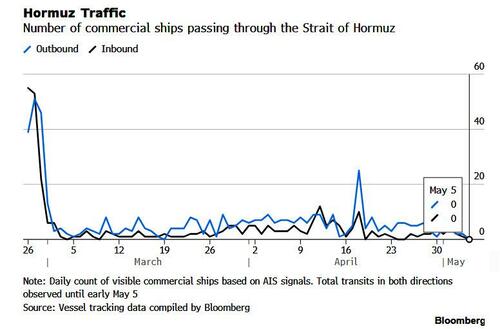
The Strait of Hormuz, through which roughly one-fifth of global oil supply historically flows, has seen commercial traffic grind to a near-halt amid Iran's assertion of broader maritime dominance, exposing vulnerabilities in global energy chokepoints that extend far beyond conventional battlefield narratives. According to Bloomberg, at least 13 commercial ships diverted after Iran’s Islamic Revolutionary Guard Corps (IRGC) released a new map expanding its claimed control zone from Kuh-e Mobarak in Iran to south of Fujairah in the UAE, and from Qeshm Island to Umm al Quwain. This has left the strait largely deserted, with hundreds of vessels instead clustering off Dubai for safety.[1][2]
The timing aligns with the U.S. launch of "Project Freedom," announced by President Donald Trump to guide stranded commercial shipping through the waterway under military protection. BBC and CNN reporting detail how this operation involves guided-missile destroyers, aircraft, and unmanned systems, yet immediate results have been mixed: one Maersk vessel transited under escort, but follow-on traffic evaporated amid Iranian threats to attack approaching U.S. forces. Satellite imagery and maritime tracking confirm two U.S. destroyers inside the Persian Gulf conducting defensive positioning near UAE anchorages.[3][4]
Iran responded with renewed aggression, including reported drone and missile strikes on the UAE’s Fujairah petroleum zone and attacks on vessels near Dubai, as documented by the Institute for the Study of War and Al Jazeera. These incidents mark the first strikes on Gulf Arab territory since the fragile April 2026 ceasefire and suggest Tehran is leveraging hybrid tactics—mapping, fast-attack craft, and selective strikes—to enforce toll-like control without needing a full conventional navy, much of which was degraded earlier in the conflict. The IRGC’s map effectively claims management rights over vast swaths previously considered international waters.[5][6]
Mainstream coverage often frames these events within the broader 2026 Iran war arc, yet the immediate economic signal is stark: pre-war daily transits averaged over 100 vessels; recent data from Kpler and others show April traffic at roughly 5% of normal levels. Iranian oil exports are shifting to darker routes via Indonesia’s Lombok Strait to evade detection and blockade risks, per maritime intelligence. This disruption compounds existing shortages of refined products in Asia and carries spillover risks for global inflation, tanker insurance rates, and supply chain rerouting that could persist even if direct U.S.-Iran clashes are avoided. Wikipedia’s entry on the 2026 Strait of Hormuz crisis and New York Times reporting contextualize how Iran’s post-ceasefire toll demands and vessel harassment have turned a critical artery into a contested zone.[7][8]
Connections often missed include the strategic asymmetry: despite significant losses to its surface fleet, Iran retains enough capability through missiles, drones, and declared control zones to deter commercial operators far more effectively than traditional blockades. The clustering of over 360 vessels near Dubai represents both capital flight to safer waters and a de facto economic sanction on Gulf energy exports. As dark fleet activity continues from Kharg Island, the ceasefire appears increasingly performative, with each side testing red lines that could rapidly escalate oil prices and force long-term diversification away from Persian Gulf dependence. This episode underscores how control of narrow maritime geography continues to outweigh raw naval tonnage in 21st-century energy warfare.
LIMINAL: Iran's hybrid expansion of Hormuz control is forcing a de facto rerouting of global oil that could sustain elevated energy prices and accelerate supply chain shifts toward Asia bypass routes, revealing how chokepoint dominance persists despite naval losses.
Sources (5)
- [1]Ships Pull Back as Iran Expands Control in Strait of Hormuz(https://www.bloomberg.com/news/articles/2026-05-04/ships-pull-back-as-iran-expands-control-in-strait-of-hormuz)
- [2]What we know about Trump's 'Project Freedom' in Strait of Hormuz(https://www.bbc.com/news/articles/c4g437depzpo)
- [3]Map of dominance: Why Iran can't afford to give up Hormuz control(https://www.aljazeera.com/news/2026/5/5/map-of-dominance-why-iran-cant-afford-to-give-up-hormuz-control)
- [4]Iran Update Special Report May 4, 2026(https://understandingwar.org/research/middle-east/iran-update-special-report-may-4-2026/)
- [5]What We Know About 'Project Freedom' in the Strait of Hormuz(https://www.nytimes.com/2026/05/05/world/middleeast/trump-strait-hormuz-plan-project-freedom-iran.html)