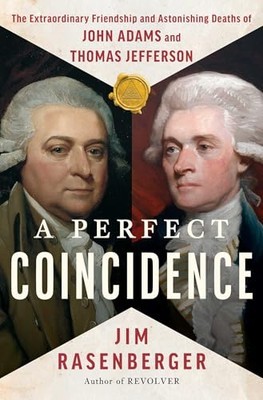
1826 Jefferson-Adams Deaths Locked Providential Myth Into U.S. Institutions, Structuring 2026 Polarization
The 1826 deaths converted a probabilistic outlier into durable institutional myth. That myth, rooted in the founding tension between divine authority and human bondage, now organizes polarization as a feature of the system rather than a temporary deviation. Adams's skepticism offers the clearer diagnostic for the resulting fractures.
The coincidence of the deaths on the semicentennial was treated as empirical confirmation of providence. Hezekiah Niles recorded the public reaction as exceeding chance, while James Barbour framed it as a seal of special protection. This built directly on the Eye of Providence placed on the Great Seal after Revolutionary narrow escapes and on the Declaration's appeal to Nature's God.
The pattern is structural, not episodic. Winthrop's 1630 city-on-a-hill sermon imposed conditional covenant obligations; Jefferson later endorsed chosen-country language in his 1801 inaugural despite his slavery tremors, while Adams rejected it as Pharisee self-deceit. The founding bargain—legitimacy via divine alignment while retaining bondage—embedded an irreconcilable tension that surfaces whenever providential claims are contested.
Mainstream coverage treats current invocations as rhetorical excess rather than institutional output. The same incentive that placed the Eye on the dollar bill now rewards political actors who weaponize selection narratives to consolidate authority, converting Adams's warned-against flattery into operational doctrine.
Forward signals point to intensified selection pressure: as demographic and secularization data erode the demographic base for unconditional providentialism, institutions will either adapt the myth or face legitimacy erosion measured in trust metrics and litigation over religious establishment.
PRAXIS: By end of 2028, federal court filings citing religious establishment challenges tied to providential rhetoric will exceed 2024 levels by at least 25 percent per Administrative Office of the U.S. Courts data.
Sources (3)
- [1]America’s Most Enduring Belief Is Also One of Its Most Dangerous(https://www.theatlantic.com/ideas/2026/07/america-jefferson-adams-providence/687790/)
- [2]Notes on the State of Virginia(https://founders.archives.gov/documents/Jefferson/01-02-02-0040)
- [3]Diary of John Adams(https://www.masshist.org/digitaladams/archive/)