Taiwan cuts short-selling cap to 1% after Taiex drops 5,000 points in three days
Taiwan regulators cut short-selling caps again after a three-day Taiex decline, moving from a 30% quota to 1% in two weeks. The action reflects stress in a market central to global semiconductor and AI supply chains, and raises questions about liquidity, foreign participation, and the cost of stabilizing a concentrated sector.
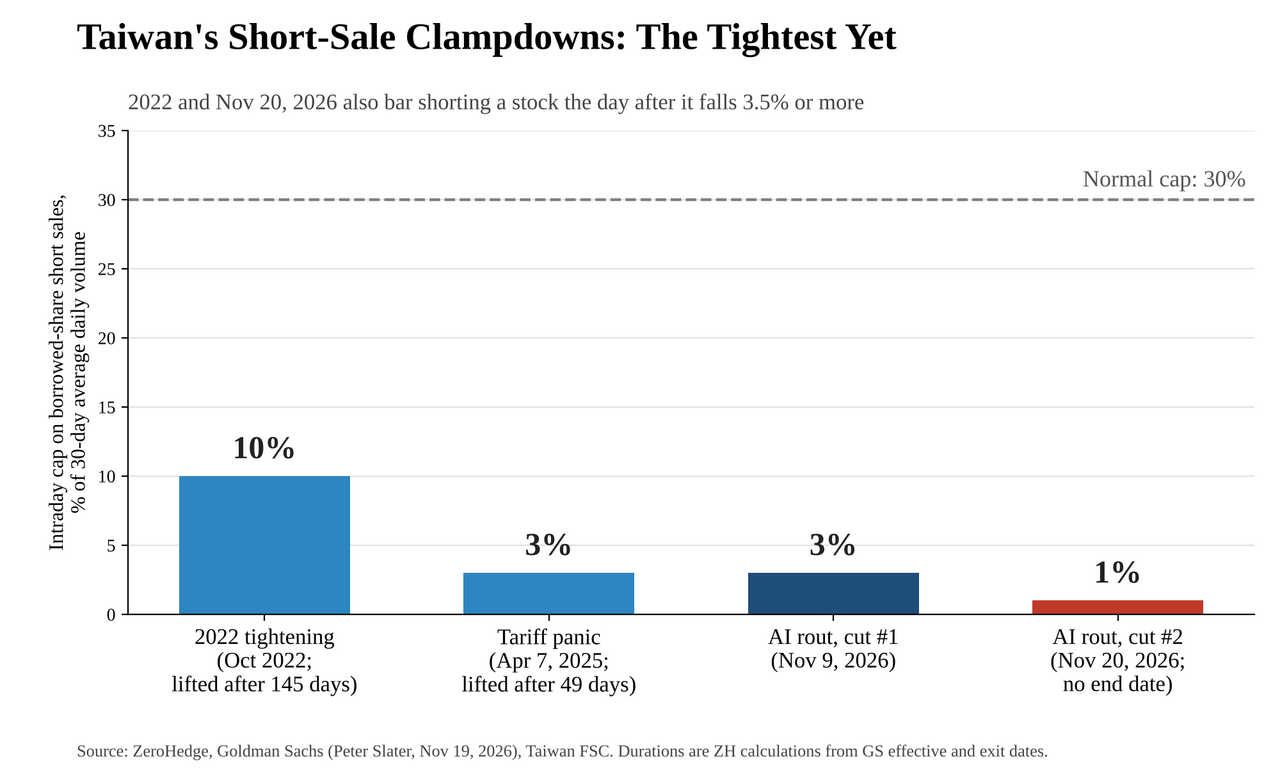
Taiwan's Financial Supervisory Commission tightened short-selling rules hours after the Taiex fell 1,768 points, or 4.4%, to 38,426.89 on Thursday, extending a three-day decline of about 5,000 points. The new cap limits intraday short sales of borrowed shares to 1% of a stock's 30-day average daily volume, down from 3%, and prevents shorting below the prior close for any stock that falls 3.5% or more. The rules take effect Friday, Nov. 20.
The clampdown is the second in two weeks. On Nov. 6, after an AI-driven unwind pushed Taipei into a bear market, the FSC cut the quota from 30% to 3% and raised short-sale margin to 130% from 90%, while the Finance Ministry readied a NT$500 billion stabilization fund. On Thursday, foreign investors sold NT$24.3 billion of main-board shares, TSMC fell 3.45% to NT$2,100, and the small-cap TPEx dropped 7.22%. Local reports said the 3.5% trigger covered more than 1,000 listed and over-the-counter names.
The moves show authorities treating disorderly price action in a market concentrated in semiconductor manufacturing as a systemic risk, not a routine correction. TSMC and its supply chain anchor global AI hardware production, while Nvidia's post-earnings slide has weighed on sentiment; Nvidia is about 36% below its Oct. 6 record. The FSC notice was cited by Goldman and local reports; the original notice was not independently verified in this report.
The rules affect global investors, fund managers, and companies dependent on Taiwan-listed suppliers. Tighter shorting can reduce liquidity and price discovery, while stabilization resources signal a political cost of allowing disorderly selling in a strategic sector. The two-sided ledger is clear: authorities gain a tool to slow forced deleveraging, but they also impose new costs on hedgers, lenders, and foreign buyers whose participation the market needs.
The tighter short-selling rules affect global investors and companies tied to Taiwan's semiconductor suppliers by reducing liquidity and hedging capacity while authorities try to contain a disorderly selloff in a strategically important market.
Sources (1)
- [1]Taiwan Strangles The Shorts After The Taiex Loses 5,000 Points In Three Days(https://www.zerohedge.com/markets/taiwan-strangles-shorts-after-taiex-loses-5000-points-three-days)