US Navy Tests Nuclear Supercarrier as Floating Power Plant, Signaling Energy-Military Convergence in Strategic Race with Russia
The US Navy will test powering Naval Station Norfolk from the nuclear reactors aboard the USS Gerald R. Ford this year and is exploring a dedicated floating reactor program, countering Russia's operational Akademik Lomonosov while merging military and energy infrastructure for enhanced resilience in strategic competition.
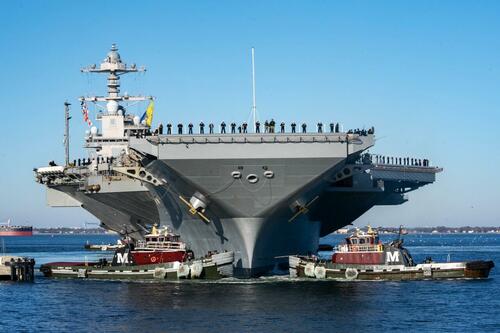
The U.S. Navy is set to demonstrate a novel use of its most advanced nuclear-powered aircraft carrier as a floating generator, exporting electricity from the USS Gerald R. Ford's two A1B reactors to Naval Station Norfolk later this year. Acting Secretary of the Navy Hung Cao announced during a May 14 House Armed Services Committee hearing on the FY2027 budget that the largest naval base in the world will be powered directly from the docked supercarrier. A Navy spokesperson confirmed the test aims to deliver firm baseload power for mission assurance during grid outages, cyberattacks, natural disasters, or other disruptions. The Ford-class reactors, which provide roughly 25% more energy than prior designs while requiring fewer crew, recently completed a record 326-day deployment before returning to Norfolk. Officials have also floated using this capability for potable water production via desalination in drought-affected regions.
This initiative is not occurring in isolation. It represents a long-delayed revival of U.S. concepts for floating nuclear power dating to the 1970s, which stalled amid regulatory challenges. In contrast, Russia has operated the Akademik Lomonosov since 2019, a barge equipped with two KLT-40S reactors supplying electricity and district heat to the remote Arctic town of Pevek in Chukotka. The plant has now generated over one billion kWh, providing up to 60% of regional energy needs and replacing older nuclear and coal facilities. Rosatom is advancing follow-on designs based on RITM-200 reactors for further Arctic mining and infrastructure projects.
At the same hearing, Chief of Naval Operations Adm. Daryl Caudle called for a dedicated Navy reactor pilot program, modeled on the Army's Janus initiative (targeting microreactors at domestic bases by 2028) and the Air Force's ANPI program (with first power eyed around 2030). This suggests the Navy seeks dedicated floating or shore-based nuclear systems beyond propulsion, integrating energy resilience directly into strategic infrastructure. While European efforts remain largely conceptual, the U.S. push—leveraging proven naval nuclear technology—highlights a shift where military platforms double as energy assets.
The development offers a fresh lens on great-power competition: Russia's floating plants support Arctic expansion, resource extraction, and sustained presence in harsh environments. The U.S. approach emphasizes hardening domestic and forward bases against hybrid threats, creating dual-use strategic infrastructure that enhances deterrence. By turning a $13 billion supercarrier into a pier-side generator, the Navy blurs traditional lines between warfighting and energy security, potentially enabling power export to surrounding communities in crises. This convergence of nuclear propulsion heritage with emerging microreactor programs positions the U.S. to close the operational gap with Russia while redefining military basing for an era of contested grids and climate pressures.
Liminal Analyst: US carriers repurposed as pier-side nuclear generators, paired with service-wide microreactor pilots, will harden military infrastructure against grid attacks and position America to contest Russia's Arctic nuclear edge through dual-use energy platforms that blend power projection with homeland resilience.
Sources (4)
- [1]U.S. Navy to power Norfolk base using aircraft carrier(https://www.ans.org/news/article-8074/us-navy-to-power-norfolk-base-using-aircraft-carrier/)
- [2]Supercarrier USS Gerald R. Ford To Act As Floating Nuclear Power Plant For Facilities On Land(https://www.twz.com/nuclear/supercarrier-uss-gerald-r-ford-to-act-as-floating-nuclear-power-plant-for-facilities-on-land)
- [3]Russia's floating nuclear power plant passes one billion kWh(https://www.world-nuclear-news.org/articles/russias-floating-nuclear-power-plant-passes-one-billion-kwh)
- [4]USS Gerald R. Ford will power Naval Station Norfolk this summer(https://www.whro.org/military-veterans/2026-05-27/uss-gerald-r-ford-will-power-naval-station-norfolk-this-summer)