NY Fed Consumer Survey Reveals Divergent Signals on Inflation and Labor: Policy Crossroads Emerge
NY Fed data shows easing short-term inflation expectations alongside weakening labor perceptions, providing mixed signals for Fed policy amid consumer financial strain.
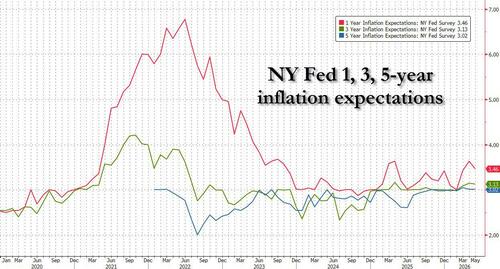
The New York Fed's May Survey of Consumer Expectations, a primary data release tracking household perceptions, shows one-year inflation expectations easing to 3.46 percent from 3.64 percent in April, driven primarily by lower gas price forecasts falling to 4.96 percent. Three- and five-year horizons remained steady at 3.1 percent and 3.0 percent respectively. This moderation contrasts with rising home price growth expectations reaching 3.5 percent, the highest since July 2022, alongside increases in food and rent outlooks. Labor market indicators point to softening conditions, with the perceived probability of job loss rising to 15.1 percent and the chance of finding new employment dropping to 43.7 percent, below the trailing average. Yet the voluntary quit probability hit a three-year high, suggesting uneven confidence across demographics. Primary documents such as the NY Fed SCE report and cross-referenced FOMC minutes from May 2024 highlight how such consumer-level data often precede shifts in official employment metrics from the Bureau of Labor Statistics. Perspectives from regional Federal Reserve analyses emphasize inflation persistence risks in shelter components, while others note potential consumer spending restraint if credit access deteriorates further, as delinquencies edge higher. The survey underscores leading indicators for monetary policy calibration without resolving debates on whether labor weakness will dominate or if energy volatility reasserts upward pressure.
MERIDIAN: The survey's labor deterioration metrics may prompt earlier Fed easing considerations if confirmed in subsequent employment data, though persistent shelter inflation could delay action.
Sources (3)
- [1]Primary Source(https://www.newyorkfed.org/microeconomics/sce)
- [2]Related Source(https://www.federalreserve.gov/monetarypolicy/fomcminutes20240501.htm)
- [3]Related Source(https://www.bls.gov/news.release/empsit.nr0.htm)