AI Efficiency Gains Upend Semiconductor Demand: Lessons from Memory Price Collapse for Global Tech Policy
Memory prices fell 15-30% after reports on AI compression tech, exposing vulnerabilities in semiconductor-dependent economies. Original coverage focused on immediate inventory dumping but missed longer cyclical patterns and policy linkages across US, China, and Korea.
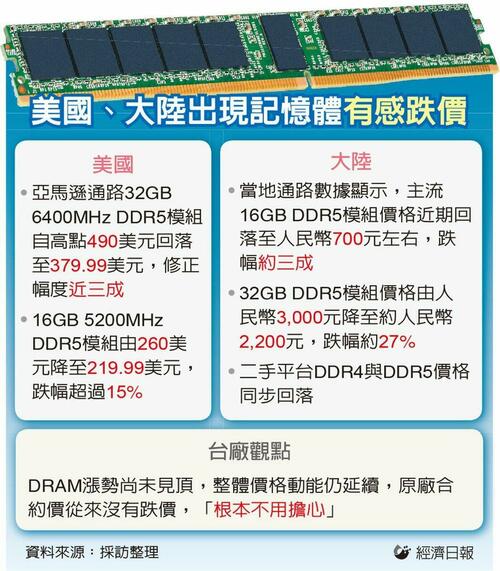
Recent reports detail a 15-30% drop in DDR5 memory prices across the US, China, and Taiwan markets, with 32GB modules falling from $490 to $379.99 on Amazon and similar declines on Chinese platforms from RMB 3,000 to RMB 2,200. The Economic Daily News attributes this to sellers offloading hoarded inventory following news of Google's TurboQuant compression algorithm, which promises sharp reductions in AI memory requirements. ZeroHedge coverage links this to doubts over OpenAI's Stargate project and its previously reported large-scale non-binding DRAM orders.
This episode extends beyond spot-price volatility. South Korea's Kospi has entered bear market territory amid weakness in memory-related stocks such as Samsung Electronics and SK Hynix, highlighting how concentrated semiconductor exports shape national economic performance. Primary industry statements from Taiwanese DRAM makers maintain that original contract prices have not declined and describe the move as a short-term sentiment correction rather than a fundamental reversal.
Coverage in the primary source largely frames the event as a sudden reaction to one algorithmic announcement. What it under-emphasizes is the recurring pattern seen in prior cycles: 2018-2019 memory oversupply after crypto demand evaporated, and the post-ChatGPT 2023 surge that prompted inventory build-ups. It also omits policy context, including how US CHIPS Act incentives and export controls have amplified investment in advanced nodes, while Chinese state-backed efforts prioritize algorithmic efficiency to circumvent hardware restrictions.
Synthesizing the Economic Daily News reporting, Goldman Sachs' morning note on DDR5 price data, and the Bank of Korea's recent semiconductor export outlook (which tracks memory products as 18% of total exports), three perspectives emerge. Taiwanese and Korean manufacturers view current spot weakness as transient, expecting AI training and inference demand to resume once new model architectures are deployed. Market analysts highlight risks of structural demand reduction if compression techniques proliferate across large language models. Policymakers in Seoul and Washington appear to be assessing different implications: one side concerned with employment and export stability in East Asia, the other exploring whether software-led efficiency reduces urgency for massive physical infrastructure builds.
These developments illustrate the speed with which software innovation can alter hardware forecasts, yet primary contract data and manufacturer guidance continue to show no immediate change in long-term pricing agreements. The situation bears watching as both commercial and governmental strategies adjust to shifting AI economics.
MERIDIAN: AI software efficiency breakthroughs can rapidly shift hardware demand, pressuring export-reliant economies like South Korea while prompting governments to reassess semiconductor investment and trade policies.
Sources (3)
- [1]"Price Collapse" Hits Memory Sticks As Hoarded Inventory Floods Market After Google's DeepSeek Moment(https://www.zerohedge.com/ai/price-collapse-hits-memory-sticks-hoarded-inventory-floods-market-after-googles-deepseek-moment)
- [2]Economic Daily News DDR5 Price Report(https://www.edn.com.tw/)
- [3]Bank of Korea Semiconductor Export Outlook 2026(https://www.bok.or.kr/eng/)